Band 6.0 IELTS Writing Task 1 Model Answer
Overall Band Score: 6.0 · IELTS Summit Mastery · 2026-11-23
IELTS Writing Task 1 question
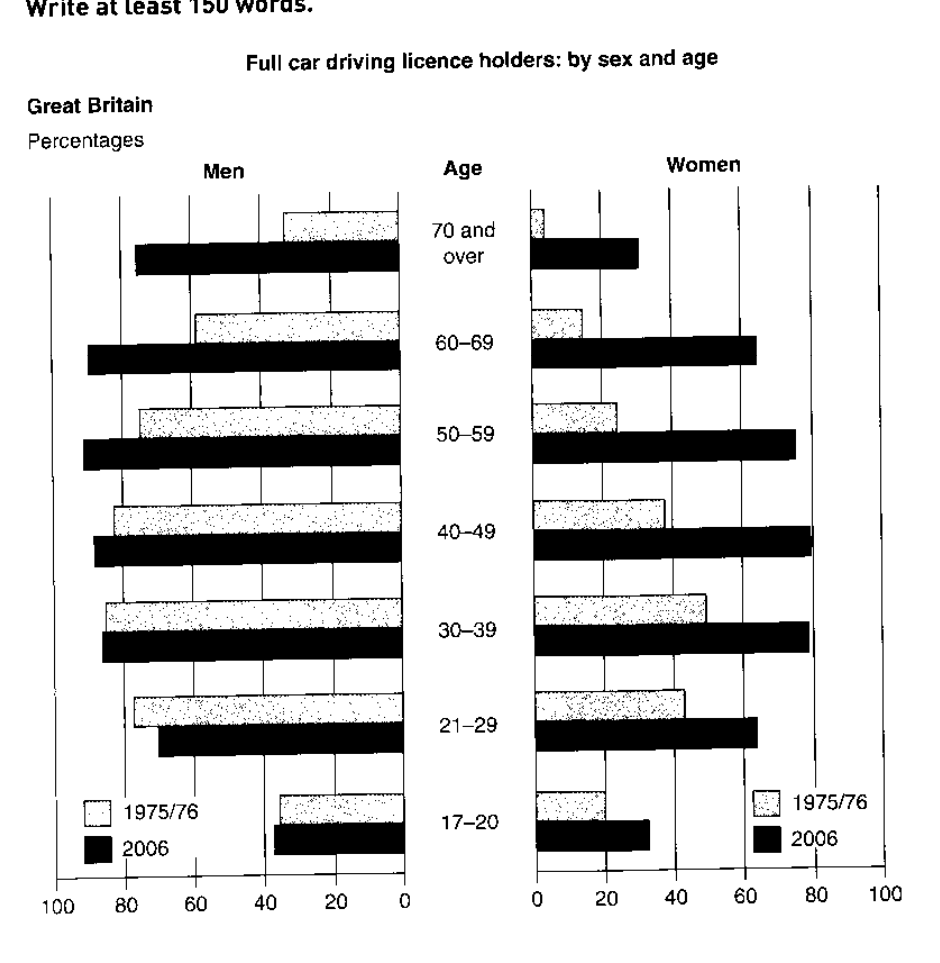
The graphs below show the percentage of people holding full driving licences in Great Britain by age and sex.
Summarise the information by selecting and reporting the main features, and make comparisons where relevant.
Full car driving licence holders: by sex and age
Student answer (Band 6.0)
The given graphs illustrate the percentage of full driving licences holders in Great Britain by age and sex between 1975/76 and 2006.
Overall, men hold the higher percentage across all ages both in 1975/76 and 2006 compared to women. while women percentages showed a big difference between 1975/76 and 2006.
For women, full driving licences holders in 2006 across all ages outnumbered those in 1975/76. while the peak quanitiy was marked at around 80% was for women aged between 40-49. It is also worth mentioning that full driving licences holders kept decreasing from ages 40-49 until 70.
On the other hand for men, it is true that the percentages were higher in 2006 across most ages, men full driving percentages were very close in both eras, for example around 85% for both eras in the age 30-39 and even people aged from 21-29 had the upper percentage in 1975/76 and that marked the only time where an 1975/76 had the upper hand for both men and women.
AI examiner evaluation
| Criterion | Band |
|---|---|
| Task Achievement / Task Response | 6.0 |
| Coherence and Cohesion | 6.0 |
| Lexical Resource | 5.5 |
| Grammatical Range and Accuracy | 5.5 |
| Overall | 6.0 |
Task Achievement / Task Response: Band 6.0
You identify the main overall pattern that men had higher licence-holding rates than women in both years, and you note the broad rise among women by 2006. Several comparisons are relevant: for example, women aged 40–49 reached about 79% in 2006, and men aged 21–29 had a slightly higher figure in 1975/76 than in 2006. However, some key details are inaccurate or unclear. The claim that men were “very close in both eras” at ages 30–39 is misleading: the figures were about 77% and 87%. The overview also misses the strong age pattern, with rates generally peaking in middle age and falling among the youngest and oldest groups. Develop the comparisons more precisely and distinguish the two years clearly.
Coherence and Cohesion: Band 6.0
The response has a recognisable structure: an introduction, an overview, and separate paragraphs for women and men. This gives the reader a basic route through the information. However, progression within paragraphs is sometimes difficult to follow, particularly in the final sentence, where several comparisons are joined together and the reference to “both men and women” is unclear. The repeated use of “while” to begin sentences also makes the linking feel mechanical, and the overview does not clearly preview the main age-related pattern. Organise each body paragraph around a clear comparison, use linking expressions to show contrast or change over time, and make pronouns and references explicit.
Lexical Resource: Band 5.5
You use relevant chart vocabulary such as “percentage,” “across all ages,” “peak,” and “higher,” so the topic is generally clear. There are also attempts to vary wording, including “outnumbered” and “upper hand,” but some choices are inaccurate or unnatural for describing percentages. “Outnumbered” usually refers to counts of people, while “upper hand” is informal; “the highest proportion” and “a higher rate” would be more suitable. Phrases such as “peak quantity” and “full driving licences holders” also show imprecise word choice or collocation, and “quanitiy” is misspelled. Aim for accurate, consistent terms such as “licence holders,” “proportion,” and “rate,” and check spelling carefully.
Grammatical Range and Accuracy: Band 5.5
You attempt both simple and more complex sentence forms, including comparisons and clauses introduced by “while” and “for example.” The main meaning is usually recoverable, but some grammatical errors reduce clarity. For instance, “men hold the higher percentage … compared to women” has an awkward comparison structure, and “the peak quanitiy was marked at around 80% was for women” contains a faulty clause construction. There are also issues with sentence boundaries and capitalisation, such as the lower-case “while” after a full stop, and with articles in “an 1975/76.” Work on building complete, well-formed comparison sentences and check agreement, articles, and punctuation when editing.
See this exact question answered at other band scores. The same prompt compared across bands.
Browse more IELTS Writing model answers or get your own writing scored by the same AI examiner.