Band 4.0 IELTS Writing Task 1 Model Answer
Overall Band Score: 4.0 · IELTS Summit Mastery · 2026-11-23
IELTS Writing Task 1 question
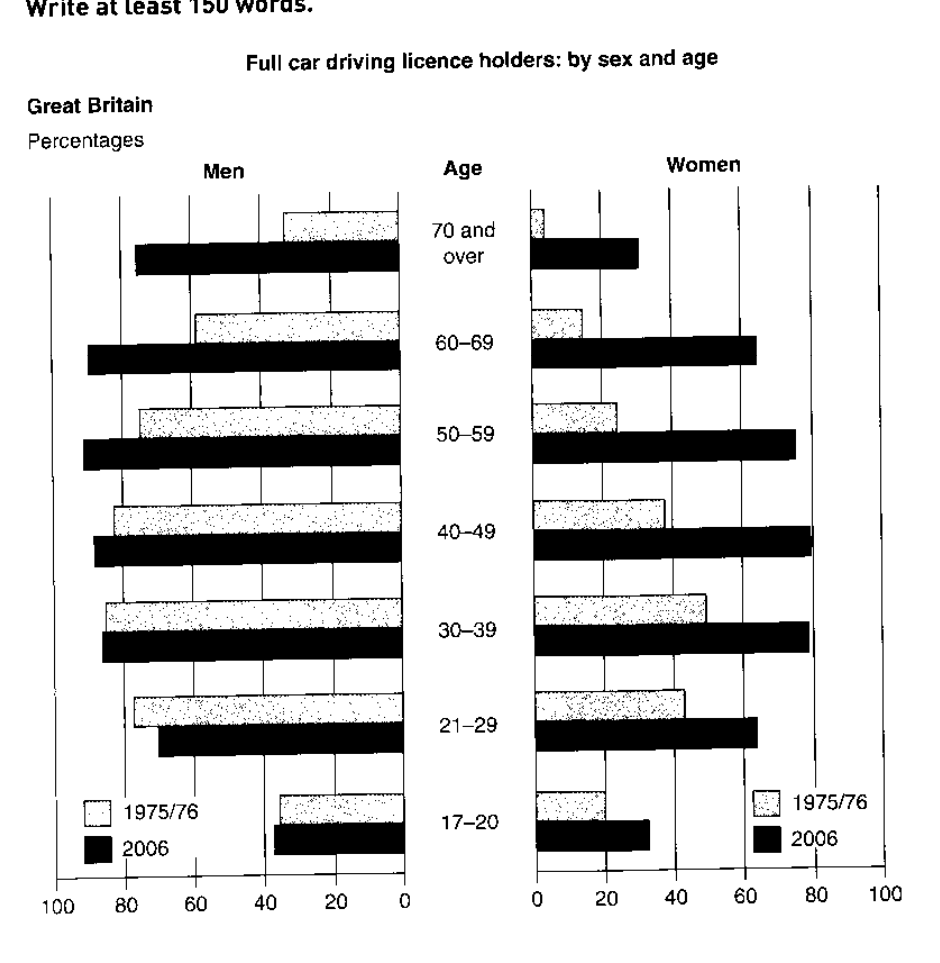
The graphs below show the percentage of people holding full driving licences in Great Britain by age and sex.
Summarise the information by selecting and reporting the main features, and make comparisons where relevant.
Full car driving licence holders: by sex and age
Student answer (Band 4.0)
The give bar charts illustrates the percentage of people in great Britain holding full driving licences in 1975/76 and 2006 by age and sex. All the data shown in the chart based on percentages.
Overall, there are noticeable differences among men and women in different ages. In addition, the categories show an effect whereas on the other hand it experienced fluctuations.
Looking at the first men in 2006 it hit to the highest 90% and in 2006 it peaked to 85%. It went up from 38% and the number of percentages a lot to the highest 90%, then it droop down and ends to 75%. In contrast, in 1975/76 the
AI examiner evaluation
| Criterion | Band |
|---|---|
| Task Achievement / Task Response | 3.0 |
| Coherence and Cohesion | 4.0 |
| Lexical Resource | 5.0 |
| Grammatical Range and Accuracy | 4.5 |
| Overall | 4.0 |
Task Achievement / Task Response: Band 3.0
You identify the chart’s subject and mention both years, but the response does not provide a usable summary of the main features. The overview—“noticeable differences among men and women”—is too general, and the claim that the categories show “fluctuations” is not supported by a clear account of the data. The figures that follow are difficult to interpret: “it hit to the highest 90%” and “ends to 75%” do not specify which age group or series they describe, and the comparison with 1975/76 is left unfinished. The response also falls 40 words short of the required minimum, leaving most age groups and the substantial changes between years unreported. Select key comparisons and describe them accurately and explicitly.
Coherence and Cohesion: Band 4.0
There is a basic attempt to organise the response, with an introduction, an overview paragraph and a further paragraph beginning to discuss the men’s figures. However, the progression is not sustained: the final paragraph stops at “In contrast, in 1975/76 the”, so the comparison is incomplete and the response has no conclusion to its data discussion. Linking phrases such as “In addition” and “In contrast” are present, but they do not consistently connect clear, complete ideas; “whereas on the other hand” is also redundant. References such as “it” and “the number” make it hard to identify the age group or series being described. Use complete paragraphs organised around clear comparisons, and name the group in each sentence.
Lexical Resource: Band 5.0
The response uses some relevant chart vocabulary, including “percentage,” “holding full driving licences,” “age and sex,” and “peaked,” so the topic is recognisable. However, the range is limited and several word choices or collocations are inaccurate or unclear. For example, “hit to the highest” and “the number of percentages a lot” do not express a precise trend, while “droop down” is an unsuitable choice for describing a bar-chart value. “The give bar charts” also contains a word-form error. Aim for standard reporting language and precise terms for increases, decreases and comparisons; this will make the data easier to understand. Avoid repeating general phrases when you can identify the specific age group and percentage.
Grammatical Range and Accuracy: Band 4.5
You attempt both simple statements and longer sentences, but control is uneven, and errors sometimes make the intended meaning difficult to follow. In “The give bar charts illustrates,” the determiner and subject–verb agreement are incorrect; “All the data shown in the chart based on percentages” is missing a finite verb. The sentence beginning “It went up from 38%” shifts between unclear subjects and contains a faulty construction, and the final comparison is incomplete. There is also inconsistent sentence punctuation and capitalisation, as in “great Britain.” Practise forming complete sentences with an explicit subject and verb, and check agreement, articles and tense. Shorter, accurate comparisons would be more effective than extended sentences whose references are unclear.
See this exact question answered at other band scores. The same prompt compared across bands.
Browse more IELTS Writing model answers or get your own writing scored by the same AI examiner.