Band 6.0 IELTS Writing Task 1 Model Answer
Overall Band Score: 6.0 · IELTS Summit Mastery · 2026-11-24
IELTS Writing Task 1 question
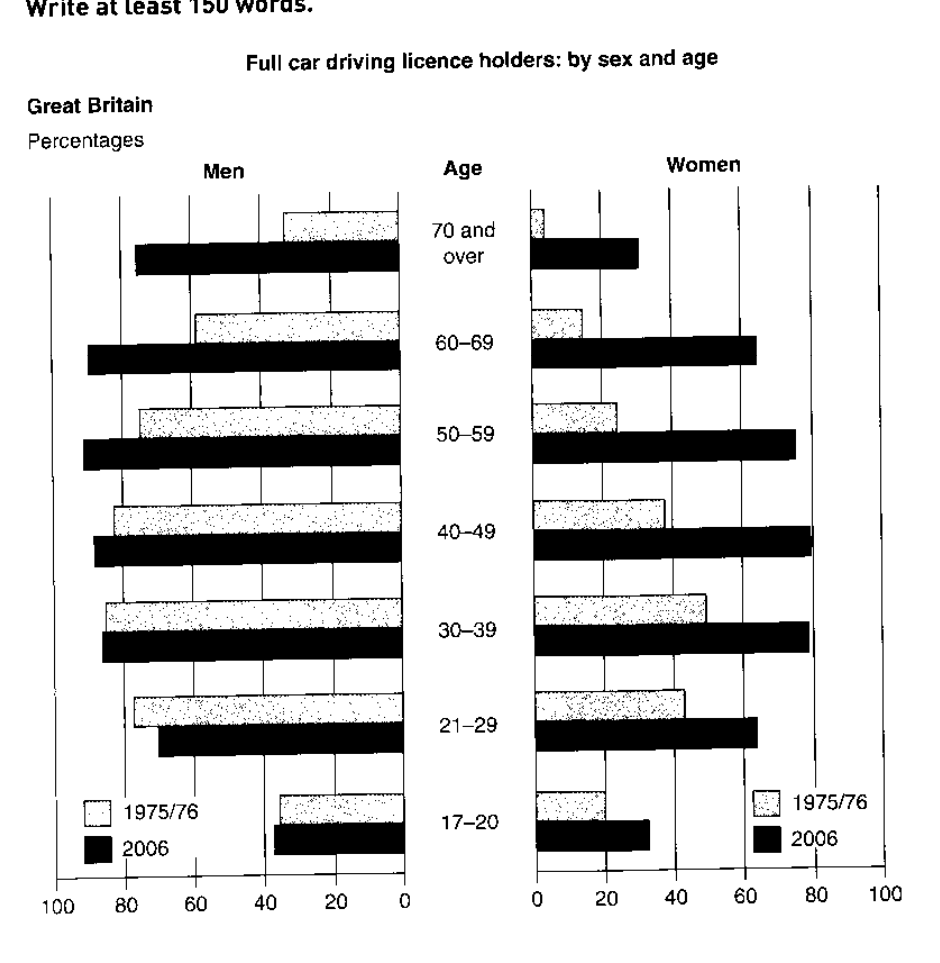
The graphs below show the percentage of people holding full driving licences in Great Britain by age and sex.
Summarise the information by selecting and reporting the main features, and make comparisons where relevant.
Full car driving licence holders: by sex and age
Student answer (Band 6.0)
The bar graph illustrates the complete information of number of individuals having a driving license for full car driving in Great Britain individually for both male and Female for the year 1975-76 and 2006.
Overall, it can be observed that in the year 1975-76 and 2006, male and female aged from 30 years to 60 years have a high percentage of driving license held whereas, the other ages in both the sex have a slighter low rate compared to them.
The Male driving index shows that,the age gap from 21 to 69 have the most highest rate among all other age group whereas, men aged 17- 20 have around 35% to 38% holders in both the years.But it can be viewed that more than 85% of men also have a driving license even when they are 70 and above in 2006 and only 35% individuals in 1975-76.
The female driving index shows that the rate of having a license is more from 21 to 69 years whereas,women aged 17 to 20 have around 37% holdings in 2006 and 20% in 1975-76 had a license. But the license holdings after women crossed aged 70 and above have been quite less such as 36% in 2006 and less than 10% in 1975-76.
AI examiner evaluation
| Criterion | Band |
|---|---|
| Task Achievement / Task Response | 6.0 |
| Coherence and Cohesion | 6.5 |
| Lexical Resource | 5.5 |
| Grammatical Range and Accuracy | 5.5 |
| Overall | 6.0 |
Task Achievement / Task Response: Band 6.0
You provide a relevant overview, noting that licence holding was generally higher among people aged 30–60 and that older men’s participation rose by 2006. You also make useful comparisons between the sexes and years. However, some key details are inaccurate: men aged 21–69 were not uniformly the highest group, since in 2006 the 17–20 and 21–29 groups were much lower than middle-aged men. The figures for women aged 17–20 and 70+ are also misreported: these were about 33% and 29% in 2006, not 37% and 36%. The response addresses the chart, but several comparisons are unclear or underdeveloped; more accurate figures and a clearer account of the overall changes would strengthen it.
Coherence and Cohesion: Band 6.5
The response has a clear overall arrangement: an introduction, an overview, and separate paragraphs for men and women. This makes the main categories easy to follow, and phrases such as “Overall” and “The female driving index shows” help signal progression. However, the comparisons within each paragraph are not always logically precise. For example, “from 21 to 69” groups together ages with quite different results, and the overview’s “other ages” does not specify which groups are lower. Some linking words, especially repeated “whereas” and “But,” make the connections feel mechanical, while punctuation around them is inconsistent. To improve, organise the details around the main patterns—changes over time, age peaks, and the gender gap—and use clearer references between comparisons.
Lexical Resource: Band 5.5
You use a range of task-related vocabulary, including “percentage,” “rate,” “holders,” and “aged,” so the topic remains understandable. There are also attempts at more formal phrasing, such as “it can be observed.” However, several expressions are unnatural or imprecise, including “complete information of number of individuals,” “driving index,” “most highest rate,” and “license holdings after women crossed aged 70.” Repetition of “rate” and “have a driving license” also limits flexibility. Choose standard chart language and collocations, such as “proportion of licence holders,” “the highest percentage,” and “the figure for women aged 70 and over.” These changes would make the comparisons more precise and natural.
Grammatical Range and Accuracy: Band 5.5
You attempt both simple and complex sentences, including clauses linked with “whereas” and “even when,” and the overall meaning is generally recoverable. However, some grammatical errors recur in sentence construction, agreement, and articles. For example, “male and female aged from 30 years to 60 years have a high percentage” needs a clearer plural subject and structure, while “women aged 17 to 20 have around 37% holdings” is not formed accurately. The sentence beginning “The Male driving index shows that,the age gap…” also has faulty punctuation and an unclear clause. Work on concise sentence patterns such as “Among men aged 40–49, the figure was…” and check agreement, articles, and punctuation when joining clauses.
See this exact question answered at other band scores. The same prompt compared across bands.
Browse more IELTS Writing model answers or get your own writing scored by the same AI examiner.