Band 5.0 IELTS Writing Task 1 Model Answer
Overall Band Score: 5.0 · IELTS Summit Mastery · 2026-11-24
IELTS Writing Task 1 question
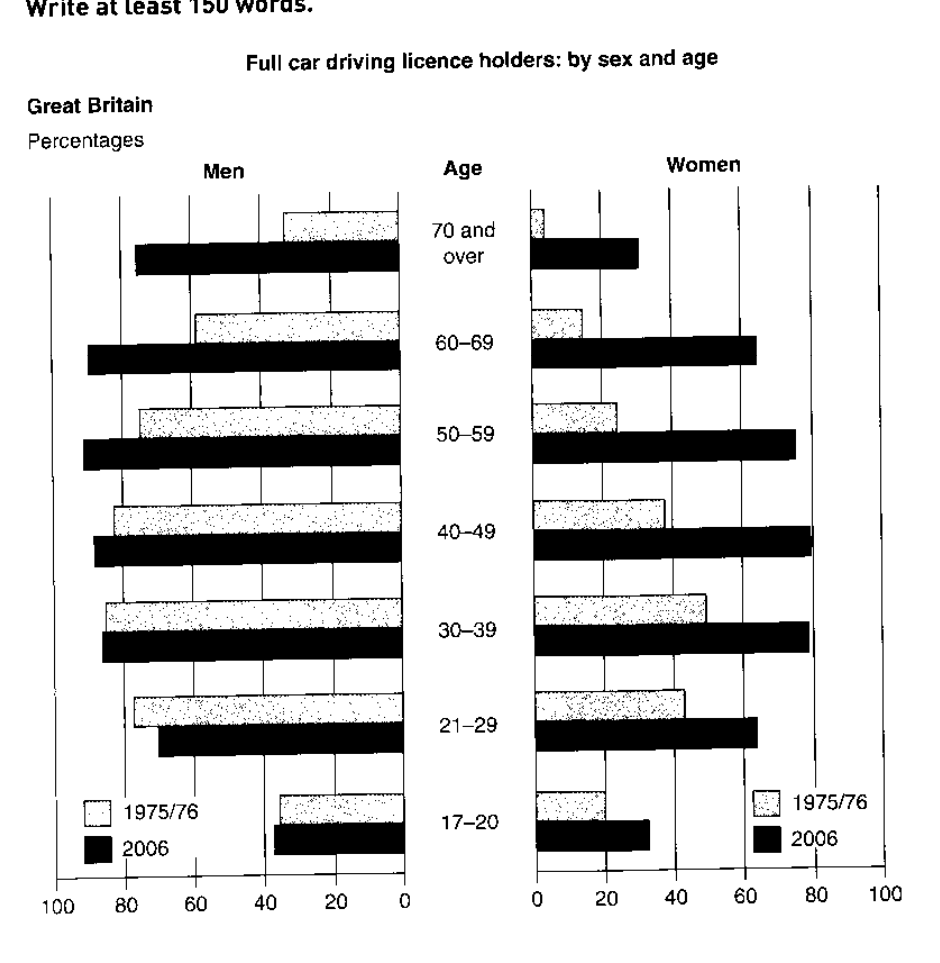
The graphs below show the percentage of people holding full driving licences in Great Britain by age and sex.
Summarise the information by selecting and reporting the main features, and make comparisons where relevant.
Full car driving licence holders: by sex and age
Student answer (Band 5.0)
The bar graph compares the percentages of men and women by their age factors who are driving in Great Britain with licenses.
Overall the both categories faced fluctuated over the period however men holding a highest proportions of driving licences in all age factors,In contrast women numbers steadly increasing with the time.
Age between 17- 20 approximately 38% men were holding driving licences and marginaly increased in 2006 at 39%, While women 20% to 38% respectively hold licenses.However age 21-29 women ratio increased from 41% to 62% and men numbers also jumped from 70% to 78% in these periods
AI examiner evaluation
| Criterion | Band |
|---|---|
| Task Achievement / Task Response | 4.5 |
| Coherence and Cohesion | 5.0 |
| Lexical Resource | 5.5 |
| Grammatical Range and Accuracy | 5.0 |
| Overall | 5.0 |
Task Achievement / Task Response: Band 4.5
You identify the chart’s subject and make a relevant broad comparison: men had higher licence-holding rates overall, while women’s rates rose over time. However, the response addresses the task only partially. It reports figures for just the two youngest age groups and omits the substantial patterns among people aged 30 and over, including the high male rates in 2006 and the marked increases for older women. Some figures are also inaccurate: for ages 21–29, men were about 78% in 1975/76 and 70% in 2006, not 70% and 78%; women were about 43% and 63%, rather than 41% and 62%. The response is 99 words, below the required 150. Add a fuller overview and select accurate comparisons across the age groups.
Coherence and Cohesion: Band 5.0
There is a basic attempt to organise the response: an opening sentence is followed by an overview and then details about two age groups. This gives the reader some sense of the intended structure. However, the progression is limited because the report stops after the 21–29 group, leaving the chart’s other age categories unaddressed. Connections between ideas are also awkward: “however” and “In contrast” do not clearly express the relationships intended, and punctuation runs words together, as in “factors,In contrast” and “licenses.However”. Use separate paragraphs for the overview and grouped comparisons, and connect each comparison clearly—for example, contrast the two years within each age group before moving to the next.
Lexical Resource: Band 5.5
The response uses relevant chart vocabulary, including “percentages,” “holding driving licences,” “increased,” and “period,” so the topic is generally understandable. There is also an attempt to vary wording with “jumped” and “marginally.” However, several choices are inaccurate or unnatural, such as “age factors,” “both categories faced fluctuated,” and “women numbers”; these make the description less precise. Spelling errors in “steadly” and “marginaly” also reduce control. Prefer standard data-reporting phrases such as “age groups,” “rates fluctuated,” and “the proportion of women holding licences.” More precise verbs such as “rose,” “declined,” or “remained stable” would help describe the chart’s patterns consistently.
Grammatical Range and Accuracy: Band 5.0
You attempt both simple statements and longer comparisons, including a sentence beginning “Age between 17–20,” but control is uneven. Errors in sentence structure and agreement appear in “Overall the both categories faced fluctuated” and “men holding a highest proportions,” while “women 20% to 38% respectively hold licenses” lacks a clear grammatical structure. The long final sentence also joins separate comparisons with a comma and has inconsistent punctuation around “While” and “However.” These problems sometimes make relationships difficult to follow. Practise forming complete comparison clauses, for example, “Among 17–20-year-olds, the male figure rose slightly, whereas the female figure increased from…” Use consistent past-tense reporting and check articles, agreement, and sentence boundaries.
See this exact question answered at other band scores. The same prompt compared across bands.
Browse more IELTS Writing model answers or get your own writing scored by the same AI examiner.