Band 5.5 IELTS Writing Task 1 Model Answer
Overall Band Score: 5.5 · IELTS Summit Mastery · 2026-11-25
IELTS Writing Task 1 question
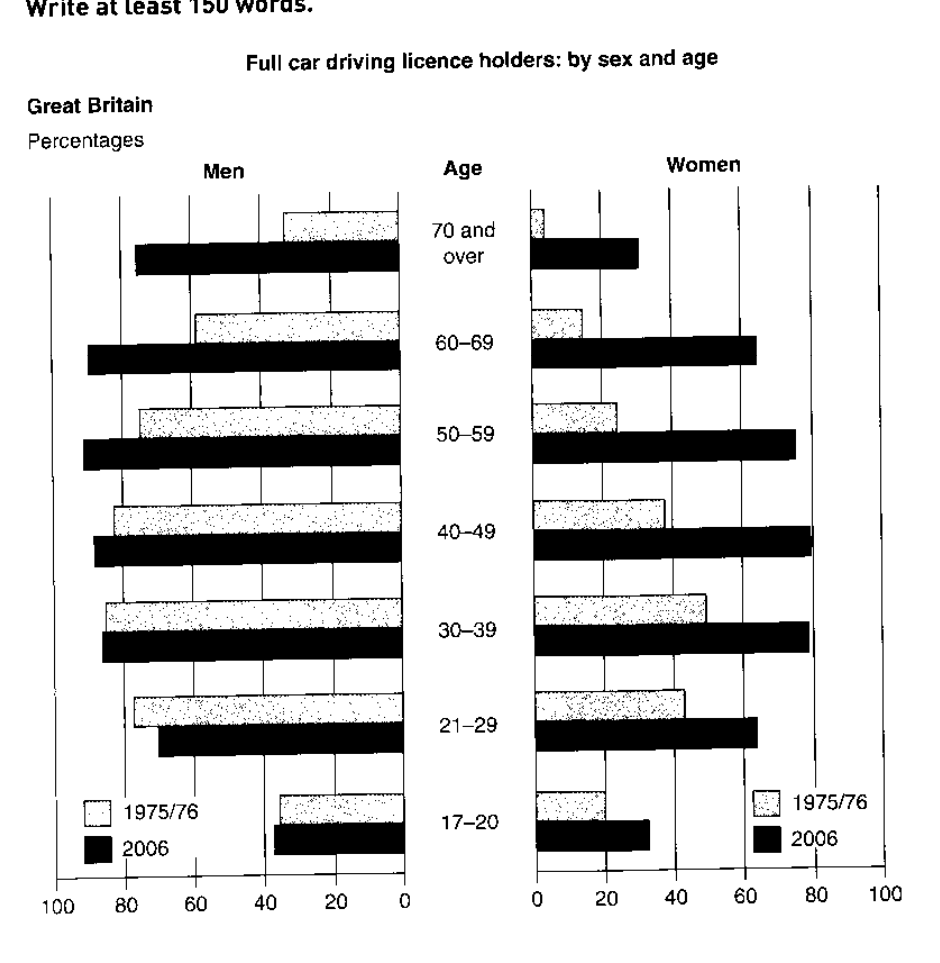
The graphs below show the percentage of people holding full driving licences in Great Britain by age and sex.
Summarise the information by selecting and reporting the main features, and make comparisons where relevant.
Full car driving licence holders: by sex and age
Student answer (Band 5.5)
The provided bar chart illustrates the proportion of residents having complete driving licences in Great Brtitain in seven age groups by gender between 2006 and 1975/76.
Overall, in 2006, the proportion of women with driving licences is significantly higher compared with 1975/76. Whereas, in the both year, men had more driving licences than women. In 2006, the number of licences hold by men increased in every age group despite 21-29.
According to the bar chart, In 1975/76, the proportion of men licences holder between the age of 17-20 stood at 36%, increased to 38% in 2006. While, in the same age 20% women holds licences in 1975/76, rose to approximatly 34% in 2006. However, the figure between 21-29 years old fell from considerably 78% to 70% respectively, whereas in the same age group these figure increased from 42% to 62%.
AI examiner evaluation
| Criterion | Band |
|---|---|
| Task Achievement / Task Response | 5.0 |
| Coherence and Cohesion | 5.5 |
| Lexical Resource | 5.5 |
| Grammatical Range and Accuracy | 5.5 |
| Overall | 5.5 |
Task Achievement / Task Response: Band 5.0
You identify the chart’s subject and make relevant comparisons, including the broad rise in women’s licence-holding and the male advantage in both periods. You also correctly note the fall among men aged 21–29, from about 78% to 70%. However, the overview is incomplete: it does not describe the main age pattern, and the claim that men’s figures rose in every group except 21–29 overlooks the near-stability among 17–20-year-olds. Several figures are inaccurate or unclear, including women aged 21–29 (about 43% to 63%, not 42% to 62%) and the 17–20 figures. The response also omits most age groups and is 10 words below the required minimum. Add a fuller overview and select accurate comparisons across the age range.
Coherence and Cohesion: Band 5.5
The response has a recognisable structure: an introduction, an overview, and a paragraph with selected figures. This gives the reader some sense of organisation. However, the progression is limited because the final paragraph covers only the two youngest groups and does not develop a systematic comparison across the chart. Some linking is awkward or unclear, particularly “Whereas, in the both year” and the final “whereas,” where the comparison between men and women is difficult to follow. Use clearer grouping, such as comparing the two sexes within age bands or describing older and younger groups in turn. Ensure each linking word connects complete, clearly related ideas.
Lexical Resource: Band 5.5
You use relevant chart vocabulary such as “proportion,” “age groups,” “gender,” and “increased,” so the topic is generally clear. There are also attempts at more precise reporting, including “stood at” and “fell from.” However, several word choices and collocations are inaccurate or unnatural: “complete driving licences,” “men licences holder,” and “the number of licences hold by men” make the description less fluent. Spelling errors such as “Brtitain” and “approximatly” are noticeable, and “considerably” is awkwardly placed before the figure. Aim for consistent, natural phrases such as “licence holders,” “the proportion of men,” and “approximately.”
Grammatical Range and Accuracy: Band 5.5
You attempt a mixture of simple and more complex sentences, using contrast clauses with “whereas” and “while.” Some sentence meanings remain understandable, but errors in agreement, verb forms, articles, and sentence construction are frequent enough to affect clarity. For example, “the proportion of women … is significantly higher compared with 1975/76” compares a proportion with a year, while “20% women holds licences” has problems with the article and verb agreement. “Whereas, in the both year” is also not a complete, well-formed clause. Practise building accurate comparison sentences, checking that the compared items match and that each clause has a clear subject and verb.
See this exact question answered at other band scores. The same prompt compared across bands.
Browse more IELTS Writing model answers or get your own writing scored by the same AI examiner.