Band 5.5 IELTS Writing Task 1 Model Answer
Overall Band Score: 5.5 · IELTS Summit Mastery · 2026-11-25
IELTS Writing Task 1 question
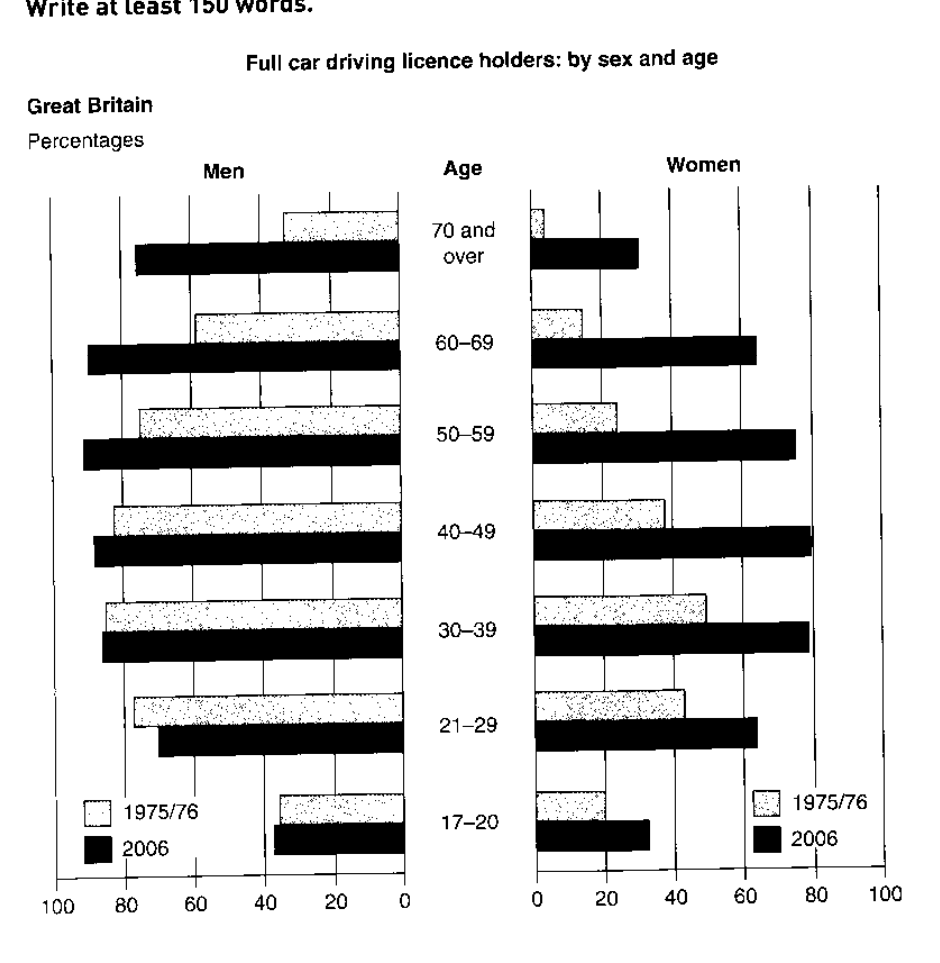
The graphs below show the percentage of people holding full driving licences in Great Britain by age and sex.
Summarise the information by selecting and reporting the main features, and make comparisons where relevant.
Full car driving licence holders: by sex and age
Student answer (Band 5.5)
The graph charts illustrate the percentage of men and women who had a driving licences in Great Britain in the year 1975/76 and 2006.
As is presented in the graphs, In 2006 the number licences holder was greater than compare to previous year in men and women over the age. In 1975/76 and 2006 the 17-20 year old had few numbered of driving licences around 46 and 48 in male and in female this figure was 20 and 26. States was steadily increased over the ages, compared to other age of group the 21-69 age men's had shows a rocket trend in 2006 in all ages but in 1975/76 it showed a decline phase after 49 age and the males who crossed 70 year had fewer number of licences in both the given period. The female trend rose gradually and it was at on it peak in 21 to 49 years age group in 2006, after that women who had completed 50 years hold lower numbered of licences. In addition to this, in 175/76 the female numbered of licences holder was greater in the age group of 30-39 after that it also followed downward trend. As seen in chart, after 70 year only 2% women hold licences in 1975/76 and 15% in 2006
In conclusion, male licences holder greater than 50 in all ages except 17-20 aged group, in female the number was less in 175/76 and recorded least in 70 age women had only 25 and in 2006 then number very much higher.
AI examiner evaluation
| Criterion | Band |
|---|---|
| Task Achievement / Task Response | 5.5 |
| Coherence and Cohesion | 5.5 |
| Lexical Resource | 5.0 |
| Grammatical Range and Accuracy | 5.0 |
| Overall | 5.5 |
Task Achievement / Task Response: Band 5.5
You identify the two years and both sexes, and you attempt to compare age groups, including the broad rise in women’s licence holding between the periods. However, several figures and trends are inaccurate: for example, the 17–20 figures are about 36% and 37% for men, not 46% and 48%, while women’s 2006 figure is about 33%, not 26%. The claim that men aged 21–69 show a “rocket trend” is also misleading: their 2006 rates are high but vary only modestly, and the youngest men’s rate barely changes. Your overview is unclear and does not consistently identify the main pattern that rates generally rose by 2006, especially for women. Select fewer key comparisons and report them accurately.
Coherence and Cohesion: Band 5.5
There is some organisation: you begin by introducing the chart, discuss several age-related patterns, and finish with a conclusion. However, the response does not progress clearly from an overview to well-grouped comparisons. The long middle section shifts between men, women, and different age bands, making relationships difficult to follow. Linking phrases such as “In addition to this” and “As seen in chart” are used, but they do not always clarify how the next point connects. The conclusion repeats broad claims rather than summarising the most important contrasts. A clearer structure would use one paragraph for the overall trends and separate paragraphs comparing men and women, with age groups ordered consistently.
Lexical Resource: Band 5.0
You use some relevant chart vocabulary, including “percentage,” “trend,” “age group,” and “downward trend,” but the range is limited and several word combinations are inaccurate or difficult to interpret. Phrases such as “number licences holder,” “few numbered,” “rocket trend,” and “at on it peak” do not express the intended comparisons naturally. “The number” is also often used where the chart reports percentages. These choices sometimes make the data claims unclear, even when the general topic is recognisable. Aim for precise, reusable expressions such as “the proportion of licence holders,” “rose substantially,” and “reached a peak,” and check plural forms and collocations before using them.
Grammatical Range and Accuracy: Band 5.0
The response attempts longer sentences and comparisons, but complex structures are often faulty, and errors frequently make the meaning difficult to follow. For example, “the number licences holder was greater than compare to previous year” has problems with articles, agreement, and sentence construction; “States was steadily increased over the ages” also has an unclear subject and verb form. There are recurring errors with plurals, articles, and tense, as in “women hold licences” and “the female numbered of licences holder.” Sentence boundaries and capitalisation are inconsistent, particularly in the long middle section. Practise building accurate simple comparison sentences first, then combine them with clauses such as “whereas” or “while,” checking subject–verb agreement and past-tense forms.
See this exact question answered at other band scores. The same prompt compared across bands.
Browse more IELTS Writing model answers or get your own writing scored by the same AI examiner.