Band 4.5 IELTS Writing Task 1 Model Answer
Overall Band Score: 4.5 · IELTS Summit Mastery · 2026-11-25
IELTS Writing Task 1 question
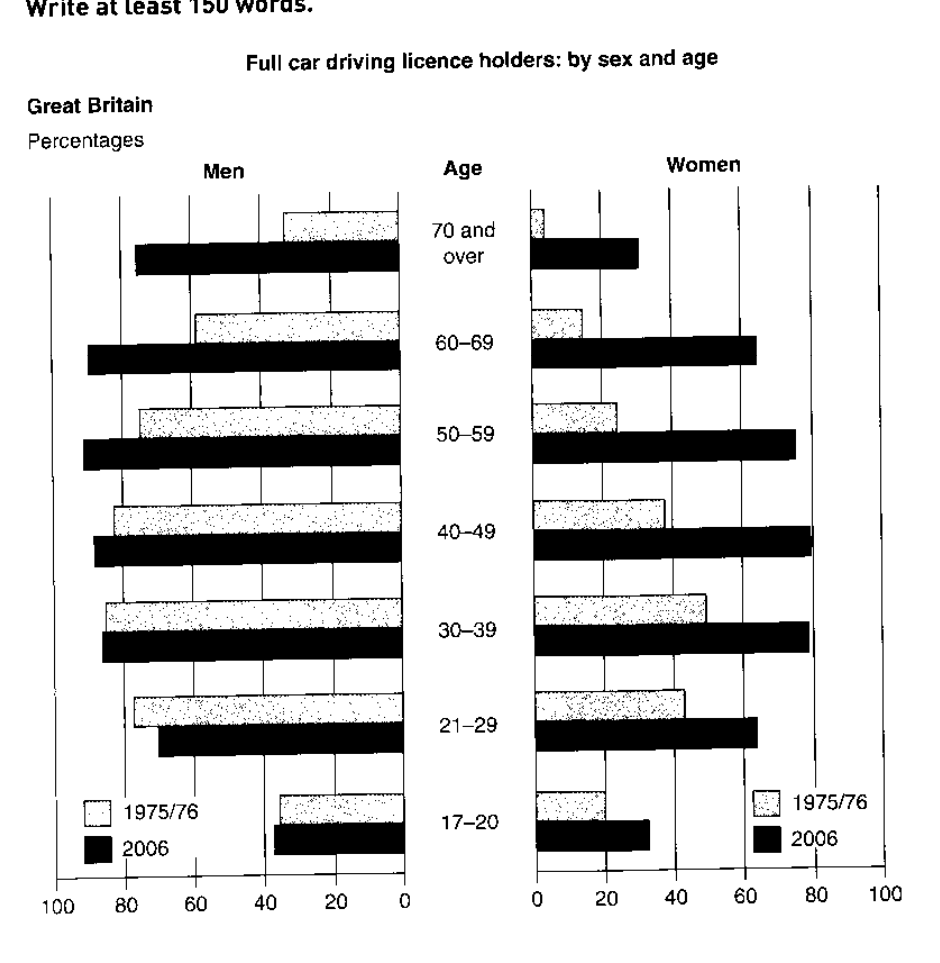
The graphs below show the percentage of people holding full driving licences in Great Britain by age and sex.
Summarise the information by selecting and reporting the main features, and make comparisons where relevant.
Full car driving licence holders: by sex and age
Student answer (Band 4.5)
The infocus bar graphs quit elaboratly provide information about proportion of thse individuals who containdriving licences in great britain with repect to their age and gander in two different time periods of 1900s and 2000s.
Overall, over fifty years men have more driving lincences but teenagers contain lowest. Whereas, while talking about women over forty year have more driving licinces and lowest in same as men and over seventy year.
First of all, men between 17 to 29 have least driving linceces but but 30 to 49 it exceeded to moderate position in both time periods. However, between 50 to 69 citizens have higest proportion.
Moreover, in women between 17 to 20 and over seventy year people have least percentage. betwe
AI examiner evaluation
| Criterion | Band |
|---|---|
| Task Achievement / Task Response | 3.5 |
| Coherence and Cohesion | 4.5 |
| Lexical Resource | 4.5 |
| Grammatical Range and Accuracy | 4.5 |
| Overall | 4.5 |
Task Achievement / Task Response: Band 3.5
You identify the chart’s broad subject and attempt an overview, noting that men generally had higher licence rates and that the youngest groups were relatively low. However, the overview is unclear and partly inaccurate: women’s highest figures were among those aged 30–49, not simply “over forty,” and the lowest group was 70 and over in 1975/76 but 17–20 in 2006. The response also gives no reliable numerical comparisons between the two years and ends mid-sentence, so several age groups and key changes are not reported. The task’s 150-word minimum is not met. To improve, complete the summary and select a few accurate figures showing the substantial rise among women and older people, alongside the smaller change among young men.
Coherence and Cohesion: Band 4.5
There is a basic attempt to organise the response: an opening, an overview beginning “Overall,” and body points introduced by “First of all” and “Moreover.” These markers help signal a sequence, and the discussion broadly moves from men to women. However, the progression is difficult to follow because comparisons are vague, some statements are incomplete, and the final sentence stops at “betwe”. The repeated “but” in “but but” and the unclear contrast introduced by “Whereas, while” also weaken cohesion. Use complete paragraphs and group information by sex or by year, then connect each comparison clearly. A finished final paragraph would make the organisation more coherent.
Lexical Resource: Band 4.5
The response uses some task-related vocabulary, including “proportion,” “time periods,” “teenagers,” and “percentage,” so the topic is generally recognisable. However, spelling errors and inaccurate word choices are frequent enough to make parts difficult to interpret: “infocus,” “thse,” “gander,” “lincences,” and “licinces” recur, while “contain” is not a natural verb for people holding licences. Phrases such as “moderate position” and “higest proportion” are also imprecise for describing chart values. Build a small, accurate set of chart expressions—such as “the proportion of licence holders,” “rose to,” and “the highest rate”—and check spelling and collocation before finishing.
Grammatical Range and Accuracy: Band 4.5
You attempt more than simple statements, using contrast and time phrases such as “Whereas” and “between 17 to 29,” but control is inconsistent. For example, “over fifty years men have more driving lincences” lacks a clear comparison structure, and “between 50 to 69 citizens have higest proportion” has faulty prepositions and an incomplete article pattern. The sentence beginning “Overall” also combines contrasting ideas without a complete, well-controlled structure. Most sentences are understandable in outline, but errors in sentence construction, agreement, and punctuation repeatedly interrupt clarity. Practise complete subject–verb sentences and accurate comparative forms, then proofread for sentence boundaries and avoid starting a clause with “Whereas” unless it is joined to a main clause.
See this exact question answered at other band scores. The same prompt compared across bands.
Browse more IELTS Writing model answers or get your own writing scored by the same AI examiner.