Band 5.0 IELTS Writing Task 1 Model Answer
Overall Band Score: 5.0 · IELTS Summit Mastery · 2026-11-26
IELTS Writing Task 1 question
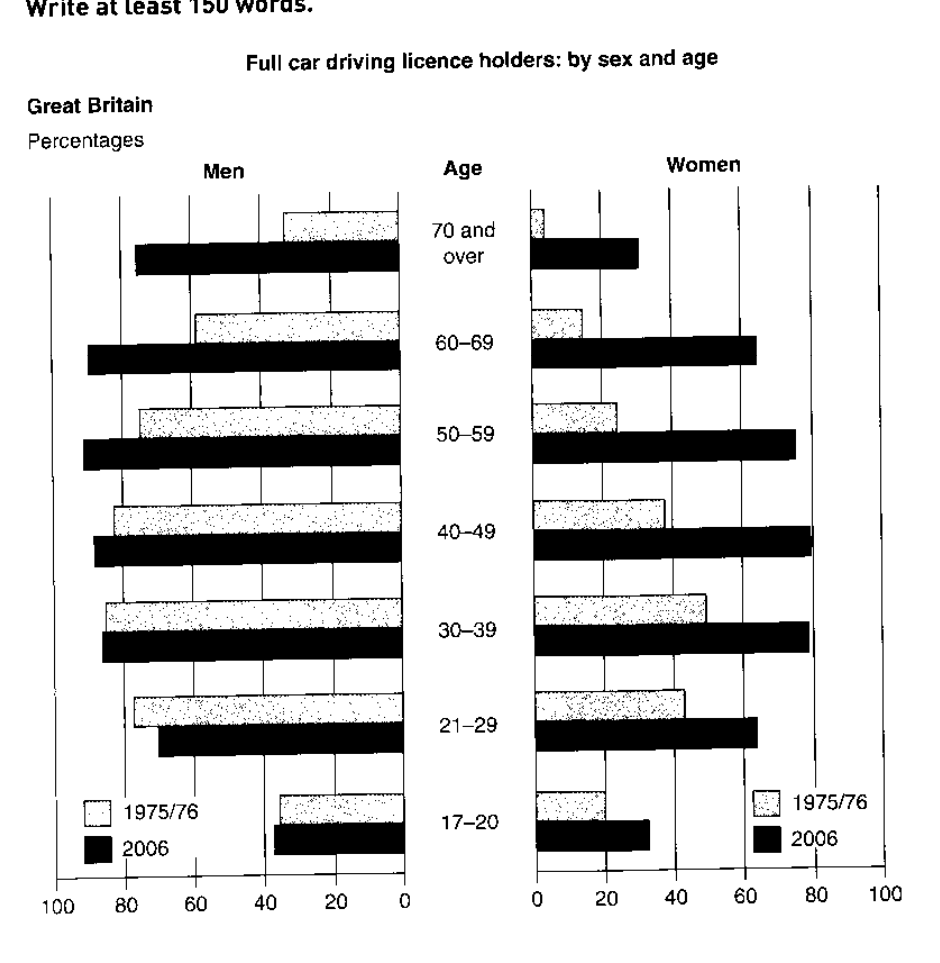
The graphs below show the percentage of people holding full driving licences in Great Britain by age and sex.
Summarise the information by selecting and reporting the main features, and make comparisons where relevant.
Full car driving licence holders: by sex and age
Student answer (Band 5.0)
These bar graphs compare the proportion of british citizens holding their driving licensce by their gender and thier age in 1975-76 and 2006.
On men side there was no major variation noticed by their age brackets. In 2006 age bracket of 30-39 hold more driving licence while in 1975-76 senior citizens with the age of 50 -59 hold majority of licence. As graph shows, in 2006 there was a rose in ratio of licence holders with respect to 1975-76 but the huge difference was noticed in age bracket of those citizens whose age was above 70. Whereas the ratio of youngsters belonged to age group of 21-29 was more then the proportion of individules of same age group in 2006.
In ladies side graduall surge was noticed. In 2006 ladies with the age bracket of 40-49 hold majority of licences while the age bracket of 30-39 hold majority licence in 1975-76.
AI examiner evaluation
| Criterion | Band |
|---|---|
| Task Achievement / Task Response | 4.5 |
| Coherence and Cohesion | 5.5 |
| Lexical Resource | 5.5 |
| Grammatical Range and Accuracy | 5.0 |
| Overall | 5.0 |
Task Achievement / Task Response: Band 4.5
The response identifies the chart’s subject and makes some relevant comparisons, including the rise among older men and the increase in women’s licence-holding. However, it only minimally reports the main features: there is no clear overview of the broad pattern that men had higher rates in both years, while women’s figures rose substantially across most age groups. Some details are inaccurate or unclear. For example, men aged 50–59 had the highest 1975/76 figure only narrowly, while the 40–49 group was higher; in 2006, men aged 50–59, not 30–39, had the highest rate. The sentence about 21–29-year-olds is difficult to interpret and reverses the comparison: the 1975/76 male figure was higher than in 2006. Select key contrasts accurately and summarise them in a clear overview.
Coherence and Cohesion: Band 5.5
The response has a basic structure, moving from men to women, and uses a few linking expressions such as “Whereas” and “while” to signal comparisons. This gives the reader some sense of how the information is grouped. However, progression within the paragraphs is not consistently clear: the discussion shifts between age rankings, changes over time, and a comparison of young men without a clear sequence. “Whereas” introduces a fragment-like contrast, and the final sentence ends without a broader summary. Organise the report into a brief introduction, an overview, and focused detail paragraphs, grouping comparable age patterns together. Use linking words only where the relationship between the figures is explicit.
Lexical Resource: Band 5.5
The response uses some task-relevant vocabulary, including “proportion,” “age brackets,” “ratio,” and “licence holders,” so the topic is generally recognisable. However, word choice and spelling are often inaccurate or repetitive, which makes several comparisons hard to understand. Examples include “a rose in ratio” for an increase, “graduall surge,” and “hold majority of licence.” “Ladies” is less suitable for a formal chart report than “women,” and “senior citizens” is less precise than naming the age group. Spelling errors such as “licensce,” “thier,” and “individules” also weaken control. Build a reliable set of terms for describing percentages, increases, decreases, and age groups, and check spelling and collocations carefully.
Grammatical Range and Accuracy: Band 5.0
The response attempts both simple and more extended sentences, including comparisons with “while” and “whereas.” However, control is inconsistent, and errors in verb forms, agreement, articles, and sentence construction sometimes make the intended meaning unclear. For example, “age bracket of 30-39 hold more driving licence” needs a plural subject and an appropriate verb form, while “there was a rose in ratio” is not a grammatical construction for describing a change. The sentence beginning “Whereas the ratio of youngsters…” is also difficult to complete as a clear comparison. Practise accurate past-tense reporting and subject–verb agreement, and use shorter, complete sentences when comparing the two years. Proofread each sentence for a clear subject and verb.
See this exact question answered at other band scores. The same prompt compared across bands.
Browse more IELTS Writing model answers or get your own writing scored by the same AI examiner.