Band 4.5 IELTS Writing Task 1 Model Answer
Overall Band Score: 4.5 · IELTS Summit Mastery · 2026-11-26
IELTS Writing Task 1 question
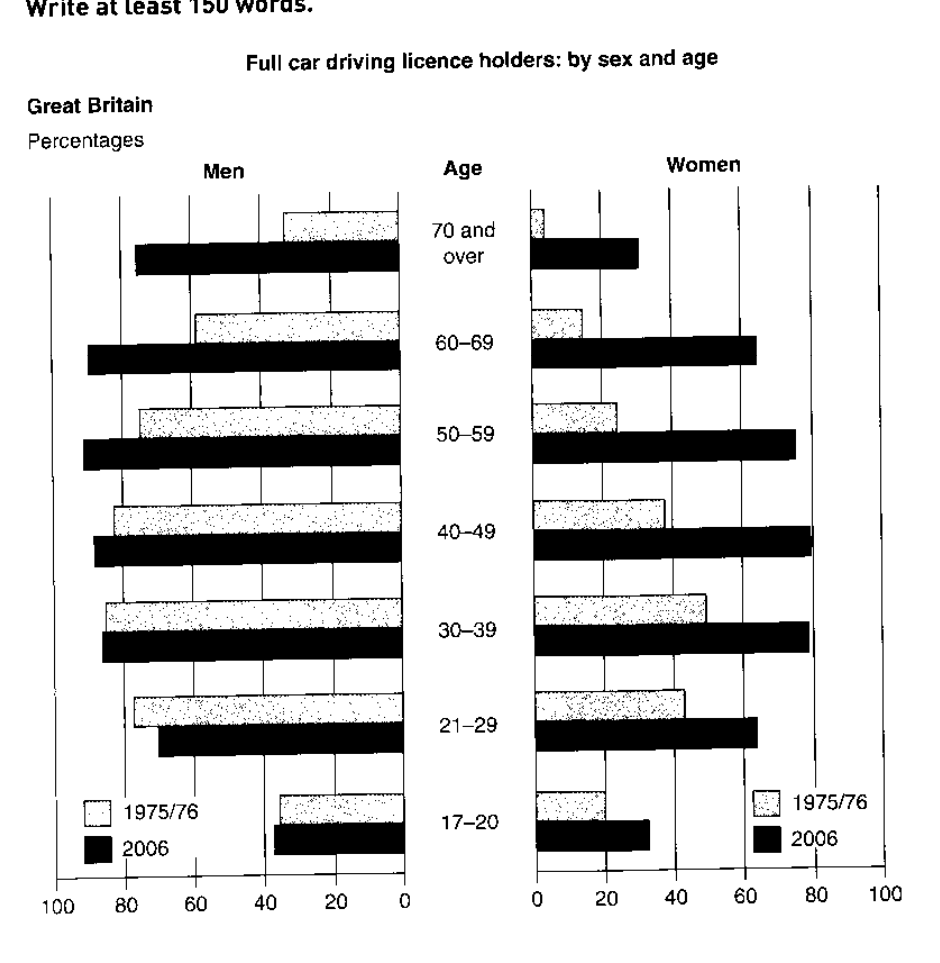
The graphs below show the percentage of people holding full driving licences in Great Britain by age and sex.
Summarise the information by selecting and reporting the main features, and make comparisons where relevant.
Full car driving licence holders: by sex and age
Student answer (Band 4.5)
The graph illustrates the ratio of individuals holding full driving licenses in great britain by age and men and women.
Looking from the overall perspective men hold much driving licenses ratherthen women in all age.meanwhile women carry least licences as compare to men .
talking about men, from the starting point men lead in all ages as compare to women. in teenegers men goes at 40% in the starting.after that it jump in apprometely 80% it has a masssive growth. in the middle age people do not have any specefic reason to claim the liecnses in between 30 to 39. men licenses holding population goes at the same level to half of the life . after that in around 60 it show slightly decerease at become 60%. furthermore in the older age it become 40%.
AI examiner evaluation
| Criterion | Band |
|---|---|
| Task Achievement / Task Response | 3.5 |
| Coherence and Cohesion | 5.0 |
| Lexical Resource | 5.0 |
| Grammatical Range and Accuracy | 4.5 |
| Overall | 4.5 |
Task Achievement / Task Response: Band 3.5
The response identifies one valid overall feature: men had higher licence-holding rates than women across the age groups. However, it reports only the men’s figures and gives no meaningful account of the women’s data or of the substantial changes between 1975/76 and 2006. Some figures and trends are also inaccurate: for example, men aged 21–29 were about 78% in 1975/76 and 70% in 2006, not part of a general rise to around 80%; the response also describes the oldest men as reaching 40%, whereas the chart shows about 35% and 77% in the two years. The overview and details are therefore very limited. The response is also 15 words below the required minimum. To improve, compare both sexes and both years, select accurate key figures, and provide a clear overview of the main changes.
Coherence and Cohesion: Band 5.0
There is a basic attempt to organise the response: an opening, a brief overall statement, and a paragraph focusing on men. Phrases such as “Looking from the overall perspective” and “talking about men” signal a change in focus. However, the progression is difficult to follow because the account moves between age groups without clearly identifying the year being described, and it omits a corresponding discussion of women. Connections such as “after that” and “furthermore” are repeated or do not make the relationship between points clear. The paragraphing provides some structure, but the response does not develop a complete, orderly summary. Grouping the data by year or by sex, and using clear comparisons to guide the reader through the age bands, would strengthen cohesion.
Lexical Resource: Band 5.0
The response uses a small range of task-related vocabulary, including “overall perspective,” “middle age,” “slightly decrease,” and “massive growth.” These attempts show some awareness of describing trends, but word choice and collocation are often inaccurate or unclear, as in “men hold much driving licenses,” “women carry least licences,” and “men licenses holding population.” Spelling errors such as “teenegers,” “apprometely,” and “liecnses” are noticeable and sometimes make the intended wording harder to recognise. The vocabulary is therefore limited for describing and comparing chart data. Use standard terms such as “licence holders,” “proportion,” “rose,” and “fell,” and check spelling and collocations carefully. More precise language would also help distinguish increases from comparisons between years.
Grammatical Range and Accuracy: Band 4.5
The response attempts both simple and longer sentence forms, for example, “after that it jump in apprometely 80%” and “in the older age it become 40%.” However, many sentences contain errors in tense, agreement, articles, and sentence construction. Examples include “men hold much driving licenses,” “it jump,” and “it show slightly decerease at become 60%.” These errors frequently make the relationships between the figures and age groups difficult to understand. Punctuation and capitalisation are also inconsistent, including the lower-case opening of several sentences and the run-on phrasing in the final paragraph. Practise accurate past-tense reporting (“rose,” “fell,” “was”) and build shorter, complete sentences before attempting more complex comparisons.
See this exact question answered at other band scores. The same prompt compared across bands.
Browse more IELTS Writing model answers or get your own writing scored by the same AI examiner.