Band 6.0 IELTS Writing Task 1 Model Answer
Overall Band Score: 6.0 · IELTS Summit Mastery · 2026-11-26
IELTS Writing Task 1 question
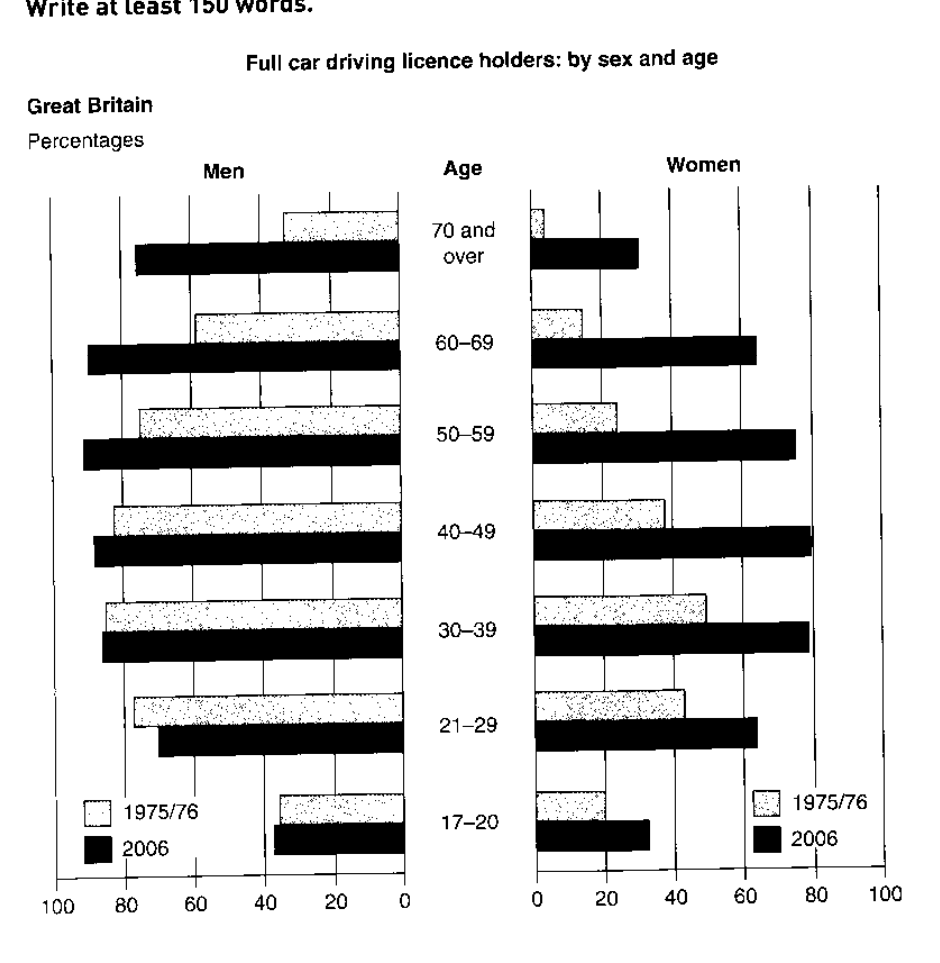
The graphs below show the percentage of people holding full driving licences in Great Britain by age and sex.
Summarise the information by selecting and reporting the main features, and make comparisons where relevant.
Full car driving licence holders: by sex and age
Student answer (Band 6.0)
The horizontal bar chart presents the percentage of driving license holders in Great Britain by age and sex.
Overall, the percentage of full driving licence holders increased for both sexes and across every single age group over the 30 year period. While men constantly held higher position than women in all categories, the gender gap narrowed noticeably by 2006.
In 1975/76, malw male licence ownership peaked among middle aged drivers, among 30-49 years olds, while only 20%od the youngest and oldest group helds licence. By 2006, rates for men aged 30-59 touched 90%. The sharpest growth occurred in 70 which tripled to 60%, while the age group 17-20 doybled to 40%.
Women started from a very low base line like only around 40% in the age group of 21-29 , which drops at 5% at the age of 70 and over By 2006 female licence ownership reaches to approximately 80% at the age of 40-49. Notably, young women aged 17-20 doubled to 40% matching nearby their male peers.
AI examiner evaluation
| Criterion | Band |
|---|---|
| Task Achievement / Task Response | 6.0 |
| Coherence and Cohesion | 6.0 |
| Lexical Resource | 6.0 |
| Grammatical Range and Accuracy | 5.5 |
| Overall | 6.0 |
Task Achievement / Task Response: Band 6.0
You provide a relevant overview, identifying the broad rise in licence ownership and the narrowing difference between men and women. You also include useful comparisons, such as women aged 40–49 reaching about 80% in 2006 and young women approaching the rate for young men. However, the overview overgeneralises: men aged 17–20 changed only slightly, from about 36% to 37%, rather than increasing across every group. Several details are inaccurate or unclear: the oldest men rose from about 35% to 77%, not 60%, and the youngest groups did not double to 40%. The claim that men peaked among 30–49-year-olds in 1975/76 also misses the high figures for men aged 21–29 and 50–59. More precise, balanced reporting of key age-group patterns would strengthen the response.
Coherence and Cohesion: Band 6.0
The response has a clear overall structure: an introduction, an overview, and separate paragraphs for men and women. This makes the main comparisons reasonably easy to follow, and transitions such as “Overall,” “By 2006,” and “Notably” help signal the direction of the discussion. However, some information is difficult to interpret because sentences are incomplete or run together, particularly the final paragraph, where the statement about women aged 70 and over lacks clear punctuation before the 2006 comparison. The sequence of figures also sometimes feels abrupt, with limited explanation of how the age groups compare. Use complete sentences, clearer punctuation, and a more consistent progression from older to younger or from largest changes to smallest.
Lexical Resource: Band 6.0
You use an adequate range of task-related vocabulary, including “percentage,” “ownership,” “peaked,” “sharpest growth,” and “gender gap.” These choices help describe trends and comparisons, and the meaning is generally recoverable. Some word choices and collocations are inaccurate or imprecise, however: “held higher position” is not natural for licence rates, “touched 90%” is informal, and “started from a very low base line like only around 40%” does not accurately describe women’s starting levels across age groups. There are also spelling and typing slips, including “malw” and “doybled,” which reduce control. Prefer precise chart language such as “the proportion rose to,” “was higher than,” and “began at a low level,” and proofread carefully.
Grammatical Range and Accuracy: Band 5.5
You attempt a mix of simple and more complex forms, including the overview sentence beginning “While men…” and the comparison introduced by “Notably.” Most of the intended meaning can be understood, but some grammatical errors and punctuation problems remain. For example, “the age group 17-20 doybled” has an incorrect verb form, while “which drops at 5%” uses an unsuitable tense and structure for describing past data. The sentence beginning “Women started…” also shifts awkwardly between past and present (“started” and “reaches”) and lacks a clear sentence boundary before the next comparison. Check tense consistency when reporting historical figures, use complete clauses, and punctuate comparisons clearly. Greater accuracy across these structures would make the response more fluent.
See this exact question answered at other band scores. The same prompt compared across bands.
Browse more IELTS Writing model answers or get your own writing scored by the same AI examiner.