Band 5.5 IELTS Writing Task 1 Model Answer
Overall Band Score: 5.5 · IELTS Summit Mastery · 2026-11-27
IELTS Writing Task 1 question
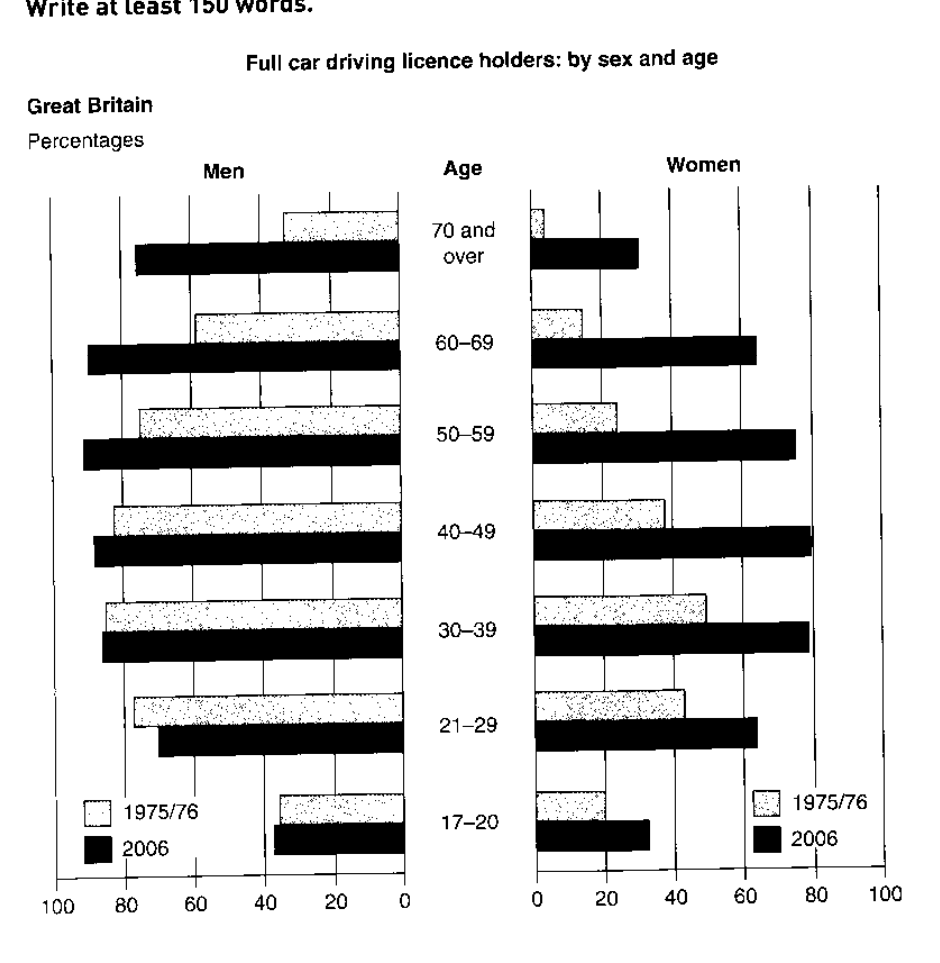
The graphs below show the percentage of people holding full driving licences in Great Britain by age and sex.
Summarise the information by selecting and reporting the main features, and make comparisons where relevant.
Full car driving licence holders: by sex and age
Student answer (Band 5.5)
The bar graph illustrates percentage of different age groups of men and women who had full car driving licence in year [redacted phone] and 2006.
Overall, more elderly men now have driving licence than men in the 20th century. In contrast, more middle age group of women now have driving licence than women in the past.
in [redacted phone], the percentage of men increased with the increase of their age, 50-59 years old men making up roughly 90%. However, the percentage followed an downward trend with age over 59 years. However, he adolescents aging from 17-20 years were the least in number, accounting for approximately 36%. While the men aging from 40-49 and 60-60 showed considerable percentage.
Between, [redacted phone] and 2006, the percentage of women followed an upward trend, starting from 17-20 years reached nearly 36% and and end with the age group 70 and over 70 who constituted almost 36%. The most increased percentage was 40-49 aging women.
AI examiner evaluation
| Criterion | Band |
|---|---|
| Task Achievement / Task Response | 5.5 |
| Coherence and Cohesion | 5.5 |
| Lexical Resource | 5.5 |
| Grammatical Range and Accuracy | 5.0 |
| Overall | 5.5 |
Task Achievement / Task Response: Band 5.5
You identify the two years and both sexes, and you attempt to describe changes over time. However, the overview is unclear and does not capture the main pattern: licence holding generally rose by 2006, especially among women and older people, while younger men changed little. Several details are inaccurate or confusing. For example, men aged 50–59 were about 76% in 1975/76, not roughly 90%, and the 17–20 group was not the least among men because the 70-and-over figure was slightly lower. The final paragraph also gives women aged 70 and over as nearly 36% in 2006, whereas the chart shows about 29%. Select a few accurate comparisons and explain the overall contrasts more clearly.
Coherence and Cohesion: Band 5.5
The response has a basic paragraph structure, moving from an introduction to an overview and then to details, so the reader can recognise the intended organisation. However, progression within the detail paragraphs is difficult to follow: the discussion shifts between age groups and years without a consistent comparison pattern. Repeated or awkward linking, such as “However” twice in succession and “Between, 1975-1976 and 2006,” also interrupts the flow. The final paragraph combines a trend claim with unclear age-group details, making the comparison hard to interpret. Organise the body by comparing men and women across the same age bands, or by describing the changes from the earlier year to 2006, and use a small number of accurate transitions.
Lexical Resource: Band 5.5
You use some relevant chart vocabulary, including “percentage,” “upward trend,” “accounting for,” and “constituted,” showing an attempt to describe data rather than simply list it. However, the range is limited and several word choices or collocations are inaccurate or unnatural, which sometimes makes the meaning unclear. Examples include “middle age group of women,” “the most increased percentage,” and “men aging from 40-49.” The phrase “least in number” is also unsuitable for percentages. Use precise terms such as “proportion,” “age group,” and “largest increase,” and distinguish clearly between a percentage and the number of people. Avoid repeating “percentage” when a more specific expression is available.
Grammatical Range and Accuracy: Band 5.0
The response attempts some longer structures, including “the percentage followed an downward trend with age over 59 years,” but control is inconsistent and many sentences contain errors. For instance, “percentage of different age groups” needs an article, while “starting from 17-20 years reached nearly 36% and and end with” has a faulty sentence structure and verb form. There are also problems with agreement and sentence boundaries, as in “the percentage of men increased … men making up,” where the relationship between clauses is unclear. Most sentences rely on simple patterns, and attempts to combine ideas often become difficult to follow. Practise writing shorter, complete comparisons first, then add subordinate clauses with accurate subjects and verbs.
See this exact question answered at other band scores. The same prompt compared across bands.
Browse more IELTS Writing model answers or get your own writing scored by the same AI examiner.