Band 5.5 IELTS Writing Task 1 Model Answer
Overall Band Score: 5.5 · IELTS Summit Mastery · 2026-11-28
IELTS Writing Task 1 question
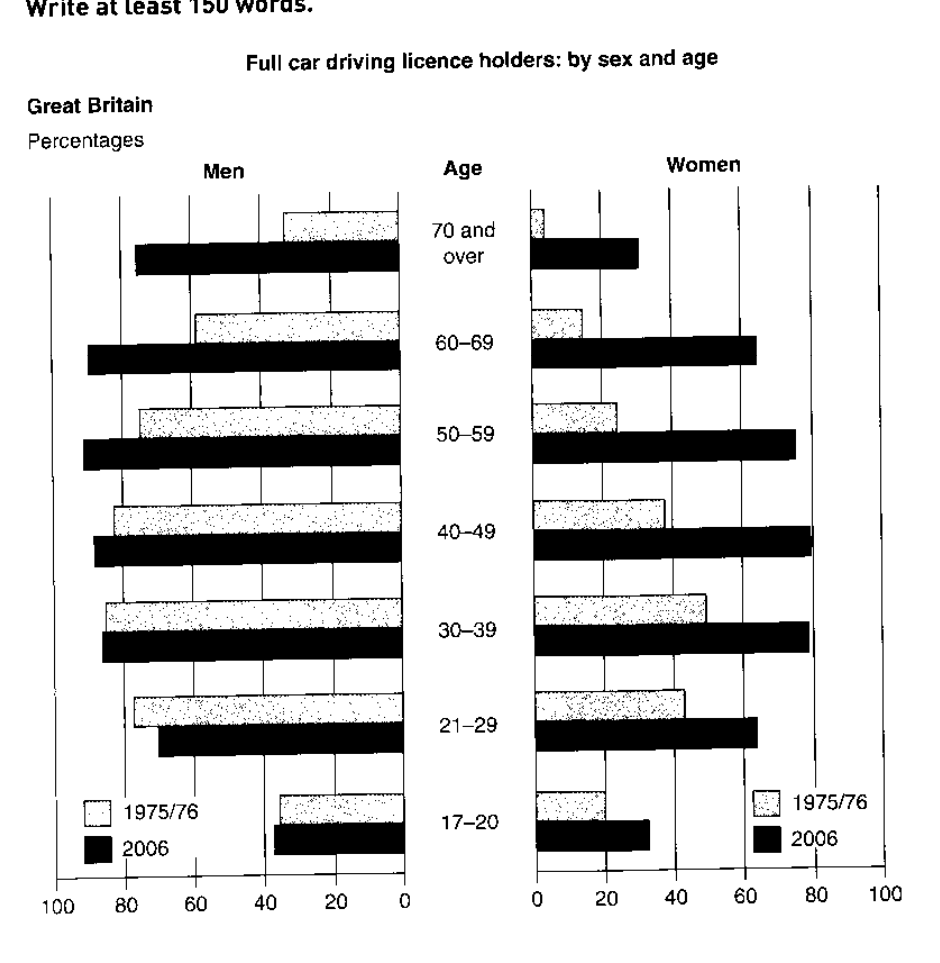
The graphs below show the percentage of people holding full driving licences in Great Britain by age and sex.
Summarise the information by selecting and reporting the main features, and make comparisons where relevant.
Full car driving licence holders: by sex and age
Student answer (Band 5.5)
The bar graphs categorise the percentage of driving licence holders in the Great Britain, based on their age and sex, in 1975 and 2006.
Overall, men showed higher numbers as compared to women across all the ages peaking at 50's. However, an increase in trend can be observed with time in both genders.
In 1975/76, around 38% of male teenagers had driving licence, while females of this group had only 20%. This doubled to almost, 70% in boys of age 21 to 29, but girls only represented 41% of total. A further surge was noticed in young adults with 82% and 43% in men and women, respectively.
In contrast, number of licence holders increased in 2006, across all categories, especially in older age groups.
AI examiner evaluation
| Criterion | Band |
|---|---|
| Task Achievement / Task Response | 5.5 |
| Coherence and Cohesion | 5.5 |
| Lexical Resource | 5.5 |
| Grammatical Range and Accuracy | 5.5 |
| Overall | 5.5 |
Task Achievement / Task Response: Band 5.5
You identify the two years and the age-and-sex categories, and your overview correctly notes that men generally had higher licence-holding rates and that participation rose over time. The figures for younger groups are broadly close to the chart. However, the overview is incomplete: the male peak was not simply “at 50’s” in both years, and the 2006 figures for men aged 21–29 and 17–20 did not rise substantially. The final paragraph says older groups increased but gives no supporting figures or comparisons, leaving much of the chart unreported. The response is also 26 words below the required minimum. Include a fuller overview and compare key older-age figures for both sexes and years.
Coherence and Cohesion: Band 5.5
The response has a recognisable structure: an introduction, an overview, and paragraphs describing selected data. This gives the reader a basic route through the information. However, the progression is limited because the final paragraph introduces the 2006 data but does not develop it with examples, so the account ends abruptly and leaves the main comparison unfinished. Linking phrases such as “Overall” and “In contrast” are used, but “In contrast” does not clearly signal a contrast with the preceding paragraph, which discusses 1975/76 rather than a contrasting trend. Organise the body by comparing the two years within age groups, and use clear references to connect each comparison.
Lexical Resource: Band 5.5
You use relevant task vocabulary, including “percentage,” “age groups,” “increased,” and “older age groups,” and the meaning is generally understandable. There is some attempt at more descriptive language, such as “peaking” and “surge,” but these choices are not always precise for a chart report: “surge” suggests a dramatic change, while the figures need to be compared carefully. Several collocations are awkward, including “higher numbers” for percentages and “young adults” for the 30–39 group. “Boys” and “girls” are also too informal or age-inaccurate when describing adult licence holders. Use precise terms such as “proportions,” “rates,” and “licence holders,” and vary comparison language without overstating trends.
Grammatical Range and Accuracy: Band 5.5
You attempt a mix of simple and more complex sentences, and the main message is usually clear. However, errors in articles, prepositions, punctuation, and sentence construction are noticeable. For example, “in the Great Britain” should be “in Great Britain,” and “had driving licence” needs an article (“had a driving licence”). The phrase “This doubled to almost, 70%” has misplaced punctuation and an unclear reference, while “number of licence holders increased” needs “the number.” The sentence beginning “Overall” also has an awkward comparison structure. Check articles and noun phrases, and make sure each pronoun clearly refers to a figure or group. More accurate sentence control would make the comparisons easier to follow.
See this exact question answered at other band scores. The same prompt compared across bands.
Browse more IELTS Writing model answers or get your own writing scored by the same AI examiner.