Band 6.5 IELTS Writing Task 1 Model Answer
Overall Band Score: 6.5 · IELTS Summit Mastery · 2026-11-05
IELTS Writing Task 1 question
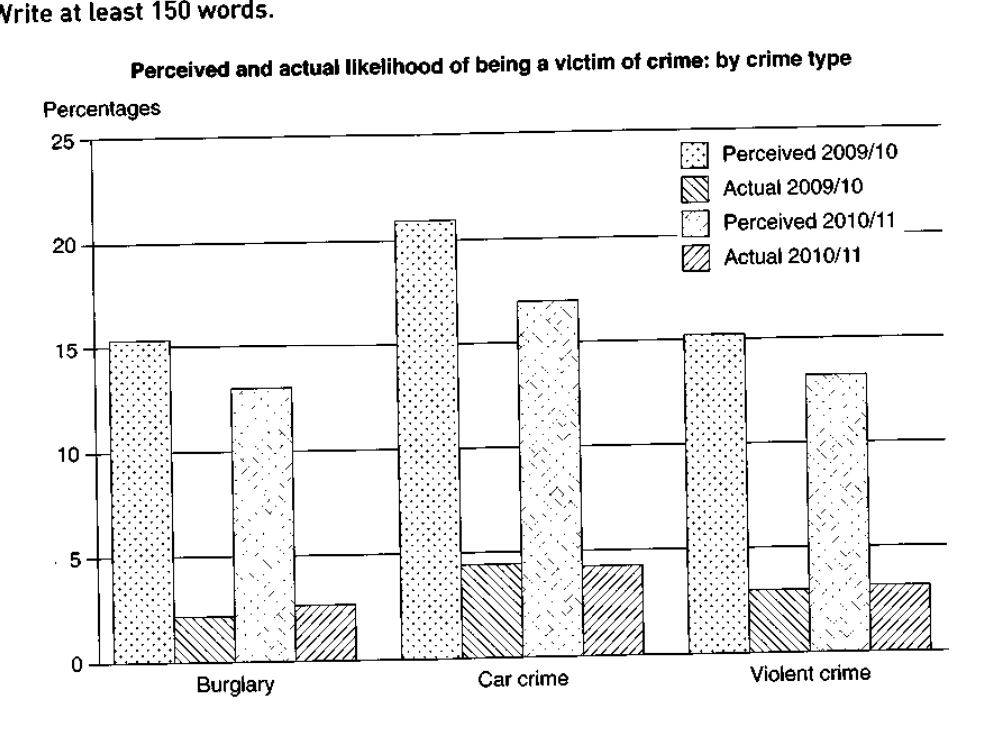
The graph below shows the perceived danger and actual likelihood of being a victim of crime.
Summarise the information by selecting and reporting the main features, and make comparisons where relevant.
Perceived and actual likelihood of being a victim of crime: by crime type
Student answer (Band 6.5)
The figure illustrates the perceived danger and actual likelihood of being a victim of crime in burglary, car crime and violent crime in 2009/10 and 2010/11.
Overall, it is clear that perceived danger exceeded the actual likelihood of being a victim in every category and every year. In addition in every category the perceived danger is higher in 2009/10 than it is in 2010/11.
First, perceived danger in car crime recorded in both years the highest rate and stood just over 20% in 2009/10 and around 17% in 2010/11. Whereas, percevied danger in burglary and violant crime had a similar rate in both years and reached roughly 15% in 2009/10 and around 13% in 2010/11.
In addition, in both years the actual likelihood of being a victim was roughly the same with around 3% for burglary and violent crime. Just in car crime the actual rate was slighlty higher and stood just under 5% in both years.
AI examiner evaluation
| Criterion | Band |
|---|---|
| Task Achievement / Task Response | 7.0 |
| Coherence and Cohesion | 7.0 |
| Lexical Resource | 6.5 |
| Grammatical Range and Accuracy | 6.0 |
| Overall | 6.5 |
Task Achievement / Task Response: Band 7.0
You identify the chart’s subject and give a clear overview: perceived risk is higher than actual victimisation in all categories, and perceived figures fall in the later year. The comparisons are generally accurate, including car crime as the highest perceived category and its actual rate as the highest. However, the claim that burglary and violent crime had “a similar rate” is broad: their perceived values are close but not identical, and actual values also differ slightly. The actual figures are described only approximately, with no year-to-year change noted. The response is also five words below the 150-word minimum; the 12 words copied from the task prompt are excluded from the count. Add a little more precise reporting to complete the summary.
Coherence and Cohesion: Band 7.0
The response is organised into a clear introduction, overview and two detail paragraphs, with a logical movement from perceived danger to actual likelihood. Linking phrases such as “Overall,” “First” and “In addition” help the reader follow this progression. The comparisons are grouped sensibly by type of likelihood, and the main points are easy to locate. Some connections are less smooth: “Whereas” begins a fragment after the preceding sentence, and “Just in car crime” is an awkward transition. The final paragraph also repeats “in both years” without developing the comparison between years. Use complete contrast sentences and vary the links so that relationships between figures are expressed more naturally.
Lexical Resource: Band 6.5
You use a suitable range of chart vocabulary, including “perceived danger,” “actual likelihood,” “recorded,” “rate” and “stood,” and the meaning remains clear throughout. There is some flexibility in describing approximate values, for example “just over 20%” and “just under 5%.” However, several choices are repetitive or imprecise: “rate” appears often, and “perceived danger” could be varied with “perceived risk.” Spelling errors in “percevied,” “violant” and “slighlty” also reduce accuracy. At this level, the vocabulary is adequate and attempts more specific reporting, but more precise collocations and careful proofreading would show the greater control needed for a higher score.
Grammatical Range and Accuracy: Band 6.0
You use a mix of simple and more complex forms, and the overview sentence beginning “Overall, it is clear that…” communicates a multi-part comparison effectively. Most meanings are understandable, but some grammatical errors remain. “Perceived danger in car crime recorded in both years the highest rate” has an awkward word order; write, for example, “Perceived danger was highest for car crime in both years.” “Whereas” is used as a sentence fragment, and “the actual likelihood … was roughly the same with around 3%” has an unclear grammatical relationship between “same” and the figure. The present-tense “is higher” also sits unevenly with the past-year data. More consistently controlled sentence patterns and past-tense reporting would improve accuracy.
See this exact question answered at other band scores. The same prompt compared across bands.
Browse more IELTS Writing model answers or get your own writing scored by the same AI examiner.