Band 5.5 IELTS Writing Task 1 Model Answer
Overall Band Score: 5.5 · IELTS Summit Mastery · 2026-11-05
IELTS Writing Task 1 question
The graph below shows the perceived danger and actual likelihood of being a victim of crime.
Summarise the information by selecting and reporting the main features, and make comparisons where relevant.
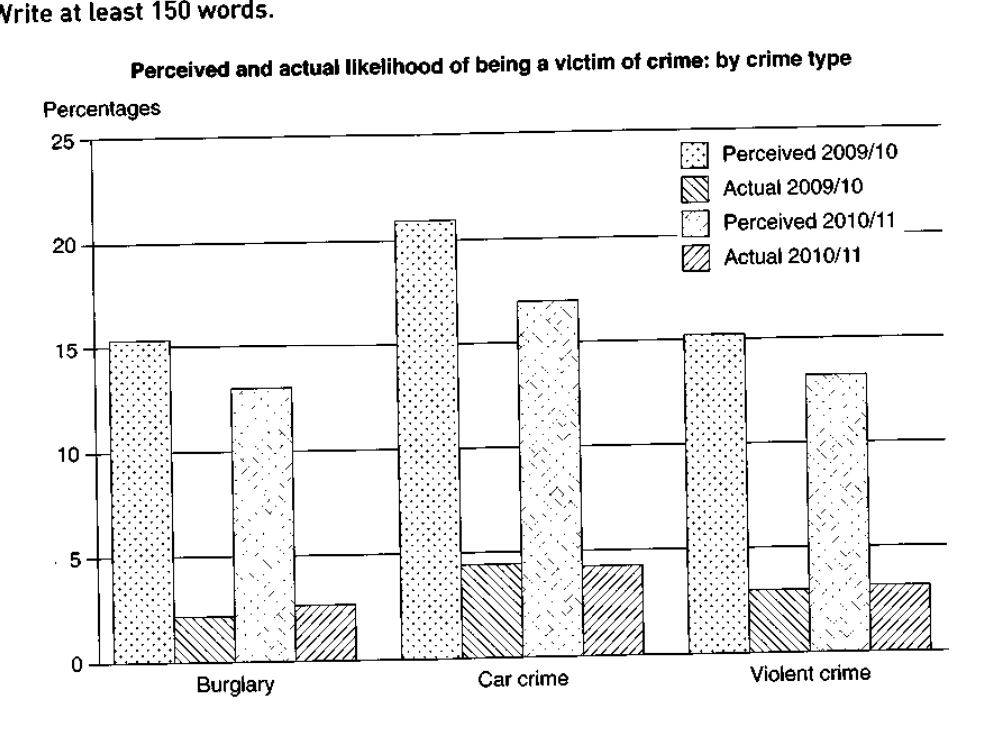
Perceived and actual likelihood of being a victim of crime: by crime type
Student answer (Band 5.5)
The bar chart illustrates the percentages of sensed danger and actually being a victim of crime. Three types of crimes are shown; burglary, car crime and violent crime, between 2009 and 2010.
Overall, the belief of being in danger is the highest, around 22% in 2009/10 in car crimes. While the actual crime taking place is recorded around 4% in 2009/10.
However, the fear of being a victim to a car crime had the most percentage in 2006 and with a 5% less percentage with burglary and violent crime, both with around 15%. Whereas, the actual crime that took place in 2006 is less than perceived crime. Actual crime that happened in 2006 in burglary as around 2%, in car crime 4% and in violent crime around 3%.
Moreover, in 2010/11 perceived danger was again high in car crime ( around 17%), in burglary and violent crime ( both same around 13%). Whereas the actual crime that took place as burglary the lowest ( around 3%), violent crime being the second highest ( around 4%) and car crime being the highest ( around 4.5%) in 2010.
AI examiner evaluation
| Criterion | Band |
|---|---|
| Task Achievement / Task Response | 5.5 |
| Coherence and Cohesion | 6.0 |
| Lexical Resource | 5.5 |
| Grammatical Range and Accuracy | 5.5 |
| Overall | 5.5 |
Task Achievement / Task Response: Band 5.5
You identify the three crime categories and make relevant comparisons between perceived danger and actual victimisation, including the consistently higher perceived figures and car crime’s leading position. However, the overview is incomplete: it focuses on one high figure rather than summarising the main pattern across both periods, such as the general decline in perceived risk and the slight rise in actual rates. Some details are inaccurate or unclear. For example, you refer to “2006” several times, although the chart shows 2009/10 and 2010/11, and say burglary was “around 3%” in 2010/11 when it is about 2.5%. A clearer overview and accurate period labels would make the response more complete and reliable.
Coherence and Cohesion: Band 6.0
The response has a recognisable structure: an introduction, an overview, and paragraphs describing the two periods. This gives the reader a basic route through the information, and connectors such as “Overall,” “However,” and “Moreover” help signal relationships. However, progression is sometimes mechanical, and the contrastive “However” does not clearly introduce a contrast in the second paragraph. The repeated “Whereas” constructions also make the comparisons feel formulaic. References such as “the actual crime that took place” are vague, and the shift from 2009/10 to “2006” interrupts the timeline. Grouping perceived figures together and actual figures together, with consistent year labels, would improve clarity and cohesion.
Lexical Resource: Band 5.5
You use relevant chart vocabulary, including “percentages,” “perceived danger,” “actual crime,” and “highest,” so the main comparisons are generally understandable. There is some repetition, particularly of “crime,” “actual,” and “around,” and several expressions are imprecise or unnatural: “sensed danger,” “the actual crime taking place,” and “fear of being a victim to a car crime.” The phrase “with a 5% less percentage” is also awkward and does not clearly express the comparison. Choose concise, standard terms such as “perceived risk,” “actual victimisation rate,” and “five percentage points lower.” More accurate collocations and less repetition would make the description more precise and fluent.
Grammatical Range and Accuracy: Band 5.5
You attempt both simple and more complex sentence forms, and the reader can usually understand the comparisons. However, some sentence structures are incomplete or awkward, including “Whereas the actual crime that took place as burglary the lowest” and “in burglary and violent crime (both same around 13%).” The opening sentence also has a punctuation problem in “Three types of crimes are shown; burglary, car crime and violent crime,” where a colon would be more suitable. There are some issues with articles, prepositions, and sentence construction, as in “a victim to a car crime.” Aim to write complete clauses with a clear subject and verb, and check that each comparison is grammatically connected to the sentence around it.
See this exact question answered at other band scores. The same prompt compared across bands.
Browse more IELTS Writing model answers or get your own writing scored by the same AI examiner.