Band 6.0 IELTS Writing Task 1 Model Answer
Overall Band Score: 6.0 · IELTS Summit Mastery · 2026-11-06
IELTS Writing Task 1 question
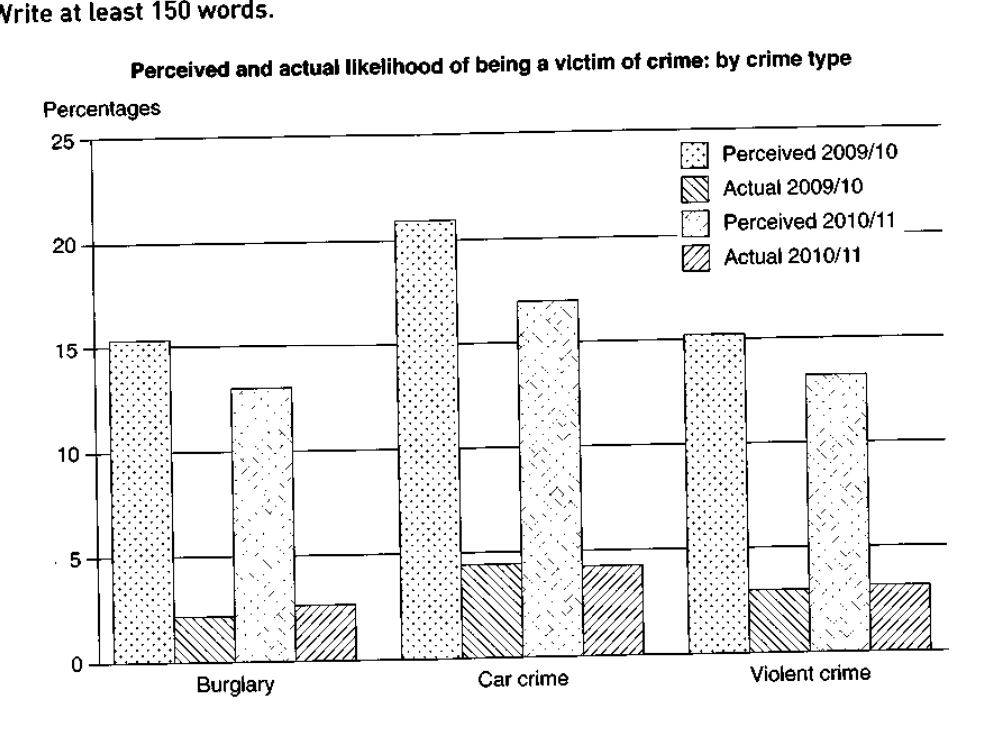
The graph below shows the perceived danger and actual likelihood of being a victim of crime.
Summarise the information by selecting and reporting the main features, and make comparisons where relevant.
Perceived and actual likelihood of being a victim of crime: by crime type
Student answer (Band 6.0)
The bar chart illustrates the potential danger and actual likelihood of being a victim of three types of crime such as burglary, car crime and violence crime in [redacted phone] and [redacted phone].
Overall,in both years, perceived danger was significantly higher yhan the actual rate for all three countries. While, the public perception of crime fell down over the years, the actual rate remained relatively stable.
In terms of perceived risk,car crime was considered the most dangerous in both years, falling from about 21% in 2009/10 to 17% in 2010/11, Bulglary and violent crime showed a similar pattern, with perceived risk dropping from around 15% to 13% for both.
In marked contrast, the actual likelihood of being a victim was much lower. The actual rate for car crime was only 5% in both years. For burglary, it rose slightly from 2% to 3%, while for violent crime it remained at around 4% in both years.
AI examiner evaluation
| Criterion | Band |
|---|---|
| Task Achievement / Task Response | 6.0 |
| Coherence and Cohesion | 6.5 |
| Lexical Resource | 6.0 |
| Grammatical Range and Accuracy | 5.5 |
| Overall | 6.0 |
Task Achievement / Task Response: Band 6.0
You identify the chart’s main contrast: perceived risk is much higher than actual victimisation for all three crimes, and perceived figures decline between the periods. You also correctly identify car crime as the highest perceived risk and describe the small rise in actual burglary. However, some details are inaccurate: actual violent crime rises from about 3% to 3.5%, rather than remaining around 4%, and actual car crime is about 4.5% in both years. The comparison of burglary and violent crime in perceived risk is also slightly imprecise, as their 2010/11 figures are about 13% and 13.5%. The response is 144 words, six short of the required minimum; use the remaining space to report key comparisons more precisely.
Coherence and Cohesion: Band 6.5
The response has a clear four-paragraph structure: an introduction, an overview, and separate paragraphs for perceived and actual risk. This makes the main categories easy to follow, and transitions such as “In marked contrast” effectively signal the shift to actual figures. The information is generally sequenced logically, with the highest perceived category discussed before the lower actual rates. To strengthen cohesion further, avoid linking clauses in ways that interrupt the flow, as in “While, the public perception…”; the comma after “While” is unnecessary, and the sentence could be joined more smoothly to the preceding overview. Also ensure comparisons within each category are consistently presented so readers can track both years without ambiguity.
Lexical Resource: Band 6.0
You use an adequate range of task-related vocabulary, including “perceived risk,” “actual likelihood,” “significantly higher,” and “remained relatively stable.” These expressions help distinguish public perception from recorded victimisation. Some word choices and spelling errors reduce precision, however: “violence crime” is not the natural label for “violent crime,” and “Bulglary” is misspelled. “Fell down” is also less suitable for describing a chart trend than “declined” or “fell.” The phrase “three types of crime such as” is awkward because the chart lists the three types directly. Aim for accurate collocations and careful spelling, particularly for the chart’s category names, while retaining the useful range of comparison language already present.
Grammatical Range and Accuracy: Band 5.5
You use a mix of simple and more complex sentence forms, including the comparison structure “While the public perception of crime fell…”. Most sentences communicate the intended meaning, and the response is easy to understand. Some grammatical and punctuation errors remain. In “Overall,in both years,” a space is needed after the comma; “While,” should not be followed by a comma in this construction, and the clause beginning with “While” should be joined to a main clause rather than left as a fragment. The sentence beginning “In terms of perceived risk” also joins two independent clauses with a comma after “2010/11,” creating a comma splice. Review sentence boundaries and punctuation, and use complex clauses with clear main-clause structure.
See this exact question answered at other band scores. The same prompt compared across bands.
Browse more IELTS Writing model answers or get your own writing scored by the same AI examiner.