Band 4.5 IELTS Writing Task 1 Model Answer
Overall Band Score: 4.5 · IELTS Summit Mastery · 2026-11-09
IELTS Writing Task 1 question
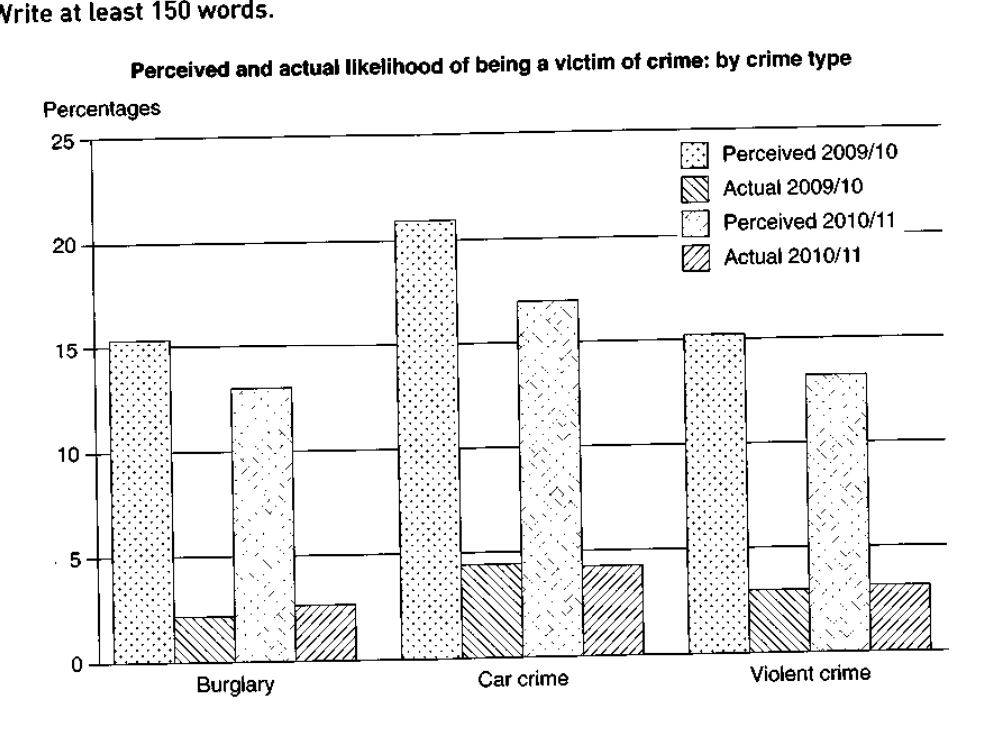
The graph below shows the perceived danger and actual likelihood of being a victim of crime.
Summarise the information by selecting and reporting the main features, and make comparisons where relevant.
Perceived and actual likelihood of being a victim of crime: by crime type
Student answer (Band 4.5)
The bar chart illustrates the data of crimes which is prediction of crime and real crime which is about any victim of the crime.
overview, first one perceived danger of being a victim of crucial activities which is absolutely harmfull for human being, additionally, the report shows the predictional crime in car crime is top of the other crime in 2009 to 2010. secondly, actual crime activities is gradually increased from 2009, 2010 respectively.
Futhermore, perceived victim of crime is about 15 percent in first year but in the next year it show huge increased is about 22 percentage. likewise, the actual victim of crime show drametically increased in car crime in 2010, Moreover, in the first year actual victim of crime is arround 15% in burglary.
lastally, violent crime shows the 15
AI examiner evaluation
| Criterion | Band |
|---|---|
| Task Achievement / Task Response | 3.5 |
| Coherence and Cohesion | 4.0 |
| Lexical Resource | 5.0 |
| Grammatical Range and Accuracy | 4.5 |
| Overall | 4.5 |
Task Achievement / Task Response: Band 3.5
You identify the chart’s broad subject and note that car crime has the highest perceived likelihood, which is a relevant main feature. However, the account is incomplete and several figures or trends are misread: perceived car crime falls from about 21% to 17%, rather than rising to 22%, and actual burglary is around 2–2.5%, not 15%. The overview also says actual crime increased, but does not clearly compare the categories or years. The final point about violent crime is unfinished, and there is no adequate summary of the chart’s main patterns. The response is also below the required 150 words. Select a few accurate comparisons and report them clearly, including the large gap between perceived and actual likelihood.
Coherence and Cohesion: Band 4.0
There is a basic attempt to organise the response: an opening, an overview-like section, and later details, with markers such as “Futhermore,” “likewise,” and “lastally.” This gives the reader some sense of progression. However, the organisation is difficult to follow because the overview is not clearly separated from the details, and the discussion shifts between crime types, years, and perceived versus actual figures without a consistent pattern. Some linking words do not express the relationship accurately, while the final sentence stops abruptly. Group the information by perceived and actual likelihood, or compare the two years for each crime type, and use clear paragraphing and transitions to guide the reader.
Lexical Resource: Band 5.0
You use some relevant topic vocabulary, including “perceived,” “actual,” “victim,” “burglary,” “car crime,” and “violent crime,” so the subject is generally recognisable. However, the range is limited and several expressions are inaccurate or unnatural, such as “predictional crime,” “crucial activities,” and “dramatically increased” where the figures actually decline or change only slightly. Spelling errors, including “harmfull,” “Futhermore,” “dramatically,” and “lastally,” also reduce clarity. Aim for precise chart language and standard collocations rather than elaborate wording. For example, describe percentages as “the perceived likelihood” and use “rose,” “fell,” or “remained stable” only when the data supports that trend.
Grammatical Range and Accuracy: Band 4.5
The response attempts some longer sentence forms, including clauses joined with “additionally” and “likewise,” but control is inconsistent and most sentences contain grammatical problems. Examples include “the report shows the predictional crime in car crime is top” and “in the next year it show huge increased,” where sentence structure, verb forms, and agreement make the meaning hard to follow. Capitalisation and punctuation are also unreliable, as in the lowercase “overview” and the run-on sentence beginning “secondly.” Use straightforward sentence patterns first: for example, “Car crime had the highest perceived likelihood in 2009/10.” Then check subject–verb agreement, tense, articles, and sentence boundaries before adding more complex clauses.
See this exact question answered at other band scores. The same prompt compared across bands.
Browse more IELTS Writing model answers or get your own writing scored by the same AI examiner.