Band 5.5 IELTS Writing Task 1 Model Answer
Overall Band Score: 5.5 · IELTS Summit Mastery · 2026-11-09
IELTS Writing Task 1 question
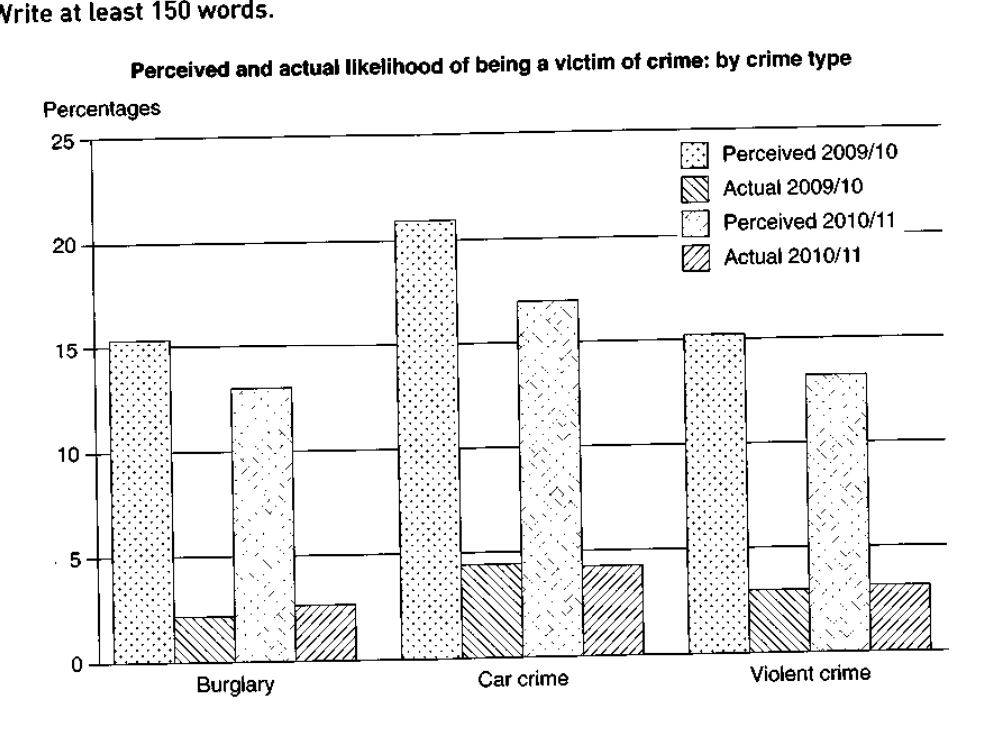
The graph below shows the perceived danger and actual likelihood of being a victim of crime.
Summarise the information by selecting and reporting the main features, and make comparisons where relevant.
Perceived and actual likelihood of being a victim of crime: by crime type
Student answer (Band 5.5)
The graph illustrates the perceived and actual percentages of the likelihood of being a victim of burglary, car crimes and violent crimes between [redacted phone] and [redacted phone].
Overall, the perceived likelihood of being a victim of a crime is a lot higher than that of the actual likelihood of it happening with car crimes having the highest percentages in both periods of time with 2009/10 being the biggest and having over 20% likelihood and 2010/11 falling a little behind.
The actual percentage of blth years seems to be significantly lower with both being aproximatly under 5%.
On the one hand, both burglary and violent crimes have the same numbers perceived in 2009/10 and 2010/11 with just over 15 on the first and a little under 15 on the second.
On the second hand, the percentages of the likelihood of a burglary actually happening seem to be lower than those of the violent crime but both being under 5%.
AI examiner evaluation
| Criterion | Band |
|---|---|
| Task Achievement / Task Response | 6.0 |
| Coherence and Cohesion | 5.5 |
| Lexical Resource | 5.5 |
| Grammatical Range and Accuracy | 5.5 |
| Overall | 5.5 |
Task Achievement / Task Response: Band 6.0
You identify the chart’s central contrast: perceived risk is much higher than actual victimisation, and car crime is highest in both periods. You also report the broad decline in perceived figures and note that actual rates remain below 5%, which gives the response a relevant overview. However, some comparisons are incomplete or unclear. The statement that burglary and violent crime have “the same numbers perceived” is only true for 2009/10; in 2010/11 they are close but not equal. You also do not give the actual figures’ small increases between periods, and the final comparison does not clearly distinguish the two years. More precise reporting of these changes would make the main features better developed.
Coherence and Cohesion: Band 5.5
The response has a recognisable structure: an introduction, an overview, and two paragraphs of detail. This helps the reader follow the general contrast between perceived and actual risk. However, progression within the detail is limited, and the linking phrases “On the one hand” and “On the second hand” feel mechanical; the latter is also not the usual paired expression. The final paragraph repeats the point that actual rates are below 5% without clearly organising the figures by crime type and year. Grouping perceived figures together, then actual figures, and using clearer links such as “By contrast” or “Meanwhile” would create a more logical progression and reduce repetition.
Lexical Resource: Band 5.5
You use relevant chart vocabulary, including “perceived likelihood,” “actual percentage,” and “percentages,” so the topic is generally clear. There is some variation in how you describe the figures, but several choices are imprecise or informal for an academic summary. “A lot higher” and “falling a little behind” are vague, while “the likelihood of a burglary actually happening” is wordy and awkward. There are also spelling errors in “blth” and “aproximatly,” and “car crimes” is less natural than “car crime” when naming the category. More precise terms such as “substantially higher,” “declined,” and “actual victimisation rate” would improve clarity and control.
Grammatical Range and Accuracy: Band 5.5
You attempt a mix of sentence forms, including a complex overview sentence and comparisons using “with” and “but.” The main meaning is usually understandable, but some sentence structures are awkward or incomplete. For example, “with 2009/10 being the biggest and having over 20% likelihood” attaches the comparison unclearly, and “but both being under 5%” does not form a complete clause. The phrase “the actual percentage of blth years seems” also has an unclear grammatical construction. Use complete clauses to report each comparison, and check agreement and punctuation when joining ideas. These revisions would make your range of structures more controlled while preserving the information you are trying to convey.
See this exact question answered at other band scores. The same prompt compared across bands.
Browse more IELTS Writing model answers or get your own writing scored by the same AI examiner.