Band 5.5 IELTS Writing Task 1 Model Answer
Overall Band Score: 5.5 · IELTS Summit Mastery · 2026-11-09
IELTS Writing Task 1 question
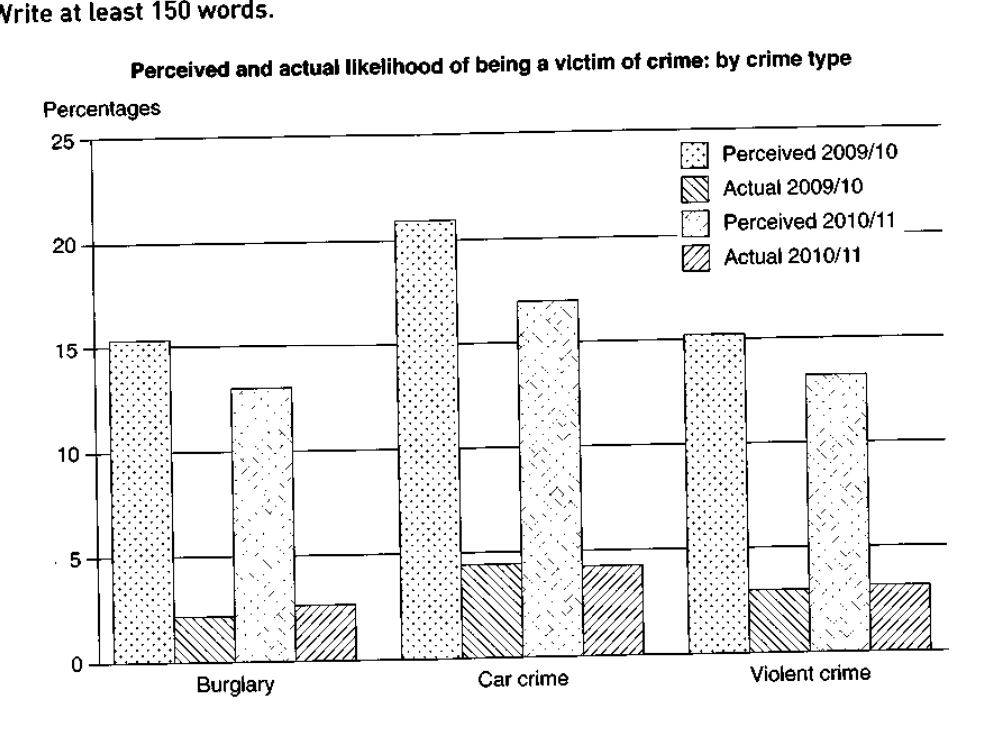
The graph below shows the perceived danger and actual likelihood of being a victim of crime.
Summarise the information by selecting and reporting the main features, and make comparisons where relevant.
Perceived and actual likelihood of being a victim of crime: by crime type
Student answer (Band 5.5)
The graph illustrates the information about danger which is perceived and the chances of being a crime's victim between years 2009/10 and 2010/11. Overall, there are 3 different types of crimes in the graph such as burglary,car crime and violent crime.
First of all, graph shows an increase of 22 percent in the perceived danger of car crime, followed by 15 percent increase in the violence and burglary for the years 2009/2010. However, the actual crime rates for these types of crimes were far below than the perceived percentages accounting for 2 and 3 percent for burglary and violent crimes, whereas, 4 percent is stated for car crimes.
Secondly, the perceived danger of crimes related to cars were highest than the other two crimes, burglary and violent crimes in the years 2010/11. The graph shows a percentage of 17 percent for a perceived danger of car crime which is more than the violent crime 13 percent and burglary 12 percent. In contrast to this, the actual crime rates for these types of crimes were even less than the perceived ones. These percentages as shown in the graph were 3 percent for violent crime, 4 percent for car crimes and 2 percent for burglary which is less than perceived percentages.
AI examiner evaluation
| Criterion | Band |
|---|---|
| Task Achievement / Task Response | 5.5 |
| Coherence and Cohesion | 5.5 |
| Lexical Resource | 6.0 |
| Grammatical Range and Accuracy | 5.5 |
| Overall | 5.5 |
Task Achievement / Task Response: Band 5.5
You identify the three crime categories and make relevant comparisons between perceived danger and actual crime, including the much lower actual figures. However, the overview is incomplete: the opening mainly lists the categories rather than summarising the chart’s main pattern, and the response does not clearly highlight that perceived figures fell from 2009/10 to 2010/11 while actual figures changed only slightly. Some data are also inaccurate: the 2009/10 perceived figures are described as increases of 22% and 15%, although they are levels of about 21% for car crime and 15.5% for both other types. The 2010/11 actual figures are also not consistently reported. A clearer overview and more accurate comparisons would make the report more complete.
Coherence and Cohesion: Band 5.5
The response has a recognisable structure, with an introduction followed by two paragraphs comparing the years, and signposts such as “First of all” and “Secondly” help indicate sequence. However, progression is somewhat mechanical, and the opening does not establish a useful overview of the main trends. The first body paragraph combines perceived and actual figures, while the second repeats the same contrast without clearly explaining the overall change between years. Some links are awkward or unclear, particularly “whereas, 4 percent is stated” and “In contrast to this.” Organise the report around the main pattern first, then compare the two years and crime types, using references that make each comparison explicit.
Lexical Resource: Band 6.0
You use a reasonable range of task-related vocabulary, including “perceived danger,” “actual crime rates,” “accounting for,” and “in contrast.” These choices generally make the topic clear. However, some expressions are imprecise or unnatural for describing chart data: “an increase of 22 percent” suggests a change over time rather than a percentage level, and “highest than” is not an appropriate comparison. “Crime’s victim” is also an awkward phrase, while repeated use of “percentages” and “crimes” limits flexibility. Aim for precise reporting verbs and collocations, such as “stood at,” “was higher than,” and “people’s likelihood of becoming victims.” This would improve naturalness while preserving the clear meaning of most of your vocabulary.
Grammatical Range and Accuracy: Band 5.5
You attempt both simple and more complex sentence forms, including clauses introduced by “whereas” and “which,” and most of the intended comparisons remain understandable. Some grammatical errors are noticeable, however. For example, “the chances of being a crime’s victim” has an incorrect possessive construction, and “the perceived danger of crimes related to cars were highest” has a subject–verb agreement problem. The phrase “far below than” also uses an incorrect comparative pattern, and punctuation is inconsistent, as in “burglary,car crime.” Work on accurate comparison structures (“far below,” “higher than”), agreement, and sentence punctuation. More reliable control of these patterns would make the complex sentences clearer.
See this exact question answered at other band scores. The same prompt compared across bands.
Browse more IELTS Writing model answers or get your own writing scored by the same AI examiner.