Band 5.5 IELTS Writing Task 1 Model Answer
Overall Band Score: 5.5 · IELTS Summit Mastery · 2026-11-09
IELTS Writing Task 1 question
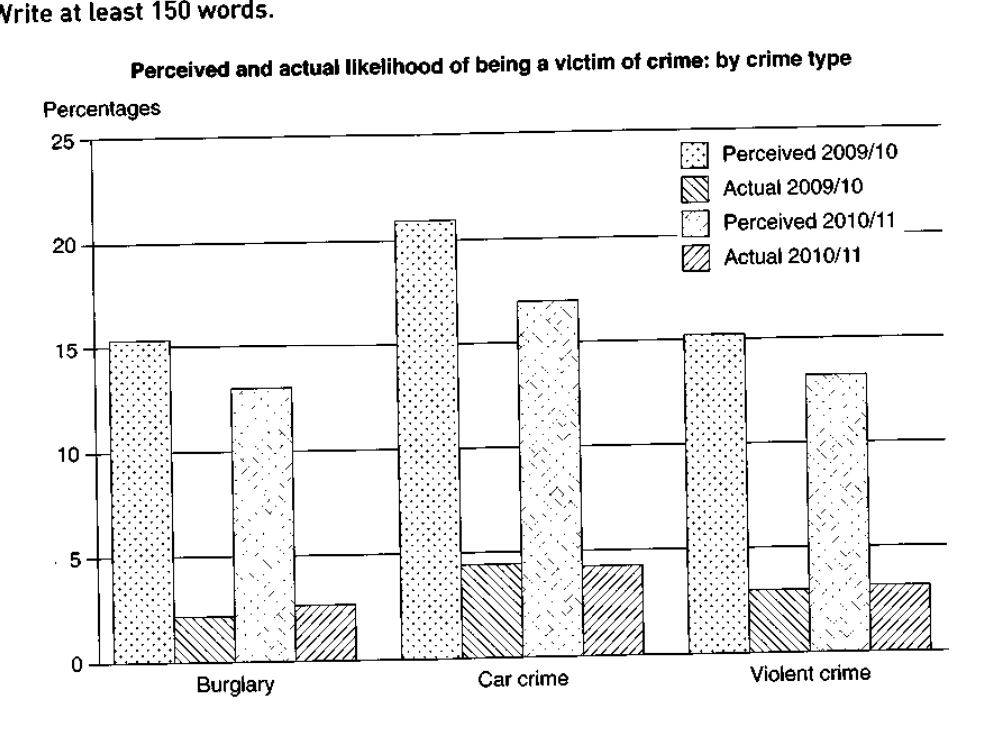
The graph below shows the perceived danger and actual likelihood of being a victim of crime.
Summarise the information by selecting and reporting the main features, and make comparisons where relevant.
Perceived and actual likelihood of being a victim of crime: by crime type
Student answer (Band 5.5)
The graph below demonstrate the precieved danger and actual likehood of being a victim of crime.
Overall the table illustreats that car crime had highest ratio in perceived in 2009. While the burglary and violent crime had almost the same ratio in perceived crime in the year 2009 and 10.
The graph shows that car crime had almost 22% perceived rate in 2009 and 10 while actual is 4% which is very low and in the year 2010/11 the perceived become low to 17% and the actual crime rate had 4% is the year 2010 and 11.
Burglary and Violent crime had almost the same in both peroid of year.
In 2009/10 the ratio is around 15% in Burglary and also of Violent crime. The actual of burglary is 3% and the violent had 4%. The perceived in 2010/11 is almost same which is about 13%. the actual of both is also same.
AI examiner evaluation
| Criterion | Band |
|---|---|
| Task Achievement / Task Response | 5.5 |
| Coherence and Cohesion | 5.5 |
| Lexical Resource | 5.0 |
| Grammatical Range and Accuracy | 5.0 |
| Overall | 5.5 |
Task Achievement / Task Response: Band 5.5
You identify the main broad pattern: perceived risk is much higher than actual victimisation, and car crime has the highest perceived figure. You also compare the two periods, noting that perceived car crime falls from about 22% to 17%. However, the overview is incomplete: it does not clearly summarise the large gap between perceived and actual rates across all three crimes or the general stability of actual rates. Some figures are inaccurate or unclear: actual burglary was about 2% and 2.5%, not 3%, while actual violent crime was about 3% and 3.5%, rather than 4%; the statement that the actual rates for burglary and violent crime are “also same” is misleading. More precise, consistently reported comparisons would make the summary fuller and clearer.
Coherence and Cohesion: Band 5.5
The response has a basic paragraph structure, moving from an introduction and overview to comparisons of car crime, burglary and violent crime. This gives the reader some organisation, and phrases such as “while” and “in the year 2010/11” attempt to connect comparisons. However, progression is limited: the final paragraph repeats the earlier point that burglary and violent crime are similar without clearly distinguishing their actual figures. Some links are awkward or incomplete, such as “While the burglary and violent crime…” and “the actual crime rate had 4% is the year…”. Grouping the data more systematically—for example, first comparing perceived rates and then actual rates—would make the relationships easier to follow and reduce repetition.
Lexical Resource: Band 5.0
You use relevant topic vocabulary, including “perceived,” “actual,” “ratio,” and the three crime categories, so the reader can generally understand what is being compared. However, the range is limited and several word choices or collocations are inaccurate, such as “highest ratio in perceived,” “actual crime rate,” and “the actual of burglary.” Repeated use of “almost,” “same,” and “ratio” also makes the description imprecise. Spelling errors—including “precieved,” “likehood,” and “illustreats”—are noticeable and can slow the reader. Aim to use standard chart language consistently, such as “percentage,” “figure,” “rate,” “rose” or “fell,” and check spelling before submitting.
Grammatical Range and Accuracy: Band 5.0
The response mainly uses simple sentence patterns, with a few attempts to combine comparisons using “while.” Errors occur frequently and sometimes make relationships difficult to interpret. For example, “The graph below demonstrate” has subject–verb disagreement, and “the actual crime rate had 4% is the year 2010 and 11” has an unclear verb structure. The fragment beginning “While the burglary…” is not a complete sentence, while “The perceived in 2010/11 is almost same” lacks a clear grammatical subject and article. Tense and sentence boundaries are also inconsistent. Practise forming complete sentences with a clear subject and verb, and use comparative structures such as “The perceived figure fell, whereas the actual rate remained stable.”
See this exact question answered at other band scores. The same prompt compared across bands.
Browse more IELTS Writing model answers or get your own writing scored by the same AI examiner.