Band 4.5 IELTS Writing Task 1 Model Answer
Overall Band Score: 4.5 · IELTS Summit Mastery · 2026-11-10
IELTS Writing Task 1 question
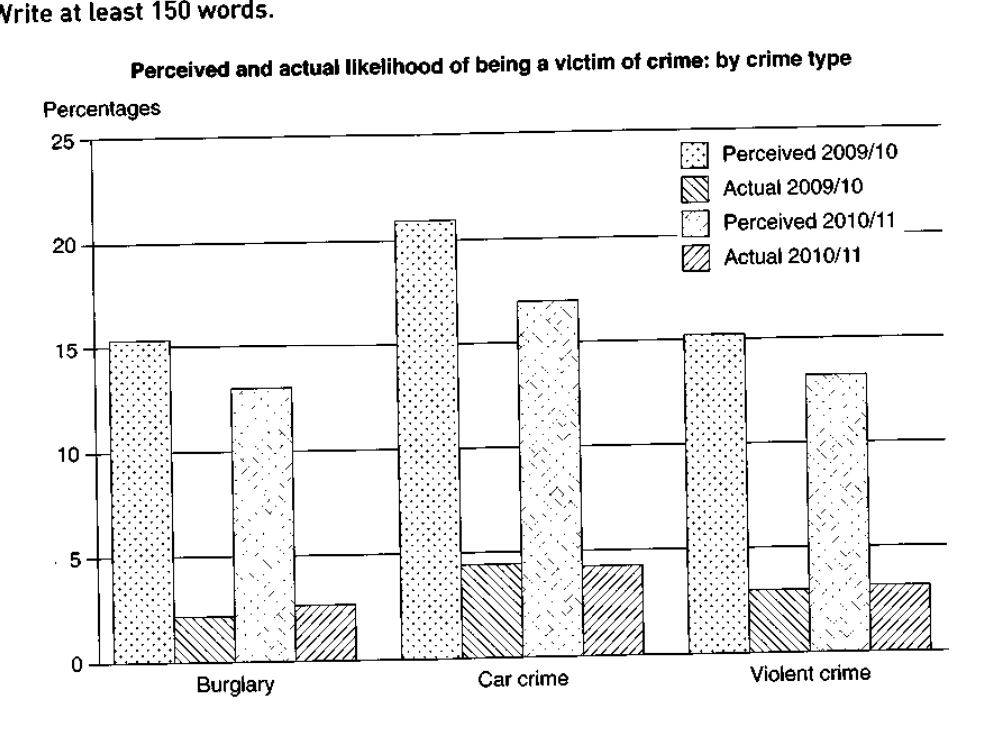
The graph below shows the perceived danger and actual likelihood of being a victim of crime.
Summarise the information by selecting and reporting the main features, and make comparisons where relevant.
Perceived and actual likelihood of being a victim of crime: by crime type
Student answer (Band 4.5)
The graph illustrates information about perceived danger and actual like hood of being a victim of crime. There had many changes in the given graph have increments as well as decrements being a victim of crime.
Overall, We see many changes in the graph and we discuss Buglary , car crime and violent crime. perceived 2009 to 10 and Actual crime 2009 to 10 and Perceived 2010 to 11 and Actual crime 2010 to 11. According to the graph percentage are increased and decreased. Perceived in Buglary is 15% and Actual 3% crime rate and perceived 2010 to 13% and Actual is 3.5%. Car crime is Perceived 2009 is to 22% crime rate and Actual is 4% and Percevied 2010 car crime rate to 17% and Actual rate is 4% and perceived 2009 is Violent crime to 15% and Actual is 3% and perceived 2010 is 13% crime rate and Actual crime rate is 4% according to the graph.
AI examiner evaluation
| Criterion | Band |
|---|---|
| Task Achievement / Task Response | 4.5 |
| Coherence and Cohesion | 4.0 |
| Lexical Resource | 5.0 |
| Grammatical Range and Accuracy | 4.5 |
| Overall | 4.5 |
Task Achievement / Task Response: Band 4.5
You identify all three crime categories and include figures for both perceived and actual risk across the two periods, so the response is relevant to the chart. However, the main features are not clearly summarised: there is no accurate overview of the large gap between perceived and actual risk, or of car crime being highest in both measures. Several figures are inaccurate or unclear—for example, burglary’s actual rate is about 2–2.5%, not 3–3.5%, and violent crime’s perceived rate in 2010/11 is about 13.5%, not 13%. The opening claim that there were “many changes” does not explain the overall pattern. Select the key comparisons and report them accurately.
Coherence and Cohesion: Band 4.0
The response has a basic opening and a longer paragraph that attempts to cover the chart categories, but the information is not arranged in a clear progression. The overview begins, “Overall, We see many changes,” yet it does not state the central comparison; the following list then moves between periods and crime types without a consistent structure. Repeated use of “and” and “According to the graph” makes the sequence difficult to follow, while the final sentence ends without a clear concluding point. Organise the report into an introduction, a concise overview, and one or two paragraphs grouped by a clear principle, such as perceived versus actual figures or changes between years.
Lexical Resource: Band 5.0
You use relevant topic vocabulary, including “perceived,” “actual,” “percentage,” and the three crime labels, which allows the reader to recognise the subject. However, the range is limited and several choices or spellings reduce clarity: “like hood” is not the intended word, “Buglary” is repeatedly misspelled, and “crime rate” is used where “percentage” or “likelihood” would be more precise. Phrases such as “many changes” and “increments as well as decrements” are vague and do not describe the chart’s main pattern naturally. Build a small set of accurate chart-reporting expressions and use them consistently, for example, “fell from,” “remained stable,” and “was considerably higher than.”
Grammatical Range and Accuracy: Band 4.5
The response attempts both simple statements and longer sentences, but grammatical control is inconsistent and errors sometimes make relationships between figures unclear. Examples include “There had many changes,” which needs a different verb structure, and “perceived 2009 is to 22%,” where the sentence pattern does not clearly express the value. Capitalisation is also inconsistent in “Overall, We,” and the long final sequence relies on repeated clauses joined by “and,” with little punctuation to separate comparisons. Practise writing short, complete comparison sentences first, then combine them using accurate clauses—for example, “Perceived risk of car crime fell from about 21% to 17%, while the actual figure remained around 4.5%.”
See this exact question answered at other band scores. The same prompt compared across bands.
Browse more IELTS Writing model answers or get your own writing scored by the same AI examiner.