Band 4.5 IELTS Writing Task 1 Model Answer
Overall Band Score: 4.5 · IELTS Summit Mastery · 2026-11-10
IELTS Writing Task 1 question
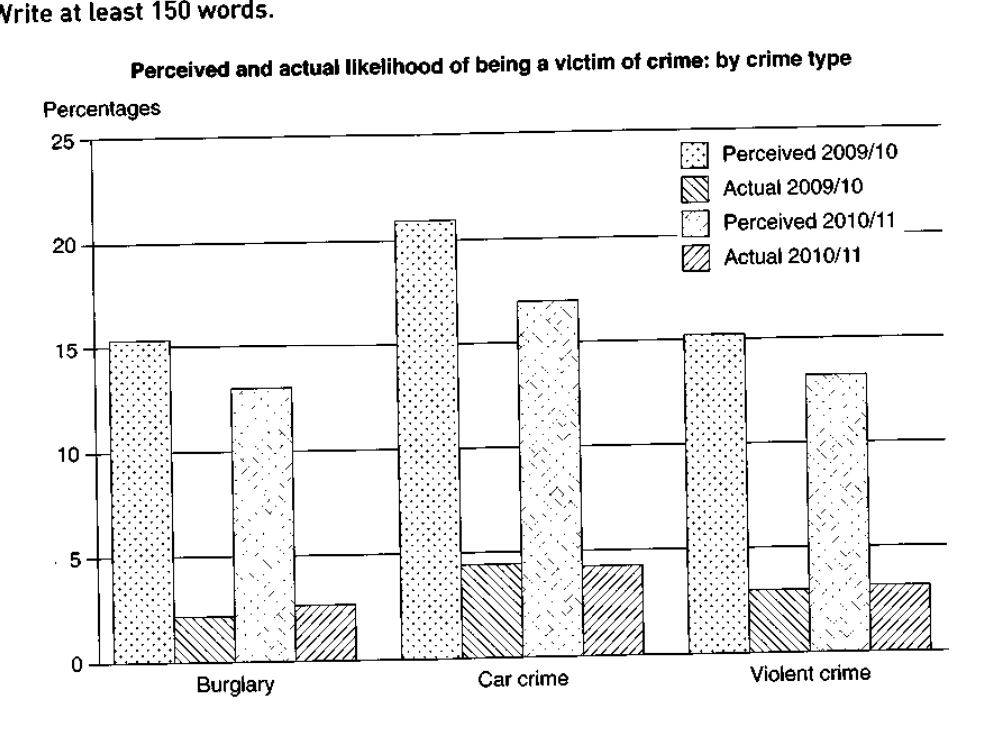
The graph below shows the perceived danger and actual likelihood of being a victim of crime.
Summarise the information by selecting and reporting the main features, and make comparisons where relevant.
Perceived and actual likelihood of being a victim of crime: by crime type
Student answer (Band 4.5)
The perceived danger and equal livelihood of being victaim of crime.In this we are making the information shorter about the livelihood of being vicaim in crrime .There are so many crime in the country happens like car crime,violent crime and also burglary .
On the one hand,if we talk about burglary crime is little high like 15 percent of percieved 2009/10 as if we compared about actual 2009/10 is very less in crime rate.Another is that the crime of percieved 2010/11 id high but not higher then percieved 2009/10.then actual of 2010/10 is lesser in crime rate of livelihood.If we talk about car crime so the percieved 2009/10 is much higher in the rate of crime like the percentage if 21 %. However,if we talk about violent crime so it is less the burglary and car crime.the car crime rate is higer amoung the burglary and violent crime because car crime is the big resons for killing.
AI examiner evaluation
| Criterion | Band |
|---|---|
| Task Achievement / Task Response | 4.5 |
| Coherence and Cohesion | 4.0 |
| Lexical Resource | 4.5 |
| Grammatical Range and Accuracy | 5.0 |
| Overall | 4.5 |
Task Achievement / Task Response: Band 4.5
You identify the three crime categories and make relevant comparisons between perceived and actual risk, including the high perceived figure for car crime in 2009/10 and the lower perceived figure for burglary in 2010/11. However, the response does not give a clear overview of the chart’s main pattern: perceived risk is much higher than actual likelihood in every category, and perceived figures generally fall in 2010/11 while actual figures rise slightly or remain stable. Some details are inaccurate or unclear, such as saying burglary is “little high” without a clear comparison, and referring to “actual of 2010/10.” The claim that car crime is a reason for killing is not supported by the chart. Focus on reporting the displayed data rather than adding explanations.
Coherence and Cohesion: Band 4.0
There is a basic attempt to organise the response, beginning with an introduction and then discussing burglary, car crime and violent crime. Linking phrases such as “On the one hand,” “Another,” and “However” show an effort to connect ideas. However, the information does not progress clearly from an overview to well-grouped comparisons, and the opening repeats the idea of summarising the chart without presenting its main message. Several sentences combine multiple points, making relationships difficult to follow; for example, the discussion of burglary shifts between perceived and actual figures without clear separation. Use distinct paragraphs for an overview and key comparisons, and connect each figure explicitly to its crime type and year.
Lexical Resource: Band 4.5
The response uses some relevant topic vocabulary, including “perceived,” “actual,” “crime rate,” and the names of the three crime types. However, the range is basic and repetitive, with “crime” and “high” used repeatedly, and several word choices or collocations make the meaning unclear. For instance, “equal livelihood” and “livelihood of being victim” do not express likelihood, while “little high” is not a natural way to describe a percentage. Spelling errors such as “victaim,” “percieved,” and “higer” also reduce accuracy. Build a small set of precise chart-reporting expressions, such as “the perceived risk was higher than the actual rate” and “the figure declined,” and check spelling carefully.
Grammatical Range and Accuracy: Band 5.0
You attempt both simple statements and longer sentences with clauses, using forms such as “if we talk about…” and “However, if we talk about…”. This shows some effort to vary sentence structure, but control is inconsistent. Errors in sentence boundaries and punctuation appear from the opening, where “crime.In this” runs together, and several clauses are joined without clear structure. There are also problems with articles, agreement and verb forms, as in “There are so many crime … happens” and “the car crime rate is higer amoung.” These errors sometimes make the intended comparison hard to understand. Practise writing short, complete comparison sentences first, then combine them with accurate conjunctions and consistent past-tense reporting.
See this exact question answered at other band scores. The same prompt compared across bands.
Browse more IELTS Writing model answers or get your own writing scored by the same AI examiner.