Band 5.0 IELTS Writing Task 1 Model Answer
Overall Band Score: 5.0 · IELTS Summit Mastery · 2026-11-10
IELTS Writing Task 1 question
The graph below shows the perceived danger and actual likelihood of being a victim of crime.
Summarise the information by selecting and reporting the main features, and make comparisons where relevant.
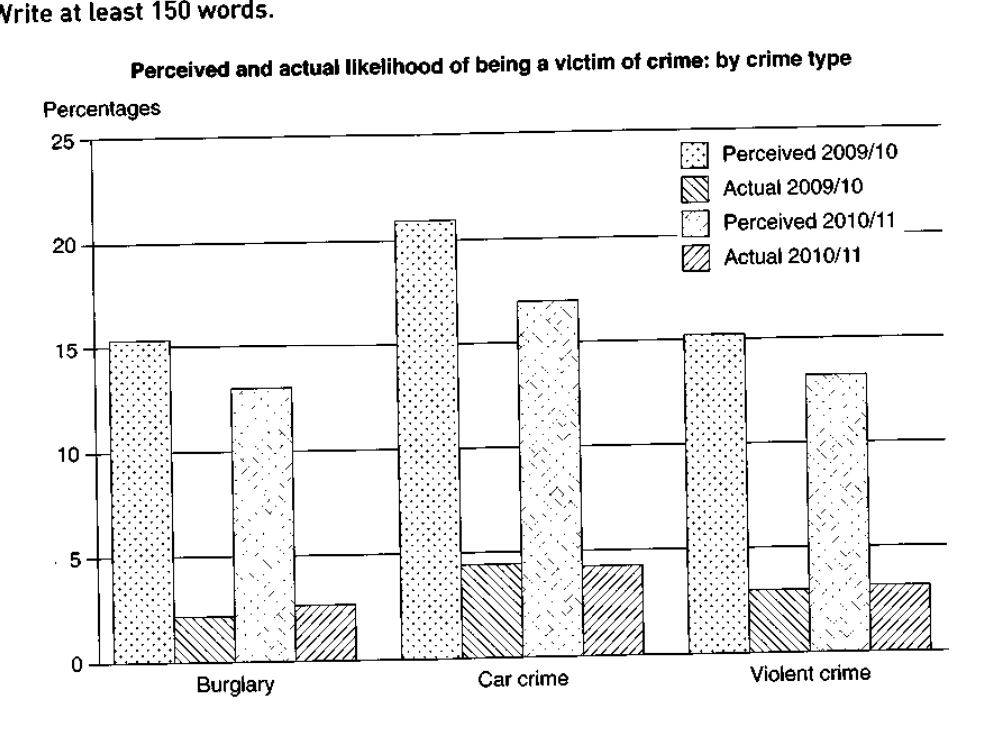
Perceived and actual likelihood of being a victim of crime: by crime type
Student answer (Band 5.0)
The graph illustrates three types of crimes under two years, the perceived danger and actual likelihood of being a victim of a crime.
However, the most crime was a vehicle crime, and it's accounted for 20% in 2009/10 and the actual was almost nearly 5%. and in 2010/11 it's perceived likely 17% and actual crime was same as previous year. Therefore, the burglary and violent crime was almost same, in 2009/10 and 2010/11 the perceived has contributed for 15 percent and a slight changes has shown in 2009/10 and actual crime was dominated for 2.5% and in 2010/11 it was likely 3% in the burglary. By the way, the actual crime of violent was same in both years.
In conclusion, the car crime has more contributed a lot in those two years, rather other crime also a more in a percentage but the car crime has dominated more than others sector.
AI examiner evaluation
| Criterion | Band |
|---|---|
| Task Achievement / Task Response | 4.5 |
| Coherence and Cohesion | 5.0 |
| Lexical Resource | 5.0 |
| Grammatical Range and Accuracy | 5.0 |
| Overall | 5.0 |
Task Achievement / Task Response: Band 4.5
You identify the chart’s main comparison: perceived risk is much higher than actual victimisation, and car crime has the highest figures. However, the account is incomplete and some details are inaccurate or unclear. For example, perceived burglary and violent crime were not both about 15% in both years: they fell to around 13% and 13.5% respectively in 2010/11. You also say actual violent crime was the same in both years, although it rose slightly from about 3% to 3.5%. The overview repeats that car crime was highest but does not clearly summarise the overall changes. The response is 140 words, below the required 150, and should include a fuller, more accurate comparison.
Coherence and Cohesion: Band 5.0
The response has a basic structure, beginning with an introduction, moving to comparisons, and ending with a conclusion. This gives the reader some organisation, and words such as “However,” “Therefore,” and “In conclusion” show an attempt to connect ideas. However, progression within the main paragraph is difficult to follow: several crime types and years are combined in long, unclear sentences, and the conclusion largely repeats the point that car crime was highest. Some linking words do not express the relationship clearly, while the opening “However” does not establish a clear contrast. Separate the overview from the detailed comparisons, then group figures by year or crime type and use simpler, more precise links.
Lexical Resource: Band 5.0
You use relevant topic vocabulary, including “perceived,” “actual likelihood,” “burglary,” “violent crime,” and “percentage,” so the reader can recognise the subject. However, the range is limited and several word combinations are unnatural or imprecise, such as “the most crime was a vehicle crime,” “perceived likely,” and “has contributed for 15 percent.” Repeated use of “crime” and “more” also makes the description less precise. Choose standard chart language such as “recorded the highest perceived risk,” “was estimated at,” and “accounted for.” Take care to distinguish car crime from vehicle crime consistently and use “victimisation” or “likelihood” where appropriate rather than describing the figures as crime itself.
Grammatical Range and Accuracy: Band 5.0
You attempt both simple and longer sentence forms, and the response is generally recognisable despite grammatical problems. However, complex sentences are often faulty, and errors frequently make comparisons hard to interpret. For example, “the perceived has contributed for 15 percent” has an unclear subject and incorrect verb pattern, while “the burglary and violent crime was almost same” has agreement and article problems. The sentence beginning “and in 2010/11” is also joined awkwardly to the preceding sentence, with inconsistent punctuation and capitalisation. Use complete sentences with a clear subject and verb, check singular and plural agreement, and keep each year’s comparison in a separate sentence. This would make the information easier to understand.
See this exact question answered at other band scores. The same prompt compared across bands.
Browse more IELTS Writing model answers or get your own writing scored by the same AI examiner.