Band 5.5 IELTS Writing Task 1 Model Answer
Overall Band Score: 5.5 · IELTS Summit Mastery · 2026-11-11
IELTS Writing Task 1 question
The graph below shows the perceived danger and actual likelihood of being a victim of crime.
Summarise the information by selecting and reporting the main features, and make comparisons where relevant.
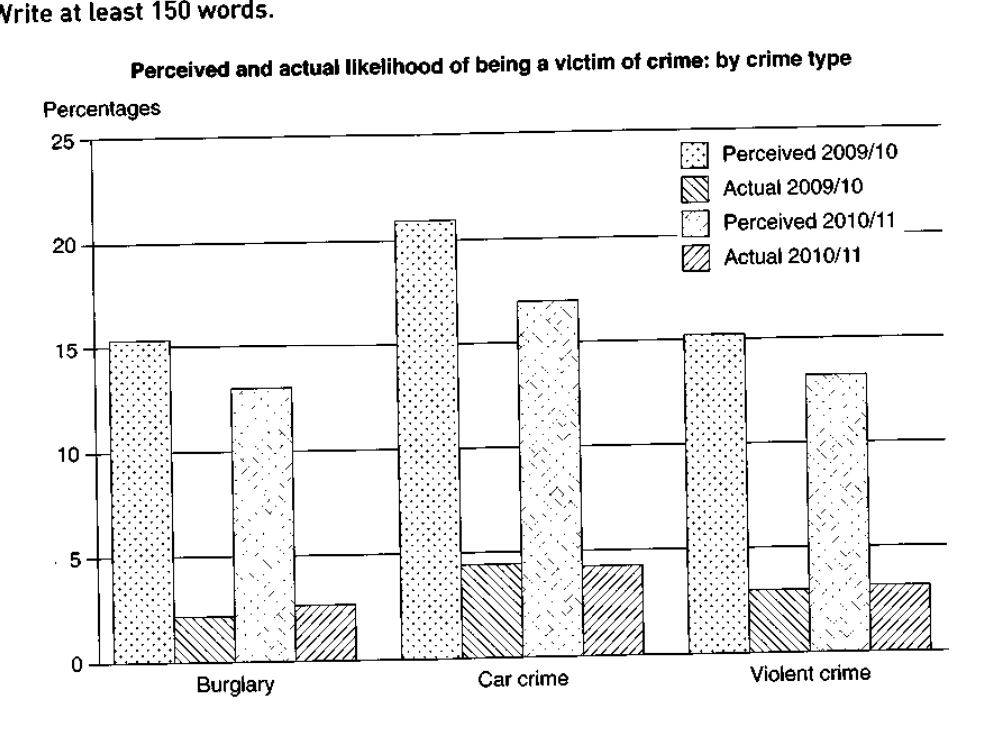
Perceived and actual likelihood of being a victim of crime: by crime type
Student answer (Band 5.5)
The barchart illustrates the percentage of preceived danger and the likelihood of being a victim of crime.
Overall, car crime has the highest proportion of percieved danger as well as actual victim of crime followed by the burglary and violent crime which followed a similar pattern.
Looking first at burglary, the percentage of perceived 2009/10 is 15% followed by 2010/11 which is 13%.Although actual 2009/10 and 2010/11 has a smaller percentage of 3% and 4% respectively.However, burglary is the same as violent crime as all the data of precieved danger in 2009/10 and 2010/11 followed by actual victim of crime in 2009/10 and 2010/11 are similar.
Furthermore, in last we have car crime which has the highest proportion than the rest of crimes.The percieved danger in 2009/10 and in 2010/11 was 21% and 16% respectively.The percentage of actual victim of crime is greater than burglary and violent crime with having 4% in actual 2009/10 and also the same.
AI examiner evaluation
| Criterion | Band |
|---|---|
| Task Achievement / Task Response | 5.5 |
| Coherence and Cohesion | 5.5 |
| Lexical Resource | 5.5 |
| Grammatical Range and Accuracy | 5.0 |
| Overall | 5.5 |
Task Achievement / Task Response: Band 5.5
You identify the chart’s main contrast: perceived danger is much higher than actual victimisation, and car crime has the highest figures in both measures. You also report several relevant values, such as perceived burglary at about 15% and car crime at 21% in 2009/10. However, some data are inaccurate: actual burglary is about 2% and 2.5%, not 3% and 4%, and actual car crime is about 4.5% in both years, rather than 4%. The overview also incorrectly says burglary and violent crime follow a similar pattern; their perceived figures are close, but the actual figures differ slightly. A clearer overview and more accurate comparisons across both years would make the summary more complete.
Coherence and Cohesion: Band 5.5
The response has a recognisable structure, with an introduction, an overview and paragraphs discussing burglary and car crime. This gives the reader a basic route through the information. However, progression is uneven: the overview says burglary and violent crime are similar, then the burglary paragraph repeats this point without clearly comparing the categories. Phrases such as “Furthermore, in last we have” and “However” do not always express the relationship between ideas accurately, and the final paragraph ends without a clear concluding comparison. Organise the details consistently—for example, compare perceived and actual figures for each crime type, or compare the two years across all types—and use linking words only where their meaning fits.
Lexical Resource: Band 5.5
You use relevant chart vocabulary, including “percentage,” “proportion,” “perceived danger” and “actual victim of crime,” so the topic is generally clear. However, the range is limited and several phrases are repetitive or unnatural, such as “actual victim of crime,” “has the highest proportion than” and “in last we have.” There are also repeated spelling errors in “perceived,” written as “preceived” or “precieved.” Use more precise and natural expressions such as “actual victimisation,” “recorded rate” and “the highest figure.” Vary the language for describing comparisons and changes, while checking spelling carefully; these improvements would make the report more fluent and precise.
Grammatical Range and Accuracy: Band 5.0
You attempt both simple statements and longer sentences, but control is inconsistent, particularly when combining comparisons and clauses. For example, “Although actual 2009/10 and 2010/11 has a smaller percentage” has faulty agreement and an incomplete use of “Although”; the following figures are also attached unclearly. In “the percentage of perceived 2009/10 is 15%,” the sentence structure does not clearly identify what the percentage refers to. Punctuation is also unreliable, with missing spaces after full stops in “13%.Although” and “respectively.The.” Aim for complete, direct sentences with a clear subject and verb, and check agreement, clause structure and punctuation. More accurate control of these patterns would make the comparisons easier to follow.
See this exact question answered at other band scores. The same prompt compared across bands.
Browse more IELTS Writing model answers or get your own writing scored by the same AI examiner.