Band 5.5 IELTS Writing Task 1 Model Answer
Overall Band Score: 5.5 · IELTS Summit Mastery · 2026-11-11
IELTS Writing Task 1 question
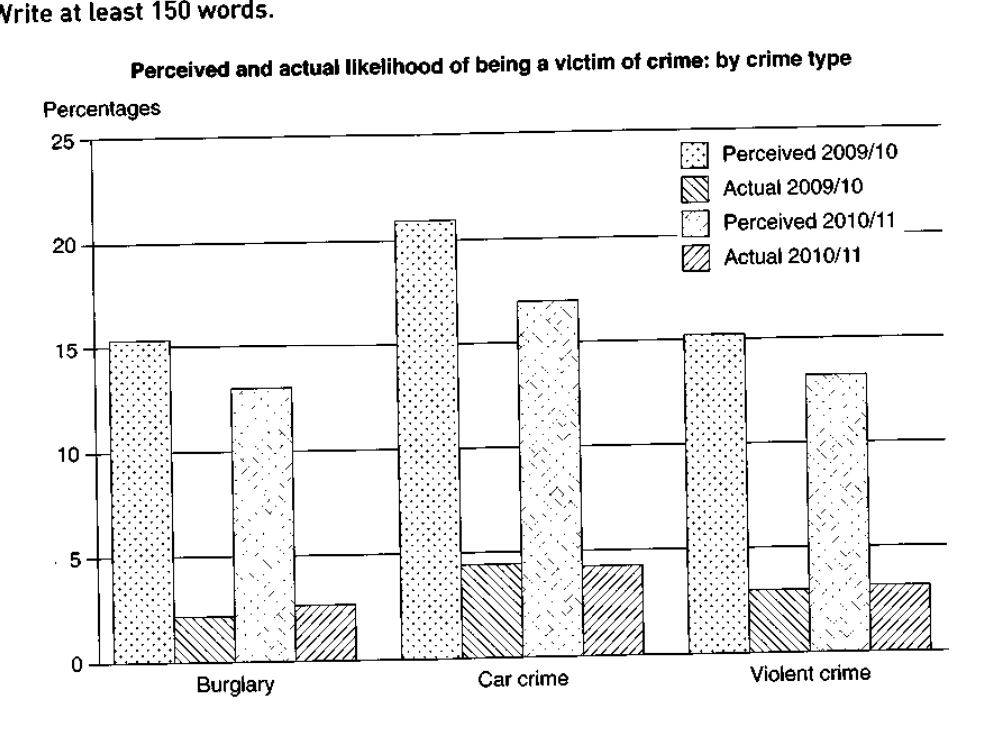
The graph below shows the perceived danger and actual likelihood of being a victim of crime.
Summarise the information by selecting and reporting the main features, and make comparisons where relevant.
Perceived and actual likelihood of being a victim of crime: by crime type
Student answer (Band 5.5)
The graph illustrates the sense of threat and likelihood of being victim of a crime.
Overall, it is clear from the graph that perceived Car crime had the highest percentage, while actual Burglary crime had the least over the period. As for Violent crime, actual crimes were the fewer than that fear of potential danger.
Looking at the proportion of Burglary crione, the people perceived at around 15 percent in 2009-10, while actual crime occured only 2 percent. In 2010-11, people assumed 13 percent, but the actual crime was 2.5 percent.
Turning to Car crime and Violent crime, citizens assumption for Car crime was relatively high in 2009-10, which was just above 20 percent, while actual crime that executed only near 5 percent. In the next year of 2010-11, the subjective sense of risk was low compared to the former, about 14 percent, but the actual crime rate remained stable, around 5 percent. Meanwhile, Violent crime was supposed to occurr approximately 15 percent in 2009-10, but the actual crime was only 3 percent which remained the same for next following year, with the lower sense of risk than the previous year.
AI examiner evaluation
| Criterion | Band |
|---|---|
| Task Achievement / Task Response | 5.5 |
| Coherence and Cohesion | 6.0 |
| Lexical Resource | 5.5 |
| Grammatical Range and Accuracy | 5.5 |
| Overall | 5.5 |
Task Achievement / Task Response: Band 5.5
You identify the main contrast accurately: perceived risk is much higher than actual victimisation, and car crime has the highest perceived figures. The overview also notes burglary’s low actual rate. However, some details are inaccurate or unclear. For example, perceived car crime in 2010/11 was about 17%, not 14%, and actual violent crime rose slightly from about 3% to 3.5%, rather than remaining the same. The overview’s comparison of violent crime is also difficult to interpret. To strengthen the response, report the key figures more precisely and make the overall trends explicit, including that perceived risk fell across all three categories while actual rates changed only slightly.
Coherence and Cohesion: Band 6.0
The response has a clear overall arrangement: an introduction, an overview, and two paragraphs grouping burglary separately from car and violent crime. Phrases such as “Looking at” and “Turning to” help signal these shifts, and the reader can generally follow the comparisons. Some connections are less clear or repetitive, however. The overview sentence beginning “As for Violent crime” does not clearly explain the comparison, while “Meanwhile” introduces another category without making the year-to-year relationship fully explicit. Use more direct links to show whether figures rose, fell, or stayed similar, and ensure each paragraph develops a clear comparison rather than listing figures.
Lexical Resource: Band 5.5
You use relevant topic vocabulary, including “perceived,” “actual,” “proportion,” and “sense of risk,” and you attempt some variation rather than repeating one term throughout. However, several choices are inaccurate or unnatural for describing chart data. “Citizens assumption” and “subjective sense of risk” are awkward, while “actual crime that executed” does not convey the intended meaning. There are also spelling errors such as “crione” and “occurr.” These issues sometimes make the description harder to understand. Aim for precise, conventional collocations such as “the proportion who perceived a risk” and “the actual rate of victimisation,” and check spelling carefully.
Grammatical Range and Accuracy: Band 5.5
You attempt a mix of simple statements and longer comparisons, using clauses with “while” and “but” to contrast perceived and actual figures. The meaning is usually recoverable, but some grammatical errors remain. For example, “being victim of a crime” needs an article, and “actual crimes were the fewer than that fear” has faulty comparison and sentence structure. In “people perceived at around 15 percent,” the verb pattern is incomplete; a clearer form is “people perceived the risk to be around 15 percent.” There are also tense and agreement issues in phrases such as “crime occured” and “which remained the same.” Practise accurate comparative structures and consistent past-tense reporting.
See this exact question answered at other band scores. The same prompt compared across bands.
Browse more IELTS Writing model answers or get your own writing scored by the same AI examiner.