Band 5.5 IELTS Writing Task 1 Model Answer
Overall Band Score: 5.5 · IELTS Summit Mastery · 2026-11-14
IELTS Writing Task 1 question
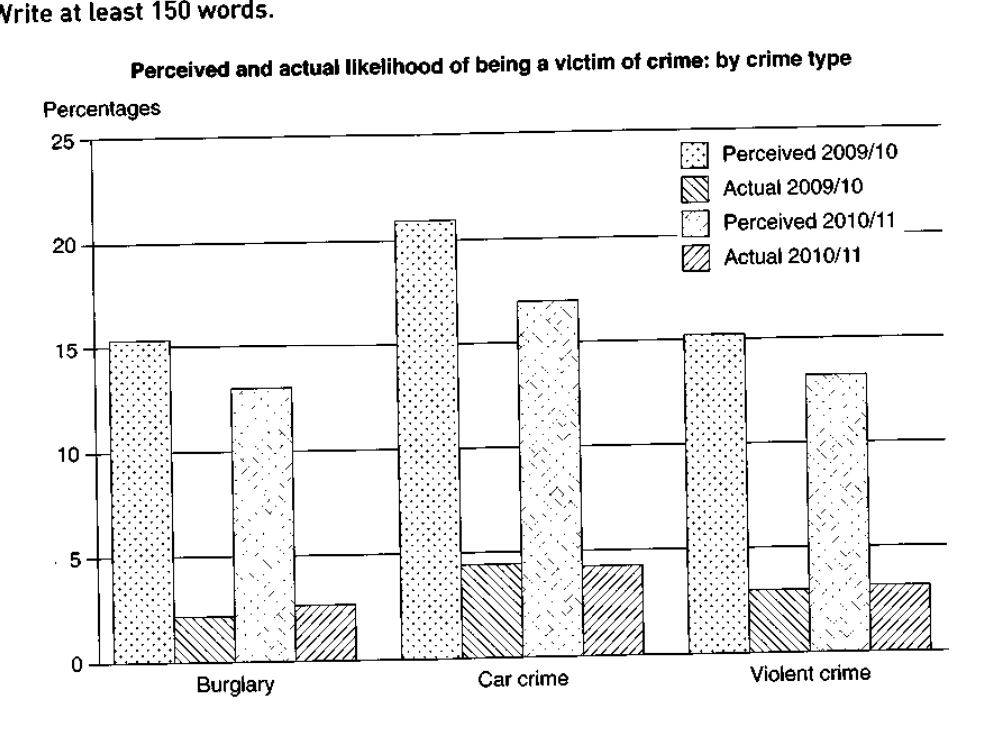
The graph below shows the perceived danger and actual likelihood of being a victim of crime.
Summarise the information by selecting and reporting the main features, and make comparisons where relevant.
Perceived and actual likelihood of being a victim of crime: by crime type
Student answer (Band 5.5)
The given line graph compares the perceived and actual likelihood of being a victim of three kinds of crimes.
Overall, the number of perceived car crime in these three types in 2009, 2010, and 2011 was significant. However, the perceived crimes of both the burglary and violent crime reamied the same in three years, while the actual number regarding likelihood of these crimes was a siginificant for the car crime.
Burglary and violent crimes perceived more than 15% in 2009 and 2010 and nearly 14% in 2010 and 2011. But the actual number was least significant overall which was between 2% to 3% in 2009 and 2010 for the burglary crime. The actual number for the violent crime stayed the same at 3% in the given three years.
Car crime showed an overall significant percentage that is 21% in 2009 and 2010 and nearly nearly 18% in 2010 and 2011 but the actual number remained the same at 4% that was a bit higher actual number than other two types of crimes.
AI examiner evaluation
| Criterion | Band |
|---|---|
| Task Achievement / Task Response | 5.5 |
| Coherence and Cohesion | 5.5 |
| Lexical Resource | 5.0 |
| Grammatical Range and Accuracy | 5.0 |
| Overall | 5.5 |
Task Achievement / Task Response: Band 5.5
You identify the chart’s central contrast: perceived risk is much higher than actual victimisation, and car crime has the highest figures. However, several details are inaccurate or unclear. The chart covers 2009/10 and 2010/11, not separate years 2009, 2010 and 2011; perceived burglary and violent crime do not remain unchanged, and actual violent crime rises from about 3% to 3.5%. The statement that actual car crime stayed at 4% also misses the chart’s approximate 4.5% in both periods. Your overview is relevant, but the comparisons are underdeveloped and some descriptions, such as “significant,” do not clearly report what the percentages show. Select the main trends accurately and compare both periods for each crime type.
Coherence and Cohesion: Band 5.5
The response has a recognisable structure, with an introduction, an overview and separate paragraphs for burglary/violent crime and car crime. This gives the reader some organisation. However, progression is not consistently clear because the time periods are repeatedly described as “2009 and 2010” or “2010 and 2011,” which obscures the chart’s two reporting periods. The overview also combines several claims without clearly distinguishing perceived from actual likelihood. Linking words such as “However” and “But” are used, but the comparisons they introduce are sometimes unclear or repetitive. Improve cohesion by grouping perceived figures together and actual figures together, or by comparing each crime across both periods in a consistent order, using precise references to the periods.
Lexical Resource: Band 5.0
You use some task-relevant vocabulary, including “perceived,” “actual,” “likelihood,” and “overall,” so the topic is generally understandable. However, the range is limited and several word choices or collocations are inaccurate, which makes parts of the report difficult to interpret. For example, “the number of perceived car crime … was significant” does not naturally describe a percentage, and “the actual number … was a significant for the car crime” is unclear. “Least significant” is also not an appropriate way to say that burglary had the lowest actual percentage. There are noticeable spelling errors, including “reamied” and “siginificant,” as well as repetition such as “nearly nearly.” Use precise terms such as “proportion,” “percentage,” “higher,” and “remained stable.”
Grammatical Range and Accuracy: Band 5.0
You attempt a mixture of simple and more complex sentences, including a contrast introduced by “while” and a relative clause in “that was a bit higher.” However, control is inconsistent, and errors in sentence structure, agreement and tense frequently affect clarity. For example, “the number of perceived car crime … was significant” has an awkward grammatical construction, while “the perceived crimes … remained the same” does not clearly express that the percentages stayed stable. The sentence beginning “Burglary and violent crimes perceived more than 15%” is missing a suitable verb construction, and “the actual number … which was between 2% to 3%” is not formed correctly. Practise clear comparison patterns, such as “The perceived figure for burglary fell from … to …,” and check articles, verb forms and sentence boundaries.
See this exact question answered at other band scores. The same prompt compared across bands.
Browse more IELTS Writing model answers or get your own writing scored by the same AI examiner.