Band 5.0 IELTS Writing Task 1 Model Answer
Overall Band Score: 5.0 · IELTS Summit Mastery · 2026-11-15
IELTS Writing Task 1 question
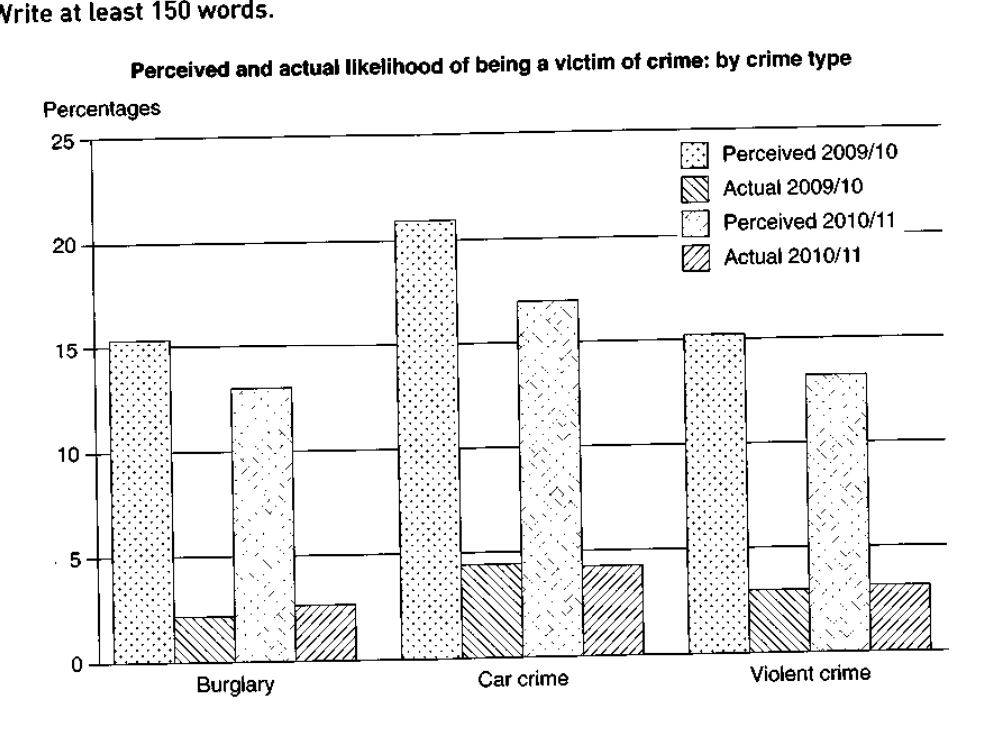
The graph below shows the perceived danger and actual likelihood of being a victim of crime.
Summarise the information by selecting and reporting the main features, and make comparisons where relevant.
Perceived and actual likelihood of being a victim of crime: by crime type
Student answer (Band 5.0)
The bar chart illustrates proportion of the precieved danger and actual likelihood of being a victim of crime.
Overall, The three type of crime showed a downward trend, Car crime had the highest sector of perceived 2009/10, while other type recorded the same percent, On the other hand burglary made up the lowest proportion of the actual 2009 and 2010.
In detail, Car crime recorded the largest peoportion in perceived 2009/10 about 21% the actual was only around 5%, In the perceived 2010/11 recorded about 13% but the actual showed simillar sevtor as the actial 2010/11.
Perceived 2009/10, Burglary and violent crime followed a similar trajectory, albeit at a less rate in the actual, Accounted for about 15% and approximately 13% in perceived 2010/11.However, burglary was around 2% in actual being the lowest proportion
AI examiner evaluation
| Criterion | Band |
|---|---|
| Task Achievement / Task Response | 5.0 |
| Coherence and Cohesion | 5.0 |
| Lexical Resource | 5.0 |
| Grammatical Range and Accuracy | 5.0 |
| Overall | 5.0 |
Task Achievement / Task Response: Band 5.0
You identify the chart’s subject and give a broad overview, noting that perceived figures are higher than actual ones and that car crime has the highest perceived level. You also include some relevant figures, such as about 21% for perceived car crime in 2009/10. However, the overview is unclear and partly inaccurate: the figures do not all show a downward trend, since actual rates rise slightly for burglary and violent crime, while car-crime actual likelihood stays level. Some comparisons are incomplete or confusing, particularly the statement about perceived car crime in 2010/11 and its actual figure. The response also contains 124 words, below the required 150; this limits the detail available to summarise the main features. Include clearer comparisons across both years and all crime types.
Coherence and Cohesion: Band 5.0
The response has a basic structure, moving from an introduction and overview to details, and it uses linking expressions such as “Overall,” “On the other hand,” and “However.” These help signal some relationships between points. However, progression is not consistently clear: the overview combines several comparisons in one sentence, and the detail paragraph shifts between years and crime types without a clear order. Phrases such as “the actual showed similar sector as the actual 2010/11” make the comparison difficult to follow, while the final sentence is incomplete in its connection to the preceding point. Organise the details systematically—for example, compare perceived and actual figures for each crime type across both years—and use references that make each comparison explicit.
Lexical Resource: Band 5.0
You use some relevant chart vocabulary, including “proportion,” “downward trend,” “highest,” and “lowest,” and you attempt to vary your wording with “recorded” and “made up.” However, the range is limited and several noticeable spelling and word-choice errors reduce clarity. Examples include “precieved,” “peoportion,” “simillar,” and “actial.” Some expressions are also unnatural or imprecise, such as “highest sector” and “at a less rate”; “sector” does not describe a percentage, and the latter phrase obscures the comparison. Aim for accurate, conventional language for describing data, such as “accounted for,” “stood at,” and “a lower figure.” Proofreading spelling and collocations would make your meaning more reliable.
Grammatical Range and Accuracy: Band 5.0
You attempt both simple and more complex sentence forms, including a contrast with “while” and a concessive clause beginning “albeit.” However, errors are frequent, and some sentences are difficult to interpret. For example, “Overall, The three type of crime showed…” has faulty capitalisation and plural agreement, while “In the perceived 2010/11 recorded…” lacks a clear subject and has an incomplete structure. The final detail also runs together after “2010/11.However,” and punctuation is inconsistent. Articles and sentence boundaries need attention as well. Build accurate sentences with a clear subject and verb first, then add comparisons using clauses such as “whereas” or “while.” Check agreement, capital letters, and spacing after full stops.
See this exact question answered at other band scores. The same prompt compared across bands.
Browse more IELTS Writing model answers or get your own writing scored by the same AI examiner.