Band 5.0 IELTS Writing Task 1 Model Answer
Overall Band Score: 5.0 · IELTS Summit Mastery · 2026-11-15
IELTS Writing Task 1 question
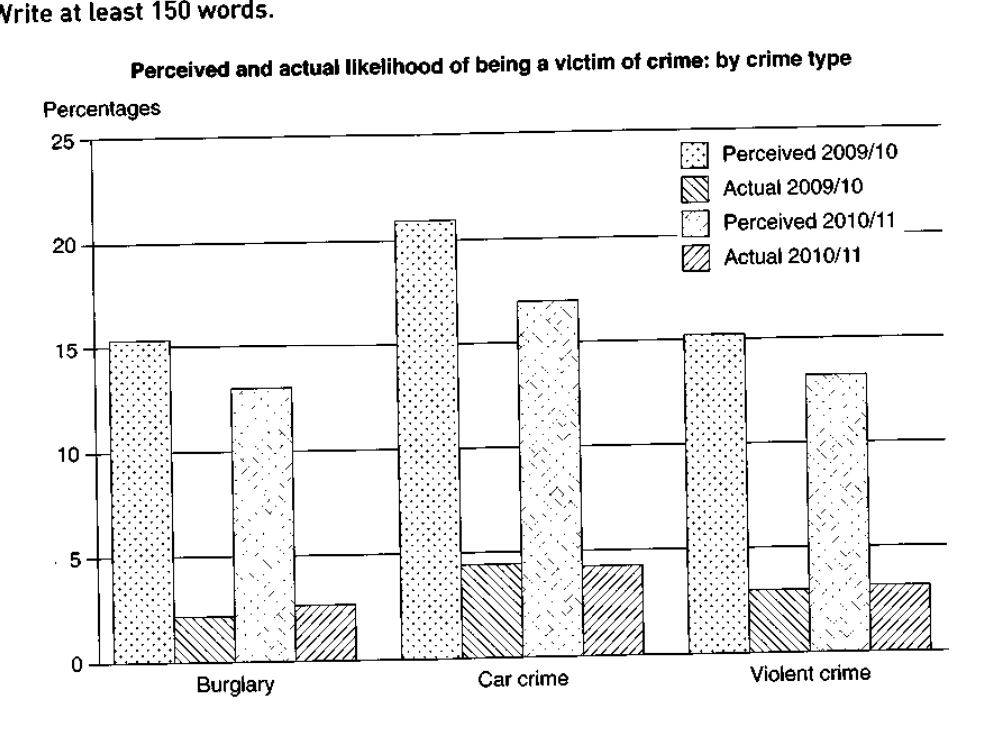
The graph below shows the perceived danger and actual likelihood of being a victim of crime.
Summarise the information by selecting and reporting the main features, and make comparisons where relevant.
Perceived and actual likelihood of being a victim of crime: by crime type
Student answer (Band 5.0)
The bar chart illustrates the proportion of perceived being in crime and the actual likelihood in two years 2009 and 20010.
Overall, The perceived being in crime recorded always the highest proportion in all the three types crime. The highest proportion of perceived recorded in car crime, other followed similar pattern, while the lowest actual acounted for burglary type. Whereas the actual remained almost stable for all three types of crime.
In detail, Perceived experienced a downward trend in all types, Car crime recorded about 21% and dclined slightly to about 16% in 2011, Burgalry and violent crime recorded about 15% and fell to around 13% in 2011.
The actual followed a similar trajectory, albeit at a less rate in burgalry, The last showed a slight change about 3,2% became 3,4% in 2011, While car crime and violent crime remained unchanged approximately 4% and 3% respectively in 2011.
AI examiner evaluation
| Criterion | Band |
|---|---|
| Task Achievement / Task Response | 5.0 |
| Coherence and Cohesion | 5.5 |
| Lexical Resource | 5.0 |
| Grammatical Range and Accuracy | 5.0 |
| Overall | 5.0 |
Task Achievement / Task Response: Band 5.0
You identify the main contrast: perceived risk is higher than actual victimisation across all three crime types, and car crime has the highest perceived figure. You also report the broad decline in perceived figures. However, some details are inaccurate or unclear: burglary and violent crime are not both about 15% in 2009/10 (violent crime is approximately 15.5%, while burglary is also around that level, so this is broadly acceptable), but the actual figures are misreported as largely unchanged. In particular, car crime stays near 4.5%, while burglary rises slightly from about 2% to 2.5% and violent crime from 3% to 3.5%. The overview is limited, and the response is two words below the required minimum. Include clearer, accurate comparisons of both years’ actual data.
Coherence and Cohesion: Band 5.5
The response has a recognisable structure, with an overview followed by details about perceived and actual crime, and the reader can generally follow the intended comparisons. However, progression within paragraphs is weakened by unclear phrasing and punctuation, such as “The actual followed a similar trajectory, albeit at a less rate in burgalry, The last showed…” The reference “The last” is difficult to identify, and the contrast introduced by “Whereas” in the overview is not smoothly connected to the preceding sentence. Some linking words, including “while” and “whereas,” are used mechanically or with awkward punctuation. Organise the details into clearer comparisons by crime type or by year, and use explicit references such as “the actual burglary rate” rather than “the last.”
Lexical Resource: Band 5.0
You use some relevant task vocabulary, including “proportion,” “downward trend,” “recorded,” and “remained stable,” which helps communicate the chart’s general patterns. However, the range is limited and several word choices or forms are inaccurate, making parts of the report difficult to interpret. For example, “perceived being in crime” does not clearly express perceived risk of victimisation, and “at a less rate” is not an appropriate collocation. There are also noticeable spelling errors, including “dclined,” “Burgalry,” and “acounted.” Use precise chart language consistently, such as “perceived likelihood,” “actual victimisation rate,” and “declined,” and check spelling before submitting.
Grammatical Range and Accuracy: Band 5.0
You attempt both simple statements and longer comparisons, for example, “Car crime recorded about 21% and dclined slightly…” and “The actual followed a similar trajectory, albeit…”. However, the longer constructions are often faulty, and sentence boundaries and punctuation are inconsistent. The opening phrase “the proportion of perceived being in crime” lacks a clear grammatical structure, while “The highest proportion of perceived recorded…” is missing a clear subject or noun phrase. Capitalisation after commas and full stops is also inconsistent, as in “burglary, The last…” Aim for complete, controlled sentences: state the subject, use a suitable verb, and separate related comparisons with full stops or semicolons. These recurring errors sometimes make the intended meaning hard to follow.
See this exact question answered at other band scores. The same prompt compared across bands.
Browse more IELTS Writing model answers or get your own writing scored by the same AI examiner.