Band 5.5 IELTS Writing Task 1 Model Answer
Overall Band Score: 5.5 · IELTS Summit Mastery · 2026-11-16
IELTS Writing Task 1 question
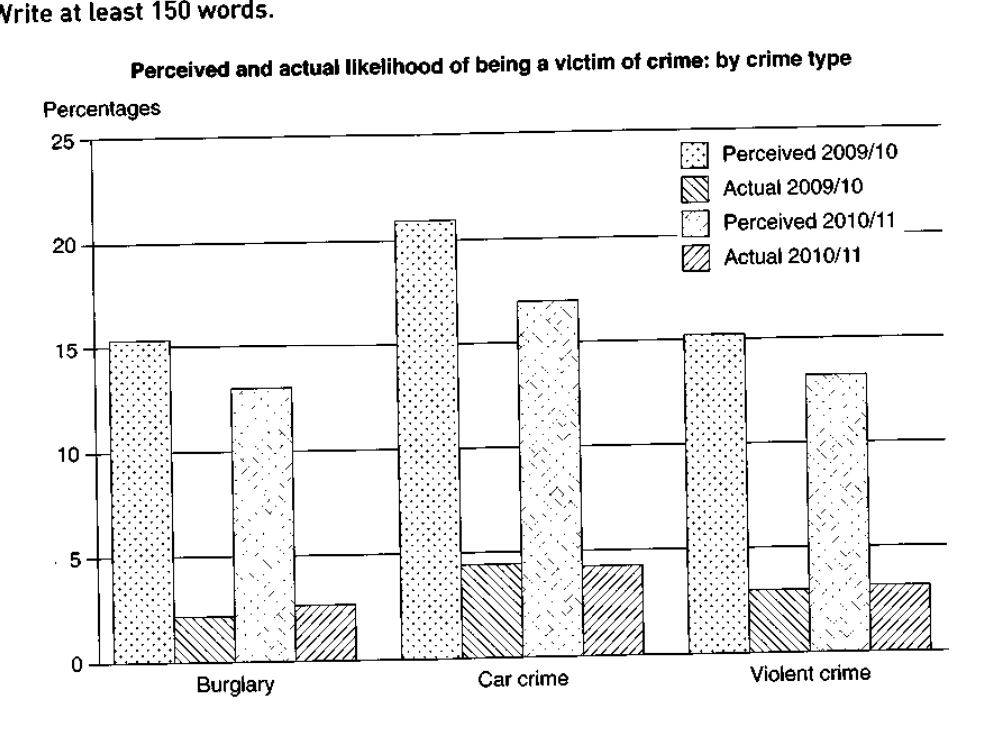
The graph below shows the perceived danger and actual likelihood of being a victim of crime.
Summarise the information by selecting and reporting the main features, and make comparisons where relevant.
Perceived and actual likelihood of being a victim of crime: by crime type
Student answer (Band 5.5)
The bar graph illustrate the proportion victim of crime like burglary, car crime ,violent crime in year 2009 to 2011 it also shows comperison between percieved and actual victims over the same year.
overall, the chat shows the number of actual victims are almost one forth of the percieved victims .people who had faced car crime are highest in number while burglary and violent crime had least affected the people .
victims who percieved car crime are highest in proportion at more then 20 percent in year 2009-10 and maintains the same position in next year .while people facing burglary and violent crime are on the same page with about 15 % in year 2009 -10 and almost 13% in 2010-11.
On the other hand proportion of actual victims who went through car crime are about 5%.while actual victim of burglary and violent crime are less then 5%.
AI examiner evaluation
| Criterion | Band |
|---|---|
| Task Achievement / Task Response | 5.5 |
| Coherence and Cohesion | 6.0 |
| Lexical Resource | 5.0 |
| Grammatical Range and Accuracy | 5.0 |
| Overall | 5.5 |
Task Achievement / Task Response: Band 5.5
You identify the main comparison: perceived risk is much higher than actual victimisation, and car crime is highest in both measures. You also report the broad perceived figures and note that actual rates are below 5%. However, the overview is imprecise: “almost one forth” is not a reliable summary of the gap, and “people who had faced car crime” confuses perceived likelihood with actual victims. The response also omits the small year-to-year changes in actual rates and does not clearly compare the two years across all categories. Some figures are broadly accurate, but the description is limited and occasionally unclear. The response is 148 words, two words below the required minimum; use the space to add a concise, accurate comparison.
Coherence and Cohesion: Band 6.0
The response has a recognisable progression: an introduction, an overall statement, perceived figures, and then actual figures. This makes the main categories of information reasonably easy to follow. Linking words such as “overall” and “on the other hand” help signal the shift between the overview and the detailed comparison. However, the paragraphing is not clearly developed, and some links are mechanical or unclear. For example, “maintains the same position in next year” does not specify what remains the same, while the final sentence gives a broad comparison without connecting it to the earlier year-by-year account. Organise the details into clearer groups and use references that make the comparisons explicit.
Lexical Resource: Band 5.0
You use some relevant task vocabulary, including “proportion,” “actual victims,” “perceived,” and “highest,” so the reader can identify the topic and the main comparisons. However, the range is limited and several word choices or collocations are inaccurate, such as “people who had faced car crime,” “on the same page,” and “least affected the people.” These expressions make the distinction between perceived risk and actual victimisation less precise. Spelling errors, including “comperison,” “percieved,” and “chat” for “chart,” are also noticeable. Aim for standard chart-reporting language and check spelling carefully; precise terms such as “estimated risk,” “recorded victimisation,” and “percentage” would improve clarity.
Grammatical Range and Accuracy: Band 5.0
The response mainly uses simple statements and attempts a few longer sentences, for example the sentence beginning “victims who percieved car crime…” and the contrast introduced by “On the other hand.” However, control is inconsistent. The opening has a subject–verb agreement error (“graph illustrate”), and several sentences lack necessary articles or have unclear sentence boundaries, as in “overall, the chat shows the number of actual victims are…” Capitalisation and punctuation are also unreliable, with sentences beginning in lower case and spaces missing after full stops. These errors sometimes make relationships between ideas difficult to follow. Practise accurate simple sentence patterns first, then add complex clauses while checking agreement, articles, and punctuation.
See this exact question answered at other band scores. The same prompt compared across bands.
Browse more IELTS Writing model answers or get your own writing scored by the same AI examiner.