Band 6.0 IELTS Writing Task 1 Model Answer
Overall Band Score: 6.0 · IELTS Summit Mastery · 2026-11-18
IELTS Writing Task 1 question
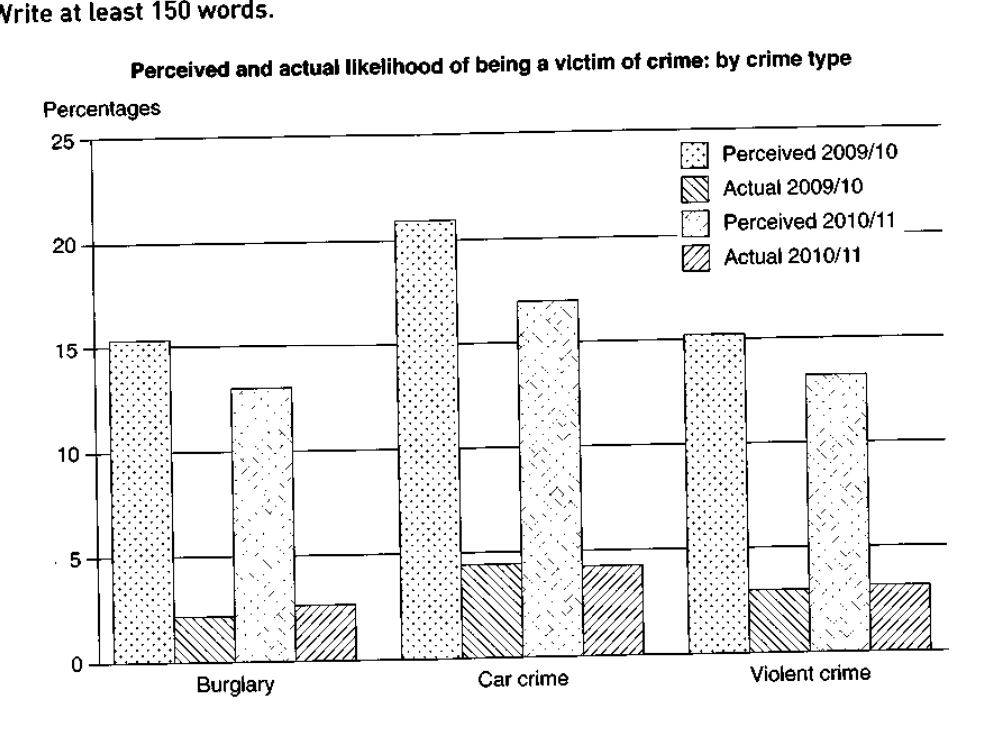
The graph below shows the perceived danger and actual likelihood of being a victim of crime.
Summarise the information by selecting and reporting the main features, and make comparisons where relevant.
Perceived and actual likelihood of being a victim of crime: by crime type
Student answer (Band 6.0)
The graph illustrates the comparision of propotion between the risk of being the victim to a crime to the crime actually taking place in that year. It highlights three crimes burglary, car crime and violent crime across 2 years 2009 and 2010.
Overall, it highlights that the probablity of car cime is highest compared to the rest of them. Across all three crimes and in both years the likelihood of being a vicitim of a crime is higher compared to the crime actually happening in the real life. Additionally, the likelihood across all three crimes is higher in 2009 as compared to 2010.
In 2009 the highest percieved crime is car crime at around 20%, which is far higher compared to its reality of approximetly below 5%. Similar pattern is observed in burglary and violent crime as they both have the precieved percentage of the crime at around 15%. However, in reality violent crime is higher in percentage than Burglary in that year.
In 2010, violent crimes likelihood is marginally higher than of bulglary. Consequently, it is also seen in reality as the percentage of violent crime is little higher than that of bulgarly, which does resonate with the prediction.
AI examiner evaluation
| Criterion | Band |
|---|---|
| Task Achievement / Task Response | 6.5 |
| Coherence and Cohesion | 6.5 |
| Lexical Resource | 5.5 |
| Grammatical Range and Accuracy | 6.0 |
| Overall | 6.0 |
Task Achievement / Task Response: Band 6.5
The response identifies the main pattern: perceived risk is much higher than actual victimisation, car crime is highest, and perceived figures generally fall in the later year. It also makes relevant comparisons between burglary and violent crime. These points address the task, but some are not fully developed or precise. For example, the overview says likelihood is higher in 2009 across all crimes, although actual figures rise slightly in 2010 for burglary and violent crime, while car crime is unchanged. The final paragraph gives no figures for 2010 and does not mention the fall in perceived car crime from about 21% to 17%. To strengthen the response, report the key changes across both years and distinguish perceived risk from actual rates consistently.
Coherence and Cohesion: Band 6.5
The response has a clear overall structure, moving from an introduction and overview to comparisons for each year. Paragraphing helps the reader follow the main points, and linking expressions such as “Overall,” “However,” and “Additionally” make relationships between ideas visible. This provides coherent organisation, though progression is not always fully controlled. The overview’s claim that likelihood is higher in 2009 across all crimes conflicts with the later-year increases in actual burglary and violent crime, and the final paragraph is brief compared with the 2009 discussion. Some references, such as “its reality” and “the prediction,” are also not fully clear. Organise the body around the two measures or the changes between years, and use explicit labels to clarify each comparison.
Lexical Resource: Band 5.5
The response uses relevant task vocabulary, including “perceived,” “likelihood,” “percentage,” and “approximately,” and it attempts to describe comparisons with phrases such as “marginally higher.” However, spelling errors are noticeable, including “comparision,” “propotion,” “probablity,” “vicitim,” and “bulgarly.” Some word combinations are also unnatural or imprecise: “the victim to a crime,” “crime actually taking place,” and “its reality” make the meaning less fluent. Repetition of “crime” and “percentage” limits flexibility. Aim for accurate, conventional collocations such as “risk of becoming a victim,” “actual crime rate,” and “the proportion who perceived a risk.” Proofreading spelling and choosing precise terms for the two measures would improve clarity.
Grammatical Range and Accuracy: Band 6.0
There is a mix of simple and more complex sentence forms, including the contrast in “However, in reality violent crime is higher in percentage than Burglary in that year.” Most sentences communicate the intended comparisons, and errors do not generally prevent understanding. Some grammatical patterns are nevertheless awkward or inaccurate. For example, “the comparision of propotion between the risk … to the crime” has an unclear comparison structure, while “Across all three crimes and in both years the likelihood … is higher compared to the crime actually happening” does not clearly express what is being compared. The sentence beginning “In 2010, violent crimes likelihood” also needs a possessive form or a different construction. Use direct structures such as “The perceived risk was higher than the actual rate,” and check articles, possessives, and comparison patterns.
See this exact question answered at other band scores. The same prompt compared across bands.
Browse more IELTS Writing model answers or get your own writing scored by the same AI examiner.