Band 4.0 IELTS Writing Task 1 Model Answer
Overall Band Score: 4.0 · IELTS Summit Mastery · 2026-11-19
IELTS Writing Task 1 question
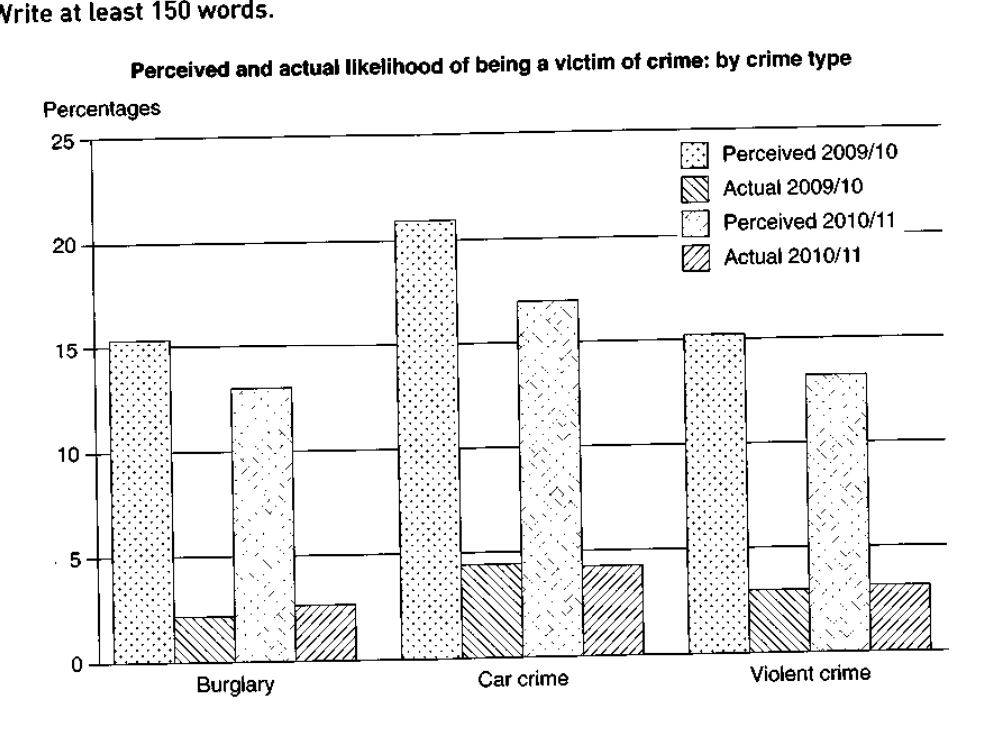
The graph below shows the perceived danger and actual likelihood of being a victim of crime.
Summarise the information by selecting and reporting the main features, and make comparisons where relevant.
Perceived and actual likelihood of being a victim of crime: by crime type
Student answer (Band 4.0)
the bar chart illustrates the results of becoming a victime of crime .
Overall , the precived in the crime was to hight camparing with the actual , the most predicted crime was the car crime marked with the highest point and the lowest with burgalary .
In 2009 /2010 the
AI examiner evaluation
| Criterion | Band |
|---|---|
| Task Achievement / Task Response | 3.0 |
| Coherence and Cohesion | 3.5 |
| Lexical Resource | 4.5 |
| Grammatical Range and Accuracy | 4.5 |
| Overall | 4.0 |
Task Achievement / Task Response: Band 3.0
The response identifies the chart’s subject and gives a relevant overall comparison: perceived risk was higher than actual victimisation, and car crime was perceived as the greatest risk. These points are supported by the chart. However, the account stops after “In 2009 /2010 the” and therefore does not report the main figures, compare the two periods, or describe actual crime rates. The overview is also incomplete: burglary, rather than car crime, had the lowest perceived figure, but this is not developed with accurate detail. The response is 51 words, below the required 150, leaving the task substantially unfinished. To improve, complete the comparison across all three crime types and both years, using selected figures and a clear overview.
Coherence and Cohesion: Band 3.5
There is a basic attempt to organise the response: an opening sentence is followed by an overview, and “Overall” signals a summary point. The ideas that are present are broadly related to the chart. However, the response has no developed progression because it ends with the incomplete phrase “In 2009 /2010 the”. There are no paragraphs or linking expressions to guide the reader through comparisons between crime types and years. The spacing around punctuation also interrupts the flow. A clearer structure would use an introduction, a concise overview, and one or two paragraphs grouping the figures—for example, perceived likelihood first and actual likelihood second—with comparisons expressed in complete sentences.
Lexical Resource: Band 4.5
The response uses a small set of relevant terms, including “bar chart”, “crime”, “actual”, “predicted”, “highest” and “lowest”, so the general topic is understandable. However, the vocabulary is very limited and some choices are inaccurate or unnatural: “the perceived in the crime” does not clearly express perceived likelihood, while “the most predicted crime” is not an appropriate description of the chart. Several spelling errors, including “victime”, “precived”, “hight” and “burgalary”, reduce clarity and control. Use the chart’s key terms consistently, such as “perceived likelihood” and “actual likelihood”, and choose precise comparison language such as “highest proportion” or “lowest figure”. Proofreading spelling would also make the intended meaning easier to follow.
Grammatical Range and Accuracy: Band 4.5
The response attempts simple statements and an overview sentence, but the range is narrow and the final sentence is unfinished: “In 2009 /2010 the” has no completed clause. The sentence beginning “Overall” also has an unclear grammatical structure, particularly “the perceived in the crime was to hight camparing with the actual”. This makes the comparison difficult to interpret. There is some basic sentence punctuation, but spacing before commas and the full stop is inconsistent. To improve, write complete sentences with a clear subject and verb, for example, “Perceived risk was higher than actual victimisation in both years.” Then use a consistent past-tense form to report the chart’s figures and check punctuation and sentence boundaries.
See this exact question answered at other band scores. The same prompt compared across bands.
Browse more IELTS Writing model answers or get your own writing scored by the same AI examiner.