Band 5.0 IELTS Writing Task 1 Model Answer
Overall Band Score: 5.0 · IELTS Summit Mastery · 2026-11-19
IELTS Writing Task 1 question
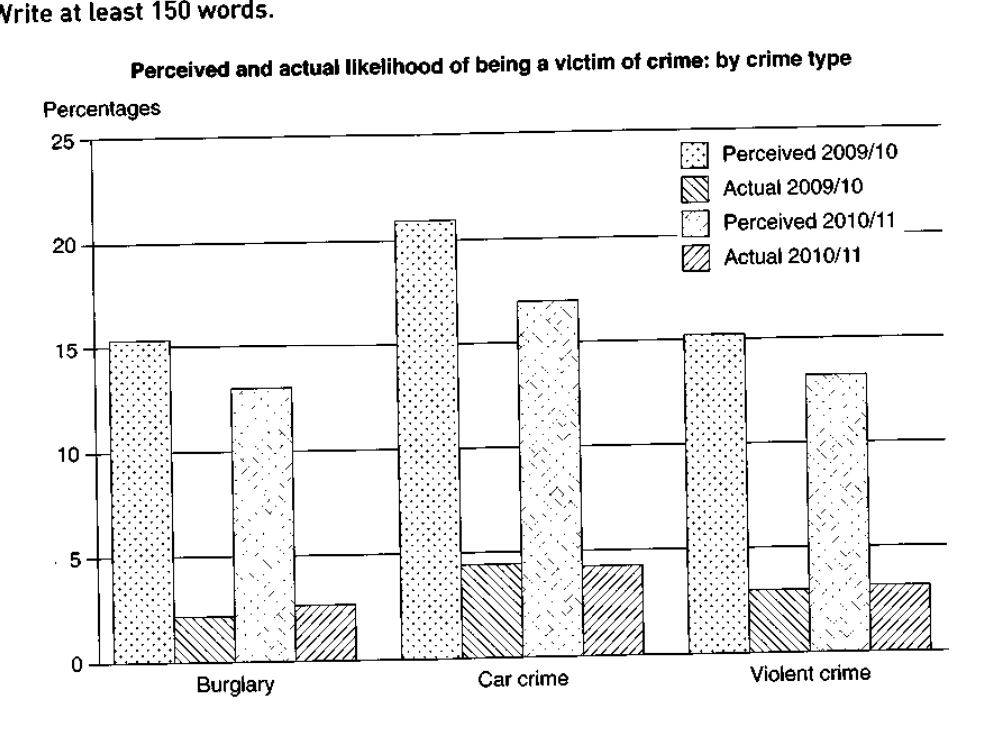
The graph below shows the perceived danger and actual likelihood of being a victim of crime.
Summarise the information by selecting and reporting the main features, and make comparisons where relevant.
Perceived and actual likelihood of being a victim of crime: by crime type
Student answer (Band 5.0)
The given chart illustrates the realised danger and actual chance of being victim of crime.Moreover, it contain different types with percentage from 2009 to 2011.
Firstly, The burglary and violent crime considered percentage of both was same that was fifteen percent from 2009 to 2010. Moreover, the real crime percentage of burglary and violent crime. The percentage was very low that was 2 percent from 2009 to 2010.On the other hand, The viewed of voilent and burglary crime percentaage of both year was same that was thirteen percent from 2010 to 2011. while, The true of burglary and violent crime percentage of both year was same that was three percent.
Secondly, the percentage of perceived car crime from 2009 to2010 was touch to peak that was twenty percent. while the real crime by car percentage was four percent.Moreover, The real crime percentage of both years was same that was four percent and in the regarded year the percentage was 17 percent.
In the overall, the car crime regarded percentage was touch to the peak while the burglary and violent crime percentages was same
AI examiner evaluation
| Criterion | Band |
|---|---|
| Task Achievement / Task Response | 5.0 |
| Coherence and Cohesion | 5.5 |
| Lexical Resource | 4.5 |
| Grammatical Range and Accuracy | 5.0 |
| Overall | 5.0 |
Task Achievement / Task Response: Band 5.0
You identify the chart’s main categories and make relevant comparisons, including that perceived car crime is highest and that actual crime figures are much lower. However, the account is only partially accurate and the overview is unclear. For example, you report perceived burglary and violent crime as 15% in 2009/10, which is close, but give both as 13% in 2010/11; the chart shows about 13% for burglary and 13.5% for violent crime. You also say actual car crime was 4% in both years, while it is approximately 4.5% in each. The final overview says burglary and violent-crime percentages were the same without specifying perceived or actual figures. Select the main contrasts accurately and summarise them clearly.
Coherence and Cohesion: Band 5.5
The response has a basic structure, with an opening, two body sections introduced by “Firstly” and “Secondly,” and a concluding overview. This gives the reader some sense of organisation. However, progression within the paragraphs is difficult to follow because comparisons are repeated or left incomplete. For instance, “the real crime percentage of burglary and violent crime” is followed by a fragment-like explanation, and “Moreover” and “while” do not always connect the ideas clearly. The overview also repeats the car-crime point rather than bringing together the key contrast between perceived and actual likelihood. Grouping the figures by year or by perceived versus actual rates, and using clearer links between complete comparisons, would improve cohesion.
Lexical Resource: Band 4.5
You use some task-related vocabulary, such as “percentage,” “perceived,” and “actual,” so the reader can recognise the subject. However, the range is limited and several word choices or collocations are inaccurate, sometimes making the meaning unclear. “Realised danger” does not express perceived risk, while “the viewed of voilent and burglary crime” is difficult to interpret. Phrases such as “touch to peak” and “regarded percentage” are not natural ways to describe chart values. Spelling errors, including “voilent” and “percentaage,” also reduce precision. Build a small set of accurate chart-description expressions—such as “was highest,” “stood at,” and “declined”—and use them consistently with the correct crime categories.
Grammatical Range and Accuracy: Band 5.0
You attempt to form longer sentences and use linking words, but the range of sentence structures is limited, and errors occur frequently enough to make some comparisons hard to follow. For example, “it contain different types” has subject–verb disagreement, while “the burglary and violent crime considered percentage of both was same” lacks a clear grammatical structure. Articles and sentence boundaries are also problematic, as in “being victim of crime.Moreover,” and several clauses beginning with “while” are not properly attached to a complete sentence. Practise writing short, complete comparison sentences first, then combine them with accurate clauses—for example, “Perceived burglary fell from about 15.5% to 13%, whereas the actual rate rose slightly.”
See this exact question answered at other band scores. The same prompt compared across bands.
Browse more IELTS Writing model answers or get your own writing scored by the same AI examiner.