Band 5.0 IELTS Writing Task 1 Model Answer
Overall Band Score: 5.0 · IELTS Summit Mastery · 2026-11-19
IELTS Writing Task 1 question
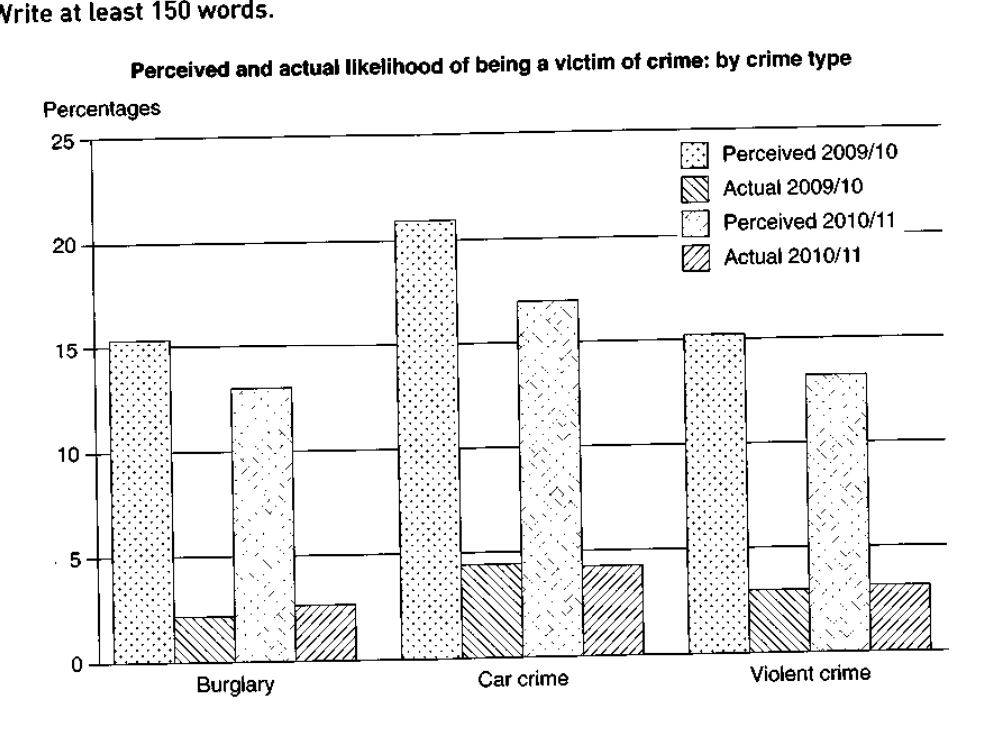
The graph below shows the perceived danger and actual likelihood of being a victim of crime.
Summarise the information by selecting and reporting the main features, and make comparisons where relevant.
Perceived and actual likelihood of being a victim of crime: by crime type
Student answer (Band 5.0)
The provided bar chart illustrates the perceived danger and actual likelihood of being a victim of crime.
Overall, it is clear that perceived figure was by far the higher among all catagories more than actual percentages. While car crime was perceived highly than actual.
In 2009, over 15% figure was perceived for burglary. However, actual ratio was under 3%.
For car crime, actual ratio accounted for the lower around 4% than its perception over 20%. Simultaneously, perception figure declined for violent crime just over 15%, Although actual crime was at 3%.
In 2010,while under 13% ratio was for burglary, actual likelihood still remained almost 3%. Although, perception figure rose at 17% for car crime but stood at 4%. In 2011, actual likelihood reached at over 3% whereas it was perceived approximately 14%. Noticeably, perceived figur for violent crime accounted for the lower percentage compared with car crime.
While, actual crime was significantly less percentage where its perceived was at higher level for car crime.
AI examiner evaluation
| Criterion | Band |
|---|---|
| Task Achievement / Task Response | 5.5 |
| Coherence and Cohesion | 4.5 |
| Lexical Resource | 5.5 |
| Grammatical Range and Accuracy | 5.0 |
| Overall | 5.0 |
Task Achievement / Task Response: Band 5.5
You identify the chart’s central contrast: perceived risk is much higher than actual victimisation for all three crime types, and car crime has the highest perceived figure. You also include several relevant comparisons, such as perceived car crime falling from just over 20% to about 17%, while its actual rate stays around 4.5%. However, the overview is brief and does not clearly summarise the overall changes across both years. Some details are unclear or inaccurate: the 2010/11 perceived burglary figure is about 13%, not “under 13%,” and the final reference to violent crime in 2011 is difficult to interpret. The response therefore covers the task only partially, with key information present but not consistently clear or well selected.
Coherence and Cohesion: Band 4.5
The response has a basic overall structure, beginning with an introduction and overview before moving through crime types and years. Time markers such as “In 2009” and “In 2010” help the reader follow the comparisons. However, progression is uneven: the account shifts between crime types and years, then returns to car crime in the final sentence, which repeats an earlier point rather than completing the summary. Several linking words are used inaccurately or mechanically, including “Although” at the start of statements that do not form complete contrasts and “While,” at the beginning of the final sentence. Group the information consistently by year or crime type, and use fewer, more precise links to make the relationships between figures clear.
Lexical Resource: Band 5.5
You attempt a range of chart-related vocabulary, including “perceived,” “actual likelihood,” “declined,” and “accounted for,” and the main topic remains understandable. However, word choice and collocation are often unnatural or imprecise, as in “perceived highly than actual,” “actual ratio,” and “perception figure rose at 17%.” There are also spelling errors, notably “catagories” and “figur.” Repeated use of “figure,” “ratio,” and “actual” limits precision, while some phrases make comparisons difficult to interpret. Use standard reporting language such as “the perceived risk was higher,” “the actual rate stood at,” and “fell to,” and check spelling and word forms carefully.
Grammatical Range and Accuracy: Band 5.0
You use some simple sentences and attempt more complex forms, including clauses beginning with “While” and “Although.” However, these attempts are often faulty: “Although actual crime was at 3%” is a dependent clause left without a main clause, and “While, actual crime…” has incorrect punctuation and an incomplete construction. Other errors include missing articles in “perceived figure,” awkward tense and preposition patterns in “perception figure rose at 17%,” and inconsistent punctuation, such as the extra space before “Although.” These problems sometimes make the intended comparison hard to follow. Build accurate simple sentences first, then combine them with correctly formed contrast clauses and consistent past-tense reporting.
See this exact question answered at other band scores. The same prompt compared across bands.
Browse more IELTS Writing model answers or get your own writing scored by the same AI examiner.