Band 5.0 IELTS Writing Task 1 Model Answer
Overall Band Score: 5.0 · IELTS Summit Mastery · 2026-11-19
IELTS Writing Task 1 question
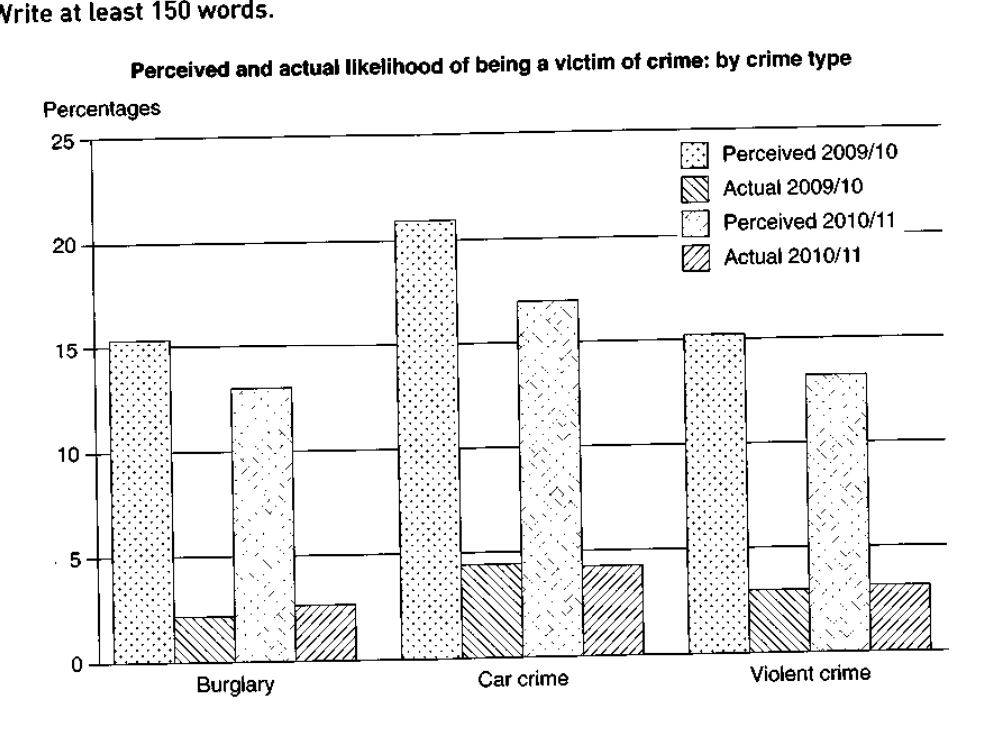
The graph below shows the perceived danger and actual likelihood of being a victim of crime.
Summarise the information by selecting and reporting the main features, and make comparisons where relevant.
Perceived and actual likelihood of being a victim of crime: by crime type
Student answer (Band 5.0)
The table illustrates the difference between perceived and actual crime rate.
Overall, the perceived car crime was maximum in 2009/10 along with that the minimum crime was actual burglary in 2009/10.
Commencing with the table, the perceived crime was the highest, its about 21% however, the actual crime was aproximately 5%, whereas in 2010/11 the perceived crime was slightly fall as compare to past year. The other was bulglary crime initially, in 2009/10 the ratio of perceived crime was aproximately 15%, furthermore the actual crime was very lowest. In year 2010/11, the actual crime was slightly lower as contast with car crime, whereas perceived crime rate was same as voilent crime in 2010/11.
In voilent crime, the ratio of perceived crime was same as bulglary crime morever, the percentage of actual crime was dramtic fell as compare to perceived crime in 2009/10. In addition to the ratio of perceived and acctual crime in 2009/10 and 2010/11 is 14% almost and 3% almost.
AI examiner evaluation
| Criterion | Band |
|---|---|
| Task Achievement / Task Response | 5.5 |
| Coherence and Cohesion | 5.0 |
| Lexical Resource | 5.0 |
| Grammatical Range and Accuracy | 5.0 |
| Overall | 5.0 |
Task Achievement / Task Response: Band 5.5
You identify the chart’s central contrast between perceived and actual crime, and your overview correctly notes that perceived car crime was highest in 2009/10 while actual burglary was lowest. You also make relevant comparisons across the three crime types. However, several details are unclear or inaccurate: actual burglary was about 2% in 2009/10 and 2.5% in 2010/11, so it was not the lowest in both years; perceived figures generally fell, while actual figures rose slightly or stayed level. The final statement that violent crime was “14% almost and 3% almost” does not clearly distinguish the two years. To make the summary more complete, report the main overall pattern and give clearer, accurate comparisons for both years.
Coherence and Cohesion: Band 5.0
The response has an opening, an overview, and paragraphs that attempt to cover the crime categories, so there is some organisation. However, the progression is difficult to follow because comparisons shift between categories and years without a consistent structure. For example, the burglary paragraph moves from 2009/10 to 2010/11 and then compares perceived burglary with violent crime, while the final paragraph repeats some information without clearly stating which year each figure refers to. Linking phrases such as “furthermore,” “whereas,” and “in addition” are used, but they do not always clarify the relationship between ideas. Group the perceived figures together and the actual figures together, or compare each crime type across both years, and use explicit year references.
Lexical Resource: Band 5.0
You use some relevant chart vocabulary, including “perceived,” “actual,” “percentage,” and “ratio,” and you attempt to describe comparisons with phrases such as “slightly fall” and “as compare to.” However, the range is limited and several word choices or collocations are inaccurate, which sometimes makes the meaning hard to follow. “Crime rate” is not the clearest label for the chart’s percentages of people at risk, and “the actual crime was very lowest” is awkward. There are also noticeable spelling errors, including “aproximately,” “bulglary,” “voilent,” and “dramtic.” Use precise terms such as “perceived likelihood,” “actual likelihood,” and “proportion,” and check spelling and common comparison phrases.
Grammatical Range and Accuracy: Band 5.0
You attempt to combine ideas in longer sentences using “whereas” and “in addition,” but these complex structures are often faulty, and sentence control is inconsistent. For example, “the perceived crime was the highest, its about 21%” joins clauses incorrectly and uses an unsuitable verb form; “the perceived crime was slightly fall” also has an incorrect verb form. In “the ratio of perceived and acctual crime in 2009/10 and 2010/11 is 14% almost and 3% almost,” the subject–verb agreement and sentence structure are unclear. Some basic meaning remains understandable, but these recurring errors can make comparisons difficult to interpret. Practise accurate past-tense reporting and build shorter, complete sentences before combining them.
See this exact question answered at other band scores. The same prompt compared across bands.
Browse more IELTS Writing model answers or get your own writing scored by the same AI examiner.