Band 6.0 IELTS Writing Task 1 Model Answer
Overall Band Score: 6.0 · IELTS Summit Mastery · 2026-11-22
IELTS Writing Task 1 question
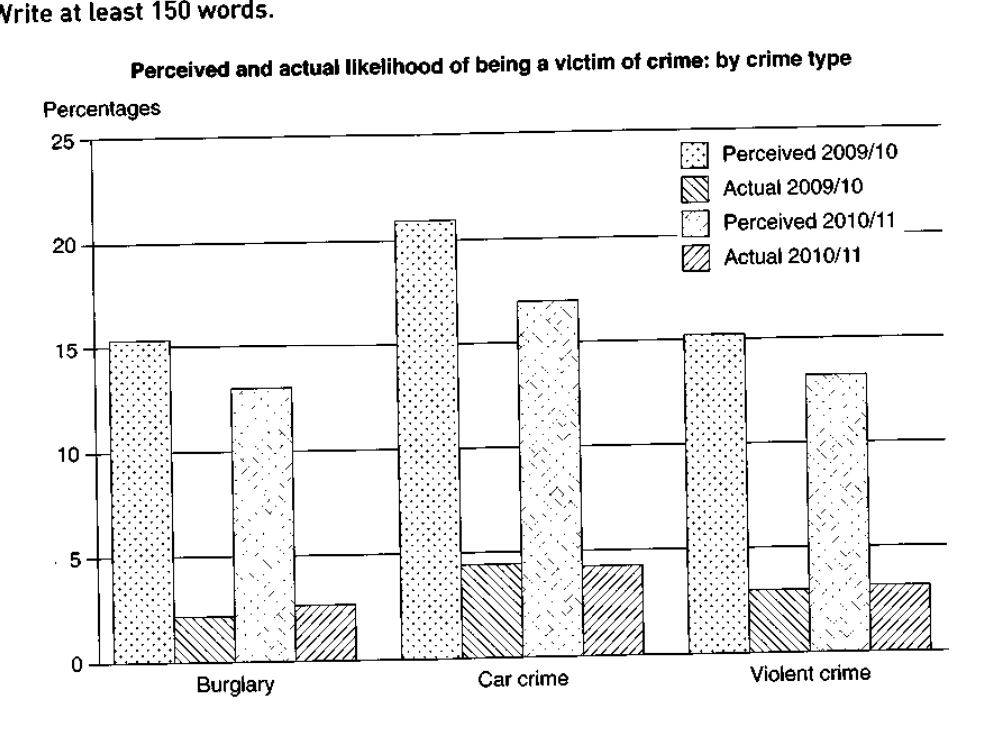
The graph below shows the perceived danger and actual likelihood of being a victim of crime.
Summarise the information by selecting and reporting the main features, and make comparisons where relevant.
Perceived and actual likelihood of being a victim of crime: by crime type
Student answer (Band 6.0)
The illustration shows a comparison between prediction and truth. It differenciates between perceived and actual crime in two years.
Overall, It is obvious that perceived danger was always more than actual crime. Also, the highest number of crime is related to cars.
In the case of Burglary, It was perceived to be just above 15% but the actual crime is just around 3% in the 2009/10 year. In the following year, the perceived crime decreased but the actual crime slightly increased. Car crime holds the highest place in both perceived and actual crime. The highest perceived crime in 2009/10 and 2010/11 is above 20% and around 17% respectively. The actual crime was similar at around 4% for both the years. Violent crime was perceived at 15 % in 2009/10 and around 13% in 2010/11. The actual likelihood of this crime was exactly the same in both 2009/10 and 2010/11 at almost 3%. It is a good sign that actual crime is far less than predicted crime rate.
AI examiner evaluation
| Criterion | Band |
|---|---|
| Task Achievement / Task Response | 6.5 |
| Coherence and Cohesion | 6.0 |
| Lexical Resource | 5.5 |
| Grammatical Range and Accuracy | 5.5 |
| Overall | 6.0 |
Task Achievement / Task Response: Band 6.5
You provide a clear overview of the main contrast: perceived likelihood is much higher than actual likelihood, and car crime is highest in both measures. You also cover all three crime types and both years, with several relevant figures. Most comparisons are broadly accurate, but some details are imprecise: burglary’s actual rate was about 2% in 2009/10, rather than around 3%, and violent crime’s actual likelihood rose slightly from about 3% to 3.5%, rather than staying exactly the same. The closing comment that this is “a good sign” adds an opinion rather than reporting the chart. The response meets the task well overall, but more precise reporting and a fully objective ending would strengthen it further.
Coherence and Cohesion: Band 6.0
The response has a coherent overall arrangement: an introduction, an overview, and a paragraph comparing the three crime categories. The sequence from burglary to car crime and violent crime is easy to follow, and phrases such as “In the following year” help signal change over time. However, the body reads somewhat like a list, with limited grouping of related comparisons. Repeated use of “actual crime” and “perceived crime” also makes the progression mechanical, while “It” in “It is a good sign” shifts away from the chart description. Grouping the two perceived figures together and then the actual figures, or using clearer comparison links, would make the relationships between data points more explicit.
Lexical Resource: Band 5.5
You use enough vocabulary to describe the chart, including “comparison,” “decreased,” “slightly increased,” and “likelihood.” However, several choices are imprecise or unnatural for this task. “Prediction and truth” does not accurately describe perceived and actual likelihood, and “the highest number of crime is related to cars” is an awkward way to report percentages. “Holds the highest place” is also an unnatural collocation, while “crime rate” and “actual crime” are used where the chart concerns the likelihood of victimisation. These choices do not prevent understanding, but they limit precision and naturalness. Prefer terms such as “perceived risk,” “actual likelihood,” and “the highest proportion” consistently.
Grammatical Range and Accuracy: Band 5.5
You attempt a mix of simple and more complex sentences, and most of the information remains understandable. Some grammatical errors are noticeable, however. In “It differenciates,” the subject–verb form should be “It differentiates”; “the highest number of crime is” has a number-agreement problem; and “in both the years” is an awkward article construction. Capitalisation is also inconsistent, as in “Overall, It” and “In the case of Burglary.” The sentence about violent crime combines a claim of an unchanged rate with figures that imply a rise, which affects clarity as well as accuracy. More consistent sentence control, agreement, and punctuation would improve the response.
See this exact question answered at other band scores. The same prompt compared across bands.
Browse more IELTS Writing model answers or get your own writing scored by the same AI examiner.