Band 4.5 IELTS Writing Task 1 Model Answer
Overall Band Score: 4.5 · IELTS Summit Mastery · 2026-11-22
IELTS Writing Task 1 question
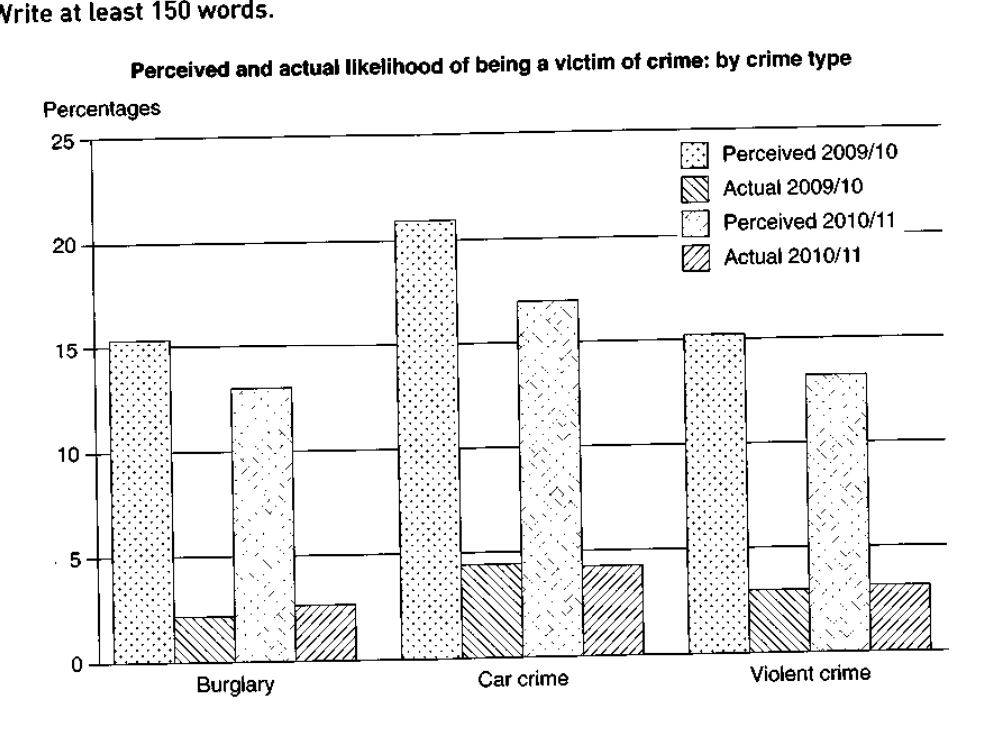
The graph below shows the perceived danger and actual likelihood of being a victim of crime.
Summarise the information by selecting and reporting the main features, and make comparisons where relevant.
Perceived and actual likelihood of being a victim of crime: by crime type
Student answer (Band 4.5)
Th bar graph illustrates the perceived danger and actual likelihood of begin a victim crime are burglary, car crime, violent crime,.
Overall the consumption of crime car crime is increses then other crime and mainly a perceived 2009/10 was grow while that for all are reduce.
In burglary crime perceived are grow up 15% and actual are decreses in starting 3% and also a perceived 2010/11 was decreses to 13% and actual 2010/11 are increses in 4% while that for 2009/10. However car crime is democrastic and highly grow up perceived 2009/10 was 21% and also a actual 2009/10 has increses sloly in 4% and perceived 2010/11 was decreses in perceived 2010/11.and actual are same the percentage are not decreses and increases.
At the last violent crime perceived 2009/10 was slowly decreases the 15% and actual are reduce while that for car crime and perceived 2009/10 slowly diminish 13% and the last actual 2010/11 are the same percentage .
AI examiner evaluation
| Criterion | Band |
|---|---|
| Task Achievement / Task Response | 4.5 |
| Coherence and Cohesion | 4.5 |
| Lexical Resource | 4.5 |
| Grammatical Range and Accuracy | 4.5 |
| Overall | 4.5 |
Task Achievement / Task Response: Band 4.5
You identify the three crime categories and attempt to compare perceived risk with actual victimisation across both periods. The overview also recognises that car crime has the highest perceived figure and that perceived figures generally fall. However, several details are inaccurate or unclear: burglary’s actual rate rises from about 2% to 2.5%, not from 3% to 4%; car crime’s perceived rate falls from 21% to 17%, while its actual rate stays near 4.5%; and violent crime’s perceived rate falls from about 15.5% to 13.5%, while its actual rate rises slightly. The description of the overall trends is too vague to give a reliable summary. Select the main comparisons and report them accurately and clearly.
Coherence and Cohesion: Band 4.5
The response has separate paragraphs and follows a broadly recognisable sequence, moving from an introduction and overview to the three crime types. This gives the reader some structure. However, progression within sentences is often difficult to follow, particularly in the car-crime paragraph, where the figures and changes are repeated or left incomplete. Phrases such as “while that for all are reduce” and “the last actual 2010/11 are the same percentage” do not make the relationships between ideas clear. Linking words such as “However” and “At the last” are attempted, but do not consistently signal the intended comparison. Use one focused paragraph per category, with clear time comparisons and simple links such as “whereas” or “by contrast”.
Lexical Resource: Band 4.5
You use some relevant task vocabulary, including “perceived,” “actual,” “percentage,” and the crime categories, so the topic is identifiable. However, the range is basic and several inaccurate word choices or spellings strain understanding. For example, “consumption of crime” does not express the highest crime rate, “democrastic” is unclear, and “grow up” and “diminish” are not natural ways to describe changes in percentages. There are also spelling errors such as “increses,” “decreses,” and “sloly.” Aim for precise chart language and check spelling: “increase,” “decrease,” “remain stable,” and “the proportion who perceived a risk” are useful options. Avoid repeating “perceived” without specifying the figure or period.
Grammatical Range and Accuracy: Band 4.5
You attempt longer sentences and use some comparison structures, including “while” and “However,” but control of sentence formation is very limited. Errors in verb forms and agreement occur throughout, as in “car crime is increses,” “actual are decreses,” and “all are reduce.” Articles and sentence boundaries are also problematic: the opening phrase “being a victim crime are burglary” does not form a clear grammatical sentence, and several later clauses run together without clear punctuation. These errors frequently make the intended comparisons difficult to understand. Build accuracy with short, complete sentences first, using patterns such as “The perceived figure fell from 21% to 17%” and “The actual rate remained at about 4.5%.” Then add comparisons once those structures are secure.
See this exact question answered at other band scores. The same prompt compared across bands.
Browse more IELTS Writing model answers or get your own writing scored by the same AI examiner.