Band 4.0 IELTS Writing Task 1 Model Answer
Overall Band Score: 4.0 · IELTS Summit Mastery · 2026-11-22
IELTS Writing Task 1 question
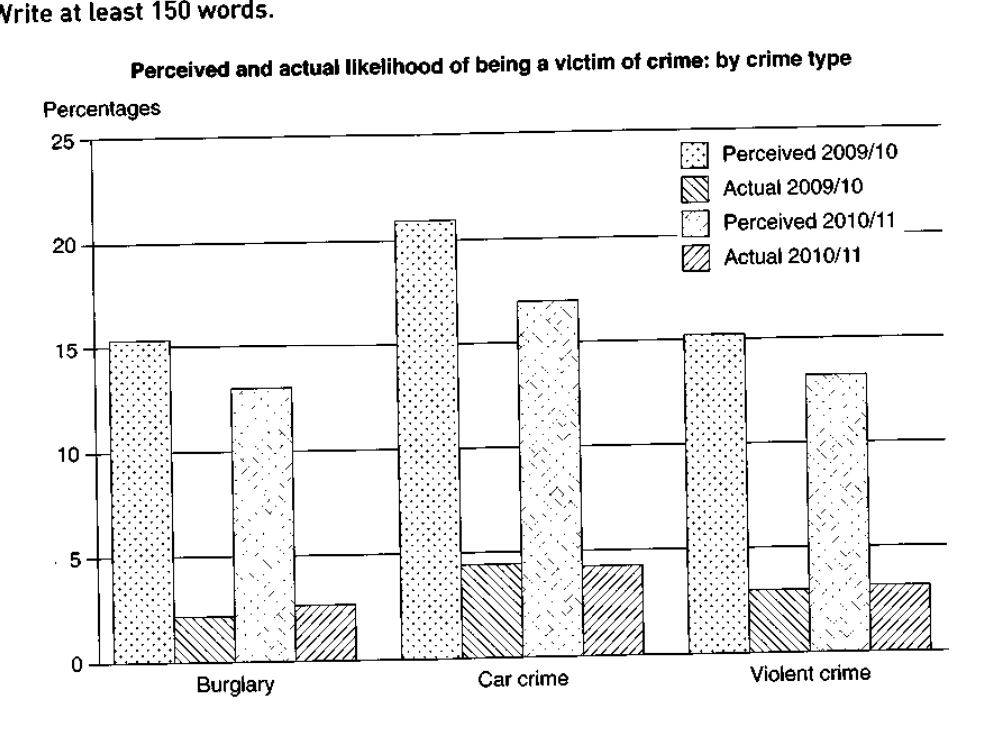
The graph below shows the perceived danger and actual likelihood of being a victim of crime.
Summarise the information by selecting and reporting the main features, and make comparisons where relevant.
Perceived and actual likelihood of being a victim of crime: by crime type
Student answer (Band 4.0)
The following chart represents the informatio of perceived danger and true likelihood of being a suspect of crime.
There are three type of crimes represnts, the list of following crimes is as e.g. burglary, car and violent crime. In each their four types of timeline showed from 2009 to 2010.
The burglary crime have highest ration in percevied september 2009 and lowest ratio is in now case.
AI examiner evaluation
| Criterion | Band |
|---|---|
| Task Achievement / Task Response | 3.0 |
| Coherence and Cohesion | 4.0 |
| Lexical Resource | 4.5 |
| Grammatical Range and Accuracy | 4.5 |
| Overall | 4.0 |
Task Achievement / Task Response: Band 3.0
The response identifies the chart’s general subject and names the three crime categories, but it does not provide a meaningful summary of the data. The statement that burglary has the “highest ration” is inaccurate: car crime has the highest perceived figures in both years, while actual likelihood is also highest for car crime. The reference to “september 2009” is not supported by the chart, which compares two annual periods, and “lowest ratio” is not explained. There is no clear overview of the large gap between perceived and actual risk or of the general changes between years. The response is also substantially below the required 150 words, leaving the task very incomplete. To improve, report the main comparisons and support them with accurate figures.
Coherence and Cohesion: Band 4.0
There is a basic attempt to organise the response into short paragraphs: the first introduces the chart, the second lists the crime types, and the final sentence attempts to describe a feature. However, the ideas do not develop in a clear sequence, and the final point is difficult to interpret. Phrases such as “In each their four types of timeline” do not explain how the four series relate to the two years and two measures. The response also lacks an overview and connected comparisons, so the reader cannot follow a coherent account of the chart. Use a clear structure—introduction, overview, then comparisons—and link related figures with simple connectors such as “whereas” and “by comparison.”
Lexical Resource: Band 4.5
The response uses a few relevant terms, including “perceived,” “likelihood,” “burglary,” and “violent crime,” showing some awareness of the chart’s subject. However, vocabulary is limited and several choices make the meaning unclear. “Suspect of crime” refers to someone suspected of committing an offence, not someone who may become a victim; “true likelihood” is less precise than “actual likelihood.” The phrase “highest ration” appears to be an inaccurate word choice, and “timeline” does not describe the chart’s annual categories. Spelling errors such as “inform atio,” “represents,” and “percevied” also reduce clarity. Build a small set of accurate chart terms and check spelling and collocations before finishing.
Grammatical Range and Accuracy: Band 4.5
The response attempts simple statements and a list-like sentence, but grammatical control is inconsistent. For example, “There are three type of crimes represnts” has errors in plural agreement and verb form, while “The burglary crime have” uses an incorrect subject–verb form. The sentence beginning “In each their four types” is not grammatically complete or clear. Articles and sentence construction also need attention, as in “the list of following crimes is as e.g.” Most sentences are short, and there is little evidence of controlled complex structures. Practise accurate basic patterns first—for example, “The chart shows three types of crime” and “Perceived risk was higher than actual risk”—then combine comparisons using clauses such as “while” or “whereas.”
See this exact question answered at other band scores. The same prompt compared across bands.
Browse more IELTS Writing model answers or get your own writing scored by the same AI examiner.