Band 6.0 IELTS Writing Task 1 Model Answer
Overall Band Score: 6.0 · IELTS Summit Mastery · 2026-11-23
IELTS Writing Task 1 question
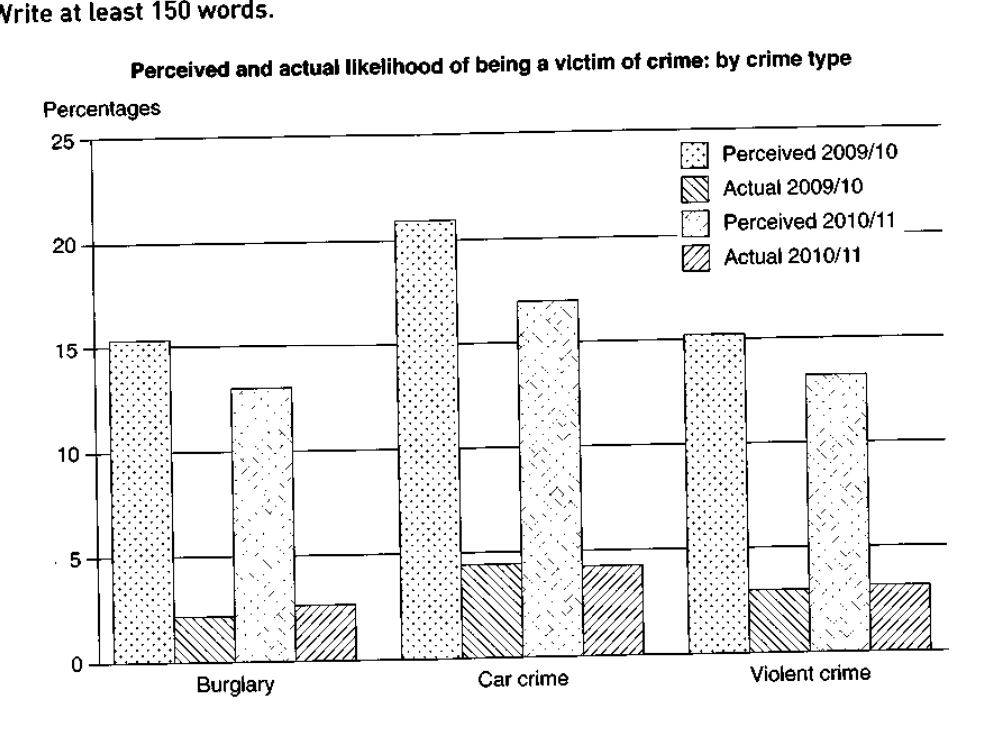
The graph below shows the perceived danger and actual likelihood of being a victim of crime.
Summarise the information by selecting and reporting the main features, and make comparisons where relevant.
Perceived and actual likelihood of being a victim of crime: by crime type
Student answer (Band 6.0)
The given graph displays three distinct perceived dangers in 2009/10 and the possibility of being assaulted 2010/11.
Overall,The percentages of perceived crimes in 2009/10 are higher than 2010/11 with car crime taking the lead in the two consecutive years. The least perceived crime were violent crimes.
In 2009/10 the most anticipated crime was car crime at 21% the actual figure of the attacked victims was however less than a quarter of the perceived amount at only 4%.The following year the perceived results lowered to about 17% and also the actual results reduce slightly from the previous year by only 0.5% getting the actual figure to 3.5%.
Consequently,burglary and violent crimes show almost the same perceived proportion in 2009/10 at 15.5 and 15%.However,the percentage of victims of the violent crimes slightly outweigh the burglary victims by 1%.In the following year,both have the same percentage of anticipation of about 13% and
violent crimes maintains the results of the previous year showing a percentage of 3 whereas burglary increases slightly from the previous year garnering 2.5%.
AI examiner evaluation
| Criterion | Band |
|---|---|
| Task Achievement / Task Response | 6.0 |
| Coherence and Cohesion | 5.5 |
| Lexical Resource | 6.0 |
| Grammatical Range and Accuracy | 5.5 |
| Overall | 6.0 |
Task Achievement / Task Response: Band 6.0
You identify several important patterns, including car crime as the most commonly perceived risk and the generally higher perceived than actual figures. You also compare the two periods and include figures for all three crime types. However, some details are inaccurate or unclear: violent crime perception is about 15.5% in 2009/10, not 15%, and in 2010/11 violent crime perception is 13.5%, rather than being the same as burglary at 13%. The actual violent-crime rate rises from 3% to 3.5%; it does not remain unchanged. The opening also misdescribes the chart as showing the possibility of being assaulted, rather than perceived and actual likelihood across three crime types. A clearer overview and more precise reporting of these comparisons would strengthen the response.
Coherence and Cohesion: Band 5.5
The response has a recognisable overall structure: an introduction, an overview, and paragraphs comparing the crime categories and years. This helps the reader follow the main subject. However, progression is not consistently clear because the discussion moves between perceived and actual figures within long sentences, and some links are awkward or mechanical, such as “Consequently” and “The following year.” The final sentence also ends with “and” before continuing on a new line, leaving the relationship between the two figures unclear. Improve cohesion by grouping perceived figures together and actual figures together, and use clear comparisons such as “by contrast” or “while.” Check punctuation and paragraph breaks so each comparison is complete.
Lexical Resource: Band 6.0
You use a reasonable range of task-related vocabulary, including “perceived,” “actual figure,” “percentage,” and “slightly,” and the meaning is generally understandable. There are also attempts at more formal phrasing, such as “taking the lead” and “garnering,” although these are not always natural for describing chart data. Some choices are imprecise: “anticipated crime” suggests prediction rather than perceived likelihood, while “the attacked victims” is an awkward way to refer to actual victims. “The least perceived crime were violent crimes” also has an unclear and repetitive formulation. Prefer standard chart language and precise terms for rates and categories. This would make the comparisons more natural and reduce ambiguity without requiring a much wider vocabulary.
Grammatical Range and Accuracy: Band 5.5
You attempt both simple and more complex sentences, including comparisons with “however” and clauses beginning “while” or “with.” The main ideas can usually be understood, but some grammatical and punctuation errors remain. For example, “The least perceived crime were violent crimes” has a number-agreement problem, and “the actual results reduce slightly” uses an incorrect verb form for a past comparison. The opening phrase “the possibility of being assaulted 2010/11” is missing a grammatical link, and several sentences run together after full stops, as in “4%.The following year.” There is also inconsistent capitalisation and spacing after commas. Use complete, shorter sentences where needed, and check tense, agreement, and punctuation when revising.
See this exact question answered at other band scores. The same prompt compared across bands.
Browse more IELTS Writing model answers or get your own writing scored by the same AI examiner.