Band 5.0 IELTS Writing Task 1 Model Answer
Overall Band Score: 5.0 · IELTS Summit Mastery · 2026-11-23
IELTS Writing Task 1 question
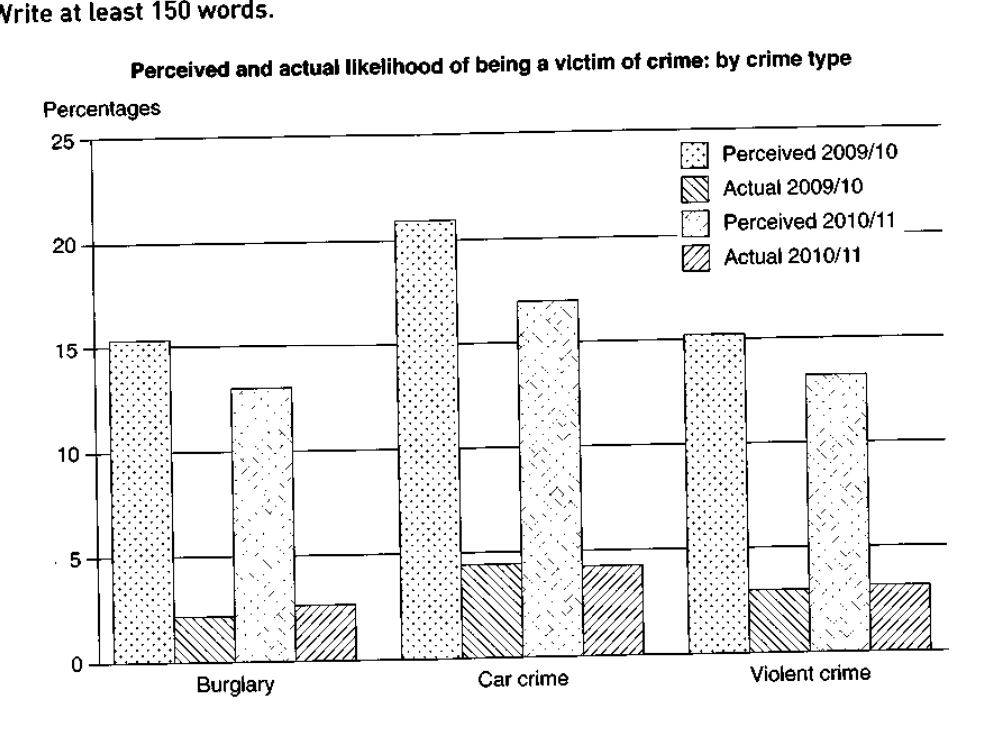
The graph below shows the perceived danger and actual likelihood of being a victim of crime.
Summarise the information by selecting and reporting the main features, and make comparisons where relevant.
Perceived and actual likelihood of being a victim of crime: by crime type
Student answer (Band 5.0)
The bar graph illustrates the preceived and actual likelihood of being a victim of crime by crime type.
Overall, the percentages vary depend on type of crime. Perceived 2009 car crime got a highest percentage of being a victim, while actual 2009 burglary is the lowest one.
Burglary and Violent crimes in 10th month of 2009 got more than 15%, compared with car crime that reach higher than 20%. in the same year, although actual crimes for three types are below 5%, car crime still lead the percentages.
Looking at crimes in 2010, car crime is more than 15%, in contrast, both burglary and violent crimes are between 10% to 15% in the 11th of 2010. Actual percentages of crimes are less than 5%, burglary around 2.5%, violent is a little bit higher than burglary and car crime closed to 5%
AI examiner evaluation
| Criterion | Band |
|---|---|
| Task Achievement / Task Response | 5.0 |
| Coherence and Cohesion | 5.0 |
| Lexical Resource | 5.0 |
| Grammatical Range and Accuracy | 5.0 |
| Overall | 5.0 |
Task Achievement / Task Response: Band 5.0
You identify the chart’s subject and include an overview, noting that perceived car-crime risk was highest and actual burglary risk lowest. You also report several relevant comparisons, such as perceived car crime being above 20% in 2009/10 and actual figures remaining below 5%. However, the overview is limited, and some comparisons are imprecise: the chart shows perceived burglary and violent crime at about 15.5% in 2009/10, while in 2010/11 they are about 13% and 13.5%, respectively. The final sentence also leaves the actual car-crime figure unclear. The response contains 129 words, below the required 150; this limits the opportunity to select and explain the main features fully. Add a clearer overview and more precise comparisons.
Coherence and Cohesion: Band 5.0
The response has a basic structure: an introduction and overview are followed by paragraphs about the two periods. This gives the reader some sense of organisation, and phrases such as “in the same year” and “Looking at crimes in 2010” signal movement between comparisons. However, progression within the paragraphs is not always clear, and the final sentence combines several figures without clearly separating the crime types or years. Some links are also awkward or incomplete, such as “in contrast” before the 2010 perceived figures. Organise each body paragraph around a consistent comparison—perceived versus actual, or crime type—and use clear references to the year and category so the reader can follow the data more easily.
Lexical Resource: Band 5.0
You use relevant chart vocabulary, including “percentages,” “perceived,” “actual,” and “crime type,” so the topic is generally understandable. However, the range is limited and several word choices or collocations are inaccurate, which sometimes makes the comparisons difficult to interpret. For example, “got a highest percentage” and “car crime still lead the percentages” are not natural ways to describe chart values; “reached the highest figure” and “had the highest rate” would be clearer. “Preceived” is misspelled, and “closed to 5%” should be “close to 5%.” Aim for precise reporting verbs and standard expressions for proportions, while checking spelling and word forms.
Grammatical Range and Accuracy: Band 5.0
You attempt a few longer structures, including the sentence beginning “although actual crimes for three types are below 5%,” and the response is usually possible to understand. However, the range is limited, and frequent errors in sentence construction and verb forms make some statements unclear. For example, “the percentages vary depend on type of crime” needs a corrected verb pattern, such as “vary depending on the type of crime.” In “car crime that reach higher than 20%,” the relative clause needs a suitable verb form, and “in the 11th of 2010” does not form a correct time expression. Capitalisation after full stops is also inconsistent. Practise accurate simple comparisons first, then build longer sentences with controlled clauses and punctuation.
See this exact question answered at other band scores. The same prompt compared across bands.
Browse more IELTS Writing model answers or get your own writing scored by the same AI examiner.