Band 6.0 IELTS Writing Task 1 Model Answer
Overall Band Score: 6.0 · IELTS Summit Mastery · 2026-11-23
IELTS Writing Task 1 question
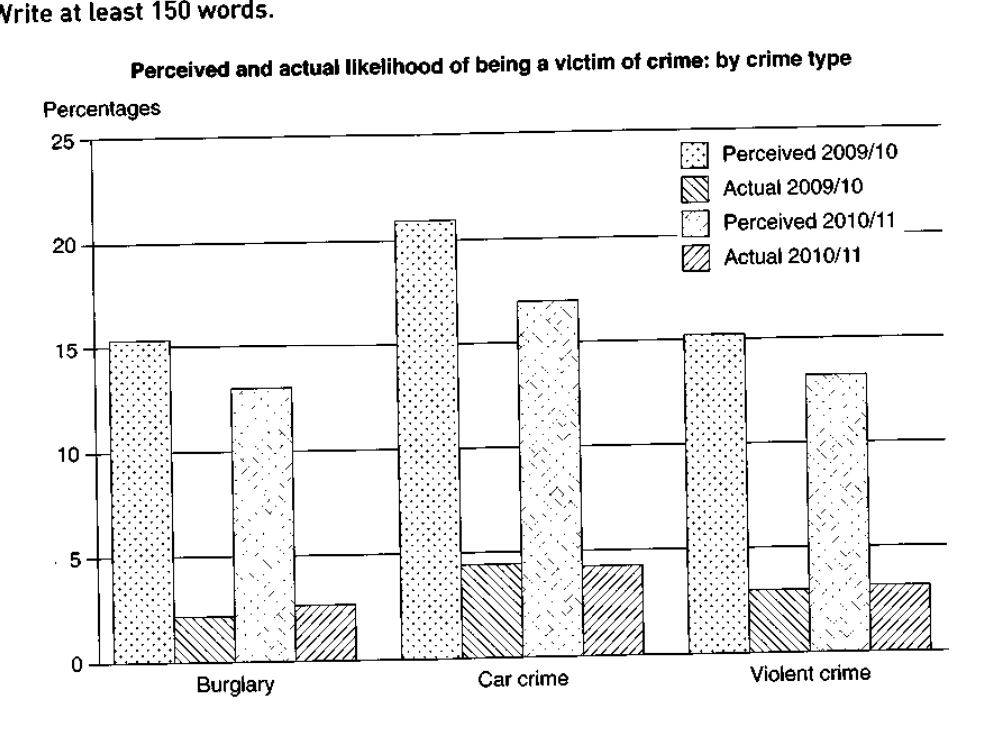
The graph below shows the perceived danger and actual likelihood of being a victim of crime.
Summarise the information by selecting and reporting the main features, and make comparisons where relevant.
Perceived and actual likelihood of being a victim of crime: by crime type
Student answer (Band 6.0)
The given graph illustrates the change in percentages in perceived danger and actual likelihood of being victim of crime across three different crimes in 2009 and 2010.
Overall, the perceived danger showed fall while, there is only slight change in actual likelihood of being viction of crime in each of the crimes over a period. And, there is vast difference in percentage between perceived danger and actual likelihood of being victim among all crimes.
In 2009, Car crime was the highest in both perceived danger and actual likelihood of being victim of crime with approximately 22% and 4% respectively. By 2010, Perceived danger reduced to 17% while other remained the same.
Similarly, Burglary and violent crime equally accounted approximately 16% perceived danger in 2009 which stayed in same position by 2010. While, violent crime contributing nearly 4% was slightly more than Burglary(3%), Burglary increased to 4% representing same with violent crime by 2010.
AI examiner evaluation
| Criterion | Band |
|---|---|
| Task Achievement / Task Response | 6.5 |
| Coherence and Cohesion | 6.5 |
| Lexical Resource | 6.0 |
| Grammatical Range and Accuracy | 5.5 |
| Overall | 6.0 |
Task Achievement / Task Response: Band 6.5
You identify the main contrast clearly: perceived risk is much higher than actual victimisation across all three crime types, and you note that perceived figures generally fell while actual figures changed little. The comparisons between car crime and the other categories are relevant, and most reported values are close to the chart. However, the overview is not fully precise: burglary and violent-crime perceptions did not both stay unchanged, as burglary fell from about 15.5% to 13%, while violent crime was roughly stable at 15.5% and 13.5%. The final comparison also misstates the actual figures: burglary was about 2% and then 2.5%, not 3% and 4%. More accurate selection and reporting of these details would make the response more complete.
Coherence and Cohesion: Band 6.5
The response has a clear overall structure, moving from an introduction and overview to comparisons of car crime and then the other categories. This makes the main message easy to follow, and linking expressions such as “Overall,” “By 2010,” and “Similarly” help signal the stages of the description. Some cohesion is less controlled, however. The overview’s sentence beginning “And” is awkwardly attached, while “While” starts a fragment in the final paragraph. The reference “other remained the same” is also unclear because it does not specify which figures or crime types are meant. Use complete sentences and name the categories or series explicitly to make the progression more precise and less mechanical.
Lexical Resource: Band 6.0
You use a suitable range of task-related vocabulary, including “perceived danger,” “actual likelihood,” “accounted,” and “reduced,” and the meaning is generally understandable. There are also attempts at more formal reporting language. However, some word choices and collocations are inaccurate or awkward: “change in percentages in perceived danger” is less natural than describing changes in perceived risk, and “stayed in same position” does not clearly express that a percentage remained similar. “Viction” is a spelling error, and “contributing” is not the right verb for reporting a chart value. Aim for precise, conventional phrases such as “the proportion who perceived a risk” and “the actual rate of victimisation.”
Grammatical Range and Accuracy: Band 5.5
You attempt both simple and more complex sentence forms, including comparisons introduced by “while” and “which,” and the overall meaning can usually be followed. Some grammatical errors remain, particularly with articles, sentence boundaries, and clause structure. For example, “being victim of crime” needs an article, and “the perceived danger showed fall while, there is only slight change” has an incorrect verb pattern and punctuation. “While, violent crime contributing…” is not a complete clause, and “Burglary increased to 4% representing same with violent crime” lacks clear grammatical connections. Practise forming complete clauses with accurate tense and punctuation, especially when combining comparisons. This would improve control while retaining your attempts at varied structures.
See this exact question answered at other band scores. The same prompt compared across bands.
Browse more IELTS Writing model answers or get your own writing scored by the same AI examiner.