Band 6.5 IELTS Writing Task 1 Model Answer
Overall Band Score: 6.5 · IELTS Summit Mastery · 2026-11-23
IELTS Writing Task 1 question
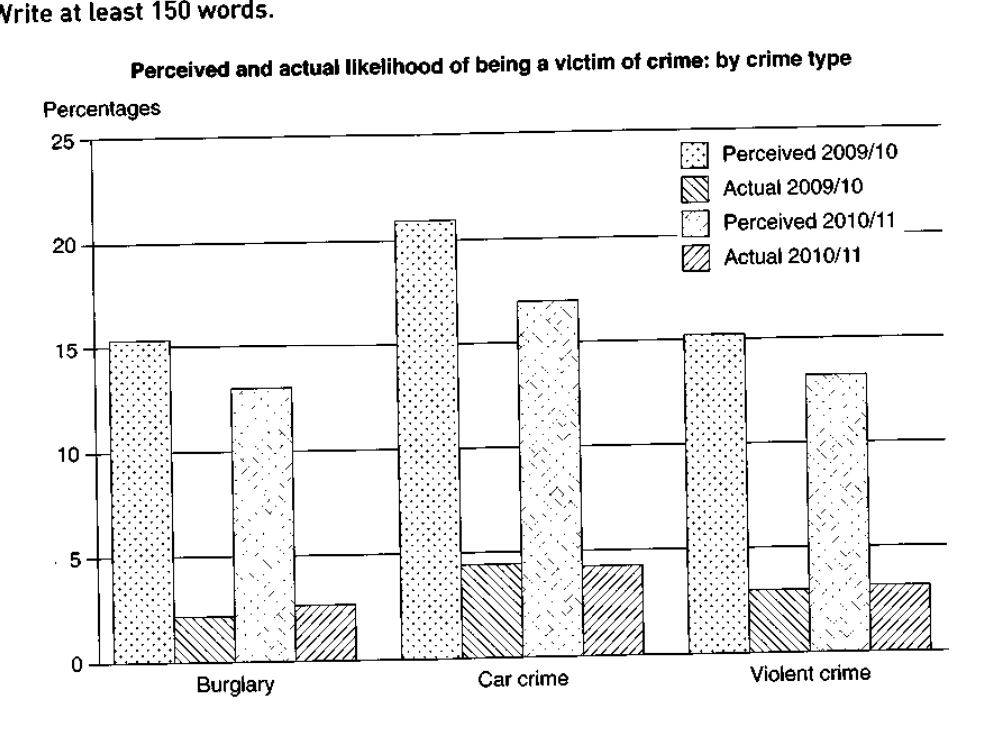
The graph below shows the perceived danger and actual likelihood of being a victim of crime.
Summarise the information by selecting and reporting the main features, and make comparisons where relevant.
Perceived and actual likelihood of being a victim of crime: by crime type
Student answer (Band 6.5)
The expected danger and actual likelihood of being a victim of a crime in 2009 and 2010 is illustrated by the provided bar graph. Overall, the graph shows three types of crimes: burglary, car crimes, and violent crimes. We can clearly see that car crimes make up the highest proportion of the perceived danger in 2009 and 2010. Further more we can see that actual likelihood of being a victim of a crime is significantly less than the perceived in both years.
In 2009, car crimes were expected to be the most executed crimes with about 22%, however, the actual likelihood of being a victim of a crime is much lower than perceived, with it being approximately 4%. The perceived danger of burglary and violent crimes were almost identical with each making about 15%. However, the actual likelihood of being a victim to a crime is much lower, with burglary accounting for almost 2% and violent crimes accounting for about 3%.
In 2010, car crimes remained the highest perceived crimes accounting for approximately 17%, whereas the actual danger was about 4%, same as 2009. Burglary and violent crimes remained similar in terms of perception, with each accounting for about 16% and 17%, respectively. As for the actual likelihood of being a victim to a crime, burglary saw a slight increase, accounting for almost 3%, but violent crimes stayed relatively the same.
AI examiner evaluation
| Criterion | Band |
|---|---|
| Task Achievement / Task Response | 7.0 |
| Coherence and Cohesion | 7.0 |
| Lexical Resource | 6.0 |
| Grammatical Range and Accuracy | 6.5 |
| Overall | 6.5 |
Task Achievement / Task Response: Band 7.0
You identify the main pattern clearly: perceived risk is much higher than actual victimisation, and car crime has the highest perceived figure in both years. The comparisons for 2009 are generally accurate, and you include relevant figures for all three crime types. However, the 2010 account misreports perception for burglary and violent crime: these are about 13% and 13.5%, not “about 16% and 17%.” The actual violent-crime figure also rises slightly, from about 3% to 3.5%, rather than staying relatively the same. The overview is useful, but a more precise summary of these changes and the overall decline in perceived figures would make the key features better supported.
Coherence and Cohesion: Band 7.0
The response is organised into a clear introduction and overview followed by separate paragraphs for the two years. This gives the reader a logical route through the comparisons, and linking expressions such as “however,” “whereas” and “as for” help signal contrasts. The main progression is easy to follow, although some transitions are formulaic and the repeated phrase “actual likelihood of being a victim” makes the account less concise. The overview could also connect the year-to-year pattern more explicitly, rather than mainly listing the highest perceived category and the gap between perception and reality. Use more varied referencing and tighter comparisons to make cohesion smoother.
Lexical Resource: Band 6.0
You use a suitable range of topic vocabulary, including “perceived danger,” “actual likelihood,” “accounting for” and “remained,” and the meaning is generally clear. However, some choices are inaccurate or unnatural for describing this chart. “Most executed crimes” does not mean the crime with the highest perceived likelihood; “highest perceived figure” would be more precise. “Actual danger” also confuses risk with recorded likelihood, while “car crimes” is less natural than “car crime.” There is some repetition of long phrases such as “being a victim of a crime.” Aim for precise chart language and natural collocations, while retaining the clear vocabulary you already use.
Grammatical Range and Accuracy: Band 6.5
You use a mix of simple and complex sentence forms, including contrast clauses with “whereas” and “however,” and most sentences communicate the intended comparisons. Some grammatical errors remain. For example, “the perceived danger of burglary and violent crimes were” has a subject–verb agreement problem; “danger” is singular. In “with it being approximately 4%,” the pronoun reference is unclear, and “the actual likelihood … is much lower” shifts into the present while describing past data. There are also awkward constructions such as “the actual likelihood of being a victim to a crime.” Keep the past-tense reporting consistent and check agreement and pronoun references; these refinements would build on the range already demonstrated.
See this exact question answered at other band scores. The same prompt compared across bands.
Browse more IELTS Writing model answers or get your own writing scored by the same AI examiner.