Band 5.0 IELTS Writing Task 1 Model Answer
Overall Band Score: 5.0 · IELTS Summit Mastery · 2026-11-24
IELTS Writing Task 1 question
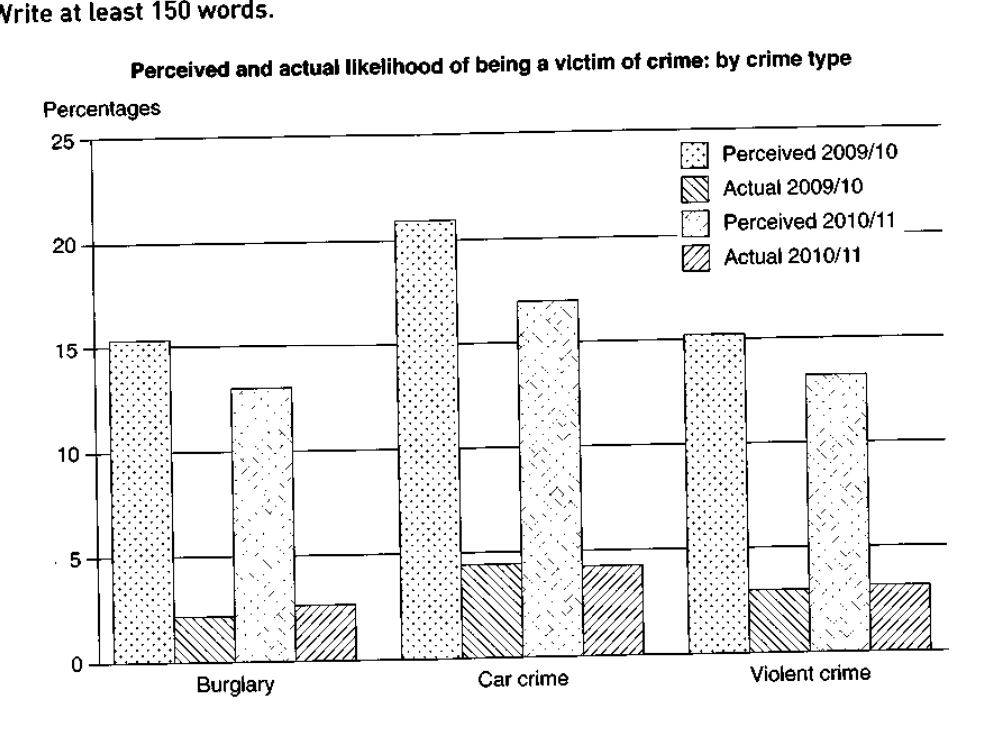
The graph below shows the perceived danger and actual likelihood of being a victim of crime.
Summarise the information by selecting and reporting the main features, and make comparisons where relevant.
Perceived and actual likelihood of being a victim of crime: by crime type
Student answer (Band 5.0)
The bar graph below illustrates the perceived danger and actual likelihood of being a victim of crime.
Overall, it is evident that perceived victim of car crime are the highest in the graph while, actually it was not that much as they are shown. There are three incidents are given which are Burglary, car crime and Violent crime.
To commennce with, Bruglary the Perceived victims in 2009/10 was around 15% and in 2010/11 it was almost 13%. Whereas the actual victims in 2009/10 and 2010/11 are almost 3% and 4% respectively. On the other hand, the perceived victims of car crime in 2009/10 was around 21% and acutal are nearly 4% whereas the percived victims of 2010/11 was almost 17% and actual were around 4%.
However, The perceived victims of 2009/10 was 15% and perceived victims of 2010/11 was nearly 14% but on the other hand the acutal victime of 2009/10 and 2010/11 are nearly similar with around 3%.
AI examiner evaluation
| Criterion | Band |
|---|---|
| Task Achievement / Task Response | 5.0 |
| Coherence and Cohesion | 5.0 |
| Lexical Resource | 5.0 |
| Grammatical Range and Accuracy | 5.0 |
| Overall | 5.0 |
Task Achievement / Task Response: Band 5.0
You identify the three crime categories and the main contrast: perceived risk is much higher than actual victimisation, with car crime perceived as the greatest danger. You also include several relevant figures, such as 21% for perceived car crime in 2009/10 and about 17% in 2010/11. However, the account is only partial: the overview is brief, and some actual figures are inaccurate or unclear. For example, burglary actual rates are about 2% and 2.5%, not around 3% and 4%; car crime actual rates are about 4.5% in both years. The violent-crime figures are not clearly identified as such. The response is 147 words, three short of the 150-word minimum. Add a fuller overview and check each comparison against the chart.
Coherence and Cohesion: Band 5.0
The response has a basic structure, with an opening, an overview and paragraphs that attempt to cover the crime types. Linking expressions such as “Whereas” and “On the other hand” show an effort to compare data. However, progression is not always clear: the final paragraph does not name violent crime, so readers must infer which category it describes. The repeated pattern of listing perceived and actual figures also makes the report feel mechanical, while “However” does not establish a clear contrast at the start of that paragraph. Use one paragraph for the overview and group the detailed comparisons logically, naming each crime type explicitly and using links only where they clarify the relationship.
Lexical Resource: Band 5.0
You use relevant task vocabulary, including “perceived,” “actual,” “victims” and the three crime labels, so the topic is generally understandable. However, the range is limited and several word choices or forms are inaccurate or awkward, including “perceived victim of car crime are the highest” and “actually it was not that much.” Spelling errors such as “Bruglary,” “commennce,” “acutal” and “percived” are noticeable and reduce precision. Prefer concise, standard chart language, for example, “the perceived risk of car crime was highest” and “the actual rate was considerably lower.” Check spelling carefully, especially for repeated key terms, and vary “around” with accurate alternatives such as “approximately” or “stood at.”
Grammatical Range and Accuracy: Band 5.0
You attempt both simple statements and longer comparisons, including sentences beginning with “Whereas” and “but on the other hand.” However, the range is limited, and errors occur frequently enough to make some sentences difficult to follow. Examples include “perceived victim of car crime are the highest,” where the subject and verb do not agree, and “There are three incidents are given,” which has an incorrect sentence structure. Tense and number are also inconsistent in phrases such as “the perceived victims … was” and “actual victims … are.” Build accurate sentences around the figures: “The perceived rate for burglary fell from about 15.5% to 13%.” Practise subject–verb agreement and use past tense consistently when describing the chart.
See this exact question answered at other band scores. The same prompt compared across bands.
Browse more IELTS Writing model answers or get your own writing scored by the same AI examiner.