Band 5.5 IELTS Writing Task 1 Model Answer
Overall Band Score: 5.5 · IELTS Summit Mastery · 2026-11-24
IELTS Writing Task 1 question
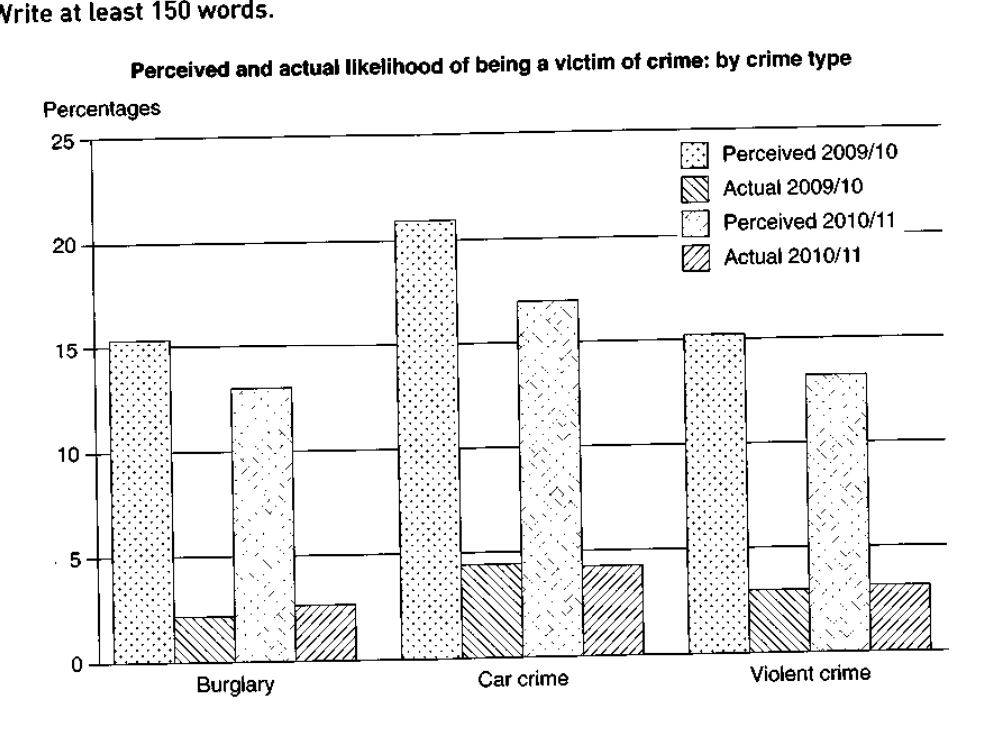
The graph below shows the perceived danger and actual likelihood of being a victim of crime.
Summarise the information by selecting and reporting the main features, and make comparisons where relevant.
Perceived and actual likelihood of being a victim of crime: by crime type
Student answer (Band 5.5)
The bar chart illustrates the assumed danger and the actual probability of being a victim of a crime.
Overall, the observed data for danger throught the years have been predicted way too much, while the actual data in all three crimes burglary, car crime and violent crime was way lesser.The highest data for crime was of cars in both observed and the actual likelihood. The actual crime rate remained stable in all three crimes.
The perceived data for crime decreased for all three 3 crimes from the year 2009/10 to 2010/11. Crime that happened the most was for cars, while burglary was the lowest. The proportion for violent crime that was predicted in 09/10 was 15 and the actual percentage was just 3. The actual crime for that happened and remained constant was for cars which was near 5 percent in both the years.
AI examiner evaluation
| Criterion | Band |
|---|---|
| Task Achievement / Task Response | 5.5 |
| Coherence and Cohesion | 5.5 |
| Lexical Resource | 5.5 |
| Grammatical Range and Accuracy | 5.5 |
| Overall | 5.5 |
Task Achievement / Task Response: Band 5.5
You identify the chart’s central contrast: perceived risk is much higher than actual victimisation, and car crime has the highest figures. You also note that perceived figures fell between the two periods. However, the overview is imprecise: actual rates did not remain stable in every category, as burglary rose from about 2% to 2.5% and violent crime from 3% to 3.5%. The claim that burglary was the lowest crime type is true for actual figures, but not for perceived figures, where burglary and violent crime were similar. Only violent crime and car crime receive specific comparisons, leaving key data underdeveloped. The response is also six words below the required minimum. Include a clearer overview and compare all three categories accurately.
Coherence and Cohesion: Band 5.5
The response has a basic, useful structure: an introduction, an overview, and a paragraph with selected details. The main comparisons are generally grouped by perceived and actual figures, so the reader can follow the broad message. However, progression is limited because the final paragraph repeats points already made in the overview, particularly that car crime was highest and actual car crime stayed near 5%. Some links between ideas are unclear, as in “The actual crime for that happened and remained constant,” and the overview combines several claims in a long, crowded sentence. Organise the details more systematically—for example, compare perceived and actual figures for each crime type—and use clearer referencing to avoid repetition.
Lexical Resource: Band 5.5
You use relevant chart vocabulary, including “bar chart,” “proportion,” “percentage,” “perceived,” and “actual,” which allows you to communicate the main topic. However, the range is limited and several choices are inaccurate or unnatural for describing statistical data. “Predicted” does not accurately convey perceived risk, while “crime that happened the most” is an imprecise way to describe the highest actual rate. Phrases such as “way lesser” and “highest data” also weaken clarity, and “throught” is misspelled. Aim for precise collocations such as “was considerably higher,” “recorded the highest proportion,” and “actual incidence.” This would make the comparisons more concise and appropriately academic.
Grammatical Range and Accuracy: Band 5.5
You attempt both simple statements and longer sentences, and the basic meaning is usually recoverable. However, the range is limited, and errors in sentence construction and agreement occur often enough to make some passages difficult to follow. For example, “the actual data … was way lesser” has a subject–verb agreement problem and an awkward comparative structure; “all three 3 crimes” has faulty number expression; and “The actual crime for that happened and remained constant was for cars” is not grammatically well formed. Punctuation and spacing are also inconsistent, as in “way lesser.The.” Practise building clear comparison sentences with accurate subjects and verbs, such as “Actual rates were lower in all three categories, although they rose slightly for burglary and violent crime.”
See this exact question answered at other band scores. The same prompt compared across bands.
Browse more IELTS Writing model answers or get your own writing scored by the same AI examiner.