Band 6.0 IELTS Writing Task 1 Model Answer
Overall Band Score: 6.0 · IELTS Summit Mastery · 2026-11-24
IELTS Writing Task 1 question
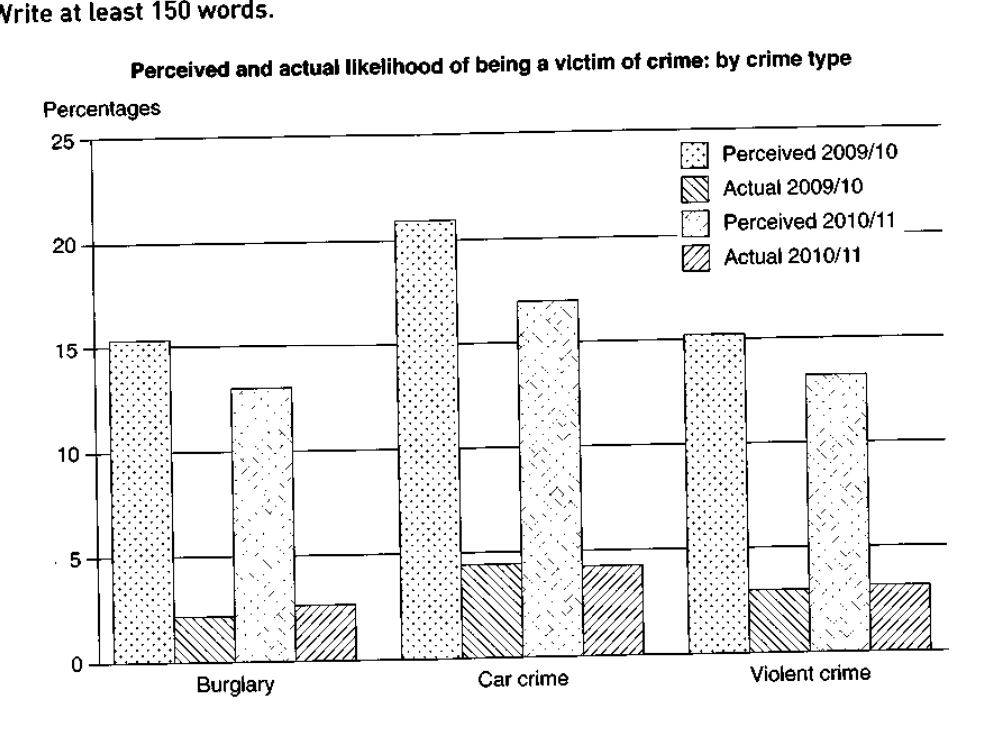
The graph below shows the perceived danger and actual likelihood of being a victim of crime.
Summarise the information by selecting and reporting the main features, and make comparisons where relevant.
Perceived and actual likelihood of being a victim of crime: by crime type
Student answer (Band 6.0)
The bar chart gives information abouit the perceived danger and the actual likelihood of being a victim of three crimes type ( Burglary, Car crime and violent crime) in percentages in two periods 2009/2010 and 2010/2011.
Overall, Car crime perceived 2009/10 and 2010/11 recorded the highest figure, while burglary cime actual was the lowest in both 2009/10 and 2010/11. Additionally violent crime actual remained approximetly stable in the two periods.
Perceived car crime in 2009/10 recoreded the highest figure at 21 percent, followed by perceived 2010/11 at 17 percent. In comparison both Burglary and violent crime perceived 2009/10 stood at approximetly 15.1 percent.
At the other end of the scale,all of the three crime types actual 2009/10 and 2010/11 stayed under five percent, with car crimes being the highest. Meanwhile perceived burglary fell by nearly 2.1 percent from 2009/10 to 2010/11, which was the same case for violent crimes declining by around 2 percent in 2010/11.
AI examiner evaluation
| Criterion | Band |
|---|---|
| Task Achievement / Task Response | 5.5 |
| Coherence and Cohesion | 6.5 |
| Lexical Resource | 5.5 |
| Grammatical Range and Accuracy | 5.5 |
| Overall | 6.0 |
Task Achievement / Task Response: Band 5.5
You identify the chart’s main contrast: perceived risk is much higher than actual victimisation, and car crime has the highest perceived figures. You also note that actual rates remain below five percent. However, the overview is incomplete and some comparisons are inaccurate or unclear. For example, the actual burglary rate is the lowest, but the response does not clearly report the overall fall in perceived figures across all three crimes. It says perceived violent crime declined by around 2 percent, whereas the chart shows a small decrease from about 15.5% to 13.5%; perceived burglary falls by about 2.5 points, not 2.1. The final paragraph also omits the actual figures and changes. Select the key trends more accurately and support them with clear comparisons.
Coherence and Cohesion: Band 6.5
The response has a clear overall arrangement: an introduction, an overview, and paragraphs describing perceived and actual figures. This gives the reader a coherent route through the information, and linking phrases such as “Overall,” “In comparison,” and “At the other end of the scale” help signal relationships. Some progression is less effective because the final paragraph moves between actual rates and perceived changes without clearly separating those comparisons. The phrase “Meanwhile” also introduces a perceived trend after a sentence about actual rates, which makes the connection less clear. Grouping all perceived comparisons together and then all actual comparisons, or comparing each crime across both measures, would make the organisation more consistent. Overall, the structure is sound, though cohesion is not always precise.
Lexical Resource: Band 5.5
You use relevant chart vocabulary, including “perceived,” “actual likelihood,” “recorded the highest figure,” and “stood at,” so the reader can generally understand the comparisons. However, the range is limited and several noticeable spelling and word-choice errors reduce precision: “abouit,” “crimes type,” “recoreded,” and “approximetly.” Some combinations are also awkward, such as “Car crime perceived” and “burglary cime actual”; use forms such as “the perceived risk of car crime” and “the actual burglary rate.” Repetition of “figure” and “crime” could be reduced with terms such as “proportion,” “rate,” and “category.” These issues do not prevent understanding, but more accurate spelling and natural collocations would make the description clearer and more controlled.
Grammatical Range and Accuracy: Band 5.5
You attempt a mixture of sentence forms, including a complex comparison beginning “Meanwhile,” and your main ideas are usually understandable. However, grammatical control is uneven. The opening phrase “three crimes type” has incorrect number agreement, while “Car crime perceived 2009/10 and 2010/11 recorded” lacks a clear grammatical subject and verb structure. In “both Burglary and violent crime perceived 2009/10 stood,” the word order also makes the relationship between the crimes and the figures difficult to follow. Punctuation is inconsistent, including missing spaces after commas and unnecessary spaces before brackets. Build sentences around clear subjects—for example, “The perceived risk of burglary fell…”—and check agreement, word order, and punctuation. More consistently accurate sentence patterns would strengthen the response.
See this exact question answered at other band scores. The same prompt compared across bands.
Browse more IELTS Writing model answers or get your own writing scored by the same AI examiner.