Band 5.5 IELTS Writing Task 1 Model Answer
Overall Band Score: 5.5 · IELTS Summit Mastery · 2026-11-25
IELTS Writing Task 1 question
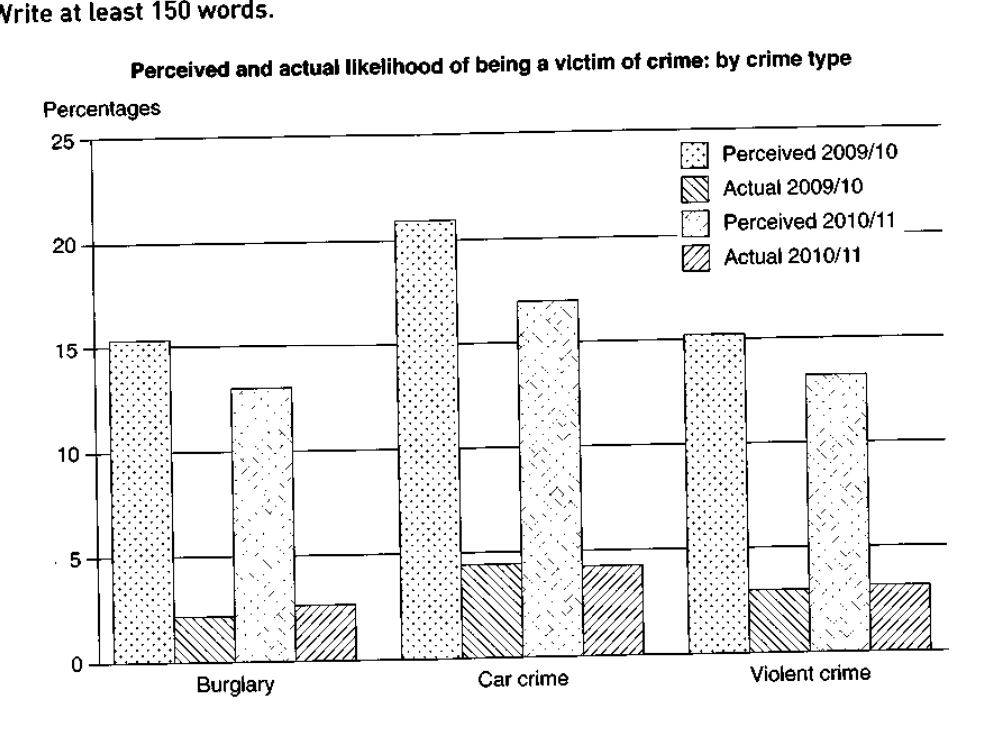
The graph below shows the perceived danger and actual likelihood of being a victim of crime.
Summarise the information by selecting and reporting the main features, and make comparisons where relevant.
Perceived and actual likelihood of being a victim of crime: by crime type
Student answer (Band 5.5)
The given bar graph depicts information about the perceived and actual likelihood of being a victim of various criminal activities like burglary, car crime and violent in 2009 and 2010. Overall, it can be seen that the rate of car cime is very high as compared to others and burglary and violent crime rate reached same.
To be specific, car crime perceived at the rate of 22 percent in 2009/10 remaining the highest criminal act. Followed by burglary and violent criminal activities both had same actual rate accounting for less then 5 percent in 2009 and 2010.
Similarly, Violent and burglary crime rate increased at the same pace at reached up to 15 and 12 percent perceived rate in 2010/11.
AI examiner evaluation
| Criterion | Band |
|---|---|
| Task Achievement / Task Response | 4.5 |
| Coherence and Cohesion | 6.0 |
| Lexical Resource | 5.5 |
| Grammatical Range and Accuracy | 5.0 |
| Overall | 5.5 |
Task Achievement / Task Response: Band 4.5
You identify the chart’s subject and make a relevant overall comparison by noting that perceived car-crime risk is highest. However, the response only partially reports the data: it gives one approximate figure for perceived car crime and broad statements about the other categories, while omitting the actual-versus-perceived contrast that is central to the chart. The claim that burglary and violent crime had the same actual rate is inaccurate, and the final figures for perceived rates are also imprecise. The response is 111 words, below the required 150; this limits the opportunity to select and explain the main features. Include a clear overview, compare both years and both measures, and support these points with accurate figures.
Coherence and Cohesion: Band 6.0
The response has a recognisable sequence: an introduction and overview are followed by two detail statements. Linking phrases such as “Overall,” “To be specific,” and “Similarly” help signal the intended progression, so the reader can follow the broad topic. However, the organisation is not fully effective because the details are not grouped or compared systematically by year or by perceived versus actual likelihood. “Followed by” introduces an incomplete sentence, and “Similarly” does not clearly connect the final comparison to the preceding point. A fuller structure—overview, then a paragraph comparing perceived figures and another comparing actual figures—would make the relationships clearer. Use linking expressions only where the logical connection is explicit.
Lexical Resource: Band 5.5
You use relevant topic vocabulary, including “perceived,” “actual likelihood,” “burglary,” and “violent,” and the reader can generally understand the subject. However, the range is limited and some word choices or collocations are inaccurate: “rate of car crime” is less precise than describing the percentage who perceived or experienced that crime, while “criminal act” does not fit the chart’s measure. There are also noticeable spelling errors, including “cime” and “less then,” and “violent” is used where the crime category needs a noun phrase. Aim for precise chart language and check spelling. Alternatives such as “proportion,” “reported likelihood,” and “remained the highest” would help describe the data more naturally.
Grammatical Range and Accuracy: Band 5.0
You attempt both simple and more extended sentence forms, and the opening sentence communicates the chart’s general subject. However, control is uneven, particularly in the detail sentences. “Car crime perceived at the rate of 22 percent” lacks a finite verb, while “Followed by burglary and violent criminal activities both had…” is a fragment with an unclear structure. In “increased at the same pace at reached,” the verb pattern is faulty, and the sentence does not clearly state what increased. There are also issues with articles and number agreement in phrases such as “burglary and violent crime rate.” Build complete sentences with a clear subject and verb, and use a consistent past-tense reporting pattern.
See this exact question answered at other band scores. The same prompt compared across bands.
Browse more IELTS Writing model answers or get your own writing scored by the same AI examiner.