Band 5.0 IELTS Writing Task 1 Model Answer
Overall Band Score: 5.0 · IELTS Summit Mastery · 2026-11-25
IELTS Writing Task 1 question
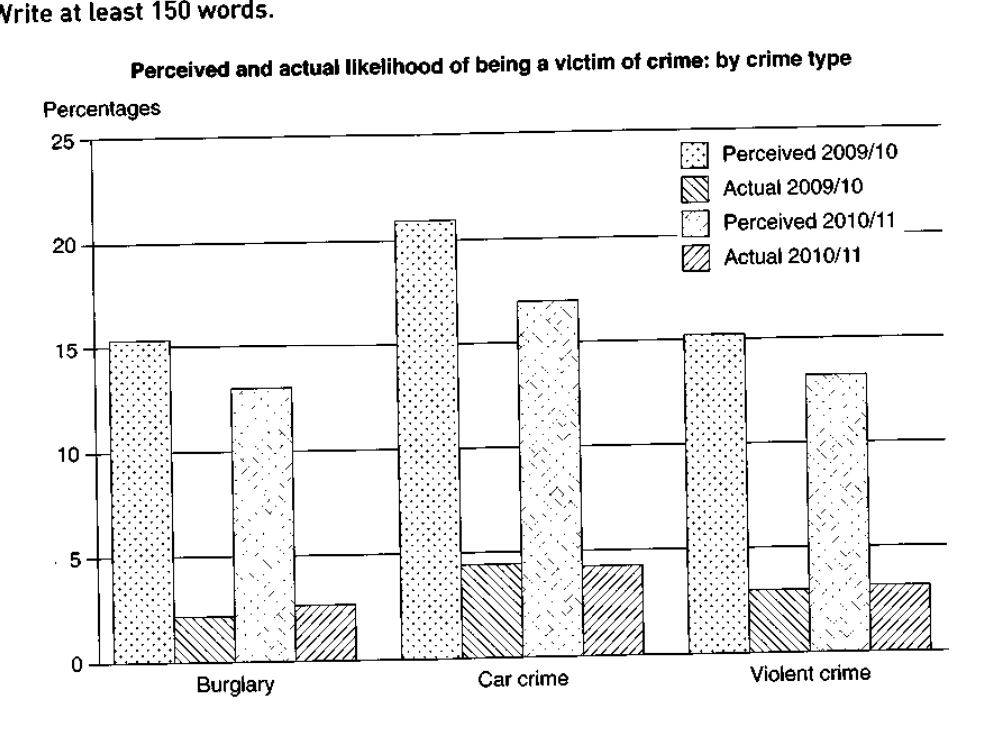
The graph below shows the perceived danger and actual likelihood of being a victim of crime.
Summarise the information by selecting and reporting the main features, and make comparisons where relevant.
Perceived and actual likelihood of being a victim of crime: by crime type
Student answer (Band 5.0)
The line graph illustrates the perceived danger and actually they are being faced with crime in different eras from 2009 to 2011.
Overall, it is clearly seen that the percentage of perceived crime is greater than the actual likelihood of crime.
Firstly, the actual crime value is 17% in car crime and assumption is 22% in 2009/10 while the assumption of perceived crime is just 4% and actually it is 3%. Secondly, the proportion of perceived crime in burglary and violent is 16% and 15% respectively, while both the facts are just 13% in 2009/10. Consequently, perceived danger in burglary and violet in 2010/11, is 2% and 3% respectively while it shows some change in reality it is 3 and 3.5%. Therefore, the perceived amount is more in car crime, burglary and violent crime in 2009/10 whereas, it shows some change in 2010/11.
AI examiner evaluation
| Criterion | Band |
|---|---|
| Task Achievement / Task Response | 4.0 |
| Coherence and Cohesion | 5.0 |
| Lexical Resource | 5.0 |
| Grammatical Range and Accuracy | 5.0 |
| Overall | 5.0 |
Task Achievement / Task Response: Band 4.0
You identify the chart’s central contrast: perceived likelihood is much higher than actual victimisation, and you mention all three crime types. However, the figures and time periods are repeatedly confused, so the report only partially conveys the data. For example, you call 17% the actual car-crime figure, although it is the perceived figure for 2010/11; you also describe perceived burglary and violent crime as 13% in 2009/10, when those values belong to 2010/11. The actual rates are generally around 2–4.5%, not the values assigned in several sentences. The overview is also limited, and the response is 7 words below the required minimum. Select the main comparisons accurately and organise them by year or by perceived versus actual rates.
Coherence and Cohesion: Band 5.0
There is a basic structure: an introduction, an overview, and a body beginning with “Firstly” and continuing with “Secondly” and “Consequently.” This gives the reader some signposting, and the overall contrast between perceived and actual crime is stated early. However, the sequence does not develop clearly because figures, crime types, and years are mixed together, making comparisons difficult to follow. The connectors “Therefore” and “whereas” do not always show a clear relationship between the information that follows them. Paragraphing is also limited, with most details crowded into one body paragraph. Group the data consistently—for example, compare all perceived and actual figures for each year—and use linking phrases only where the relationship is clear.
Lexical Resource: Band 5.0
You use some relevant task vocabulary, including “percentage,” “proportion,” “perceived,” and “actual likelihood,” so the topic is generally recognisable. However, the range is limited and several word choices or collocations make the data hard to interpret. “Actually they are being faced with crime” is an unclear way to describe actual victimisation, while “assumption” is not an appropriate substitute for perceived likelihood. “The actual crime value” and “both the facts” are also imprecise, and “violet” appears where “violent” is intended. Aim for consistent chart language such as “perceived risk,” “actual rate,” and “the proportion of people who experienced car crime.” This would make the comparisons more precise and reduce repetition.
Grammatical Range and Accuracy: Band 5.0
You attempt both simple and longer sentences, including a contrast with “while” and a concluding sentence beginning “Therefore.” Some basic sentence meanings can be understood, but errors are frequent and sometimes obscure the relationships between figures. For example, “the actual crime value is 17% in car crime and assumption is 22%” has unclear sentence structure and does not establish which year each figure refers to. The opening phrase “the perceived danger and actually they are being faced with crime” is also grammatically incomplete in its construction. Commas are used inconsistently, including around “in 2010/11,” and some clauses are joined without clear grammatical control. Practise writing short, complete comparison sentences with an explicit subject, verb, crime type, and year before attempting longer structures.
See this exact question answered at other band scores. The same prompt compared across bands.
Browse more IELTS Writing model answers or get your own writing scored by the same AI examiner.