Band 5.0 IELTS Writing Task 1 Model Answer
Overall Band Score: 5.0 · IELTS Summit Mastery · 2026-11-25
IELTS Writing Task 1 question
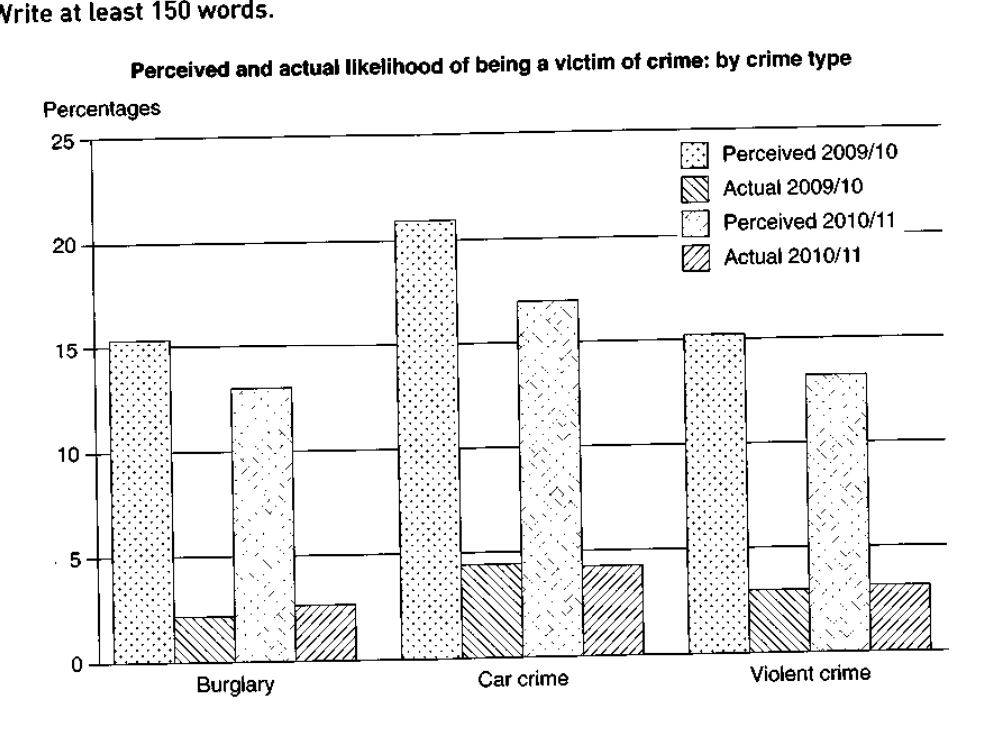
The graph below shows the perceived danger and actual likelihood of being a victim of crime.
Summarise the information by selecting and reporting the main features, and make comparisons where relevant.
Perceived and actual likelihood of being a victim of crime: by crime type
Student answer (Band 5.0)
The given bar chart explain the preceived danger and actual likelihood of being a victim of crime according to diffenet type of crimes.
Overall, the burglary is at 15 but decrease afterwards while car crime and vicient crime also show same type of trend.
To begin with, Car crime it show a spike up to 21 percent which decrease dramatically and then climbed up to17 percent from 4 percent. At the end it show drastic decrease and move from 17% to 4 percent While burglary show same behavior but a bit different from car crime .It inclined to 16%in start but than show a great decrease to 3% afterward it increase and after some time then back decrease and stop at 4%.
Furthermore, Vicient crime highlights a anomlous behavior and climbed up to 15% and dip back to 3%,afterwards it show again a slight increase to 14% and then decline to 4% back after a moment.
AI examiner evaluation
| Criterion | Band |
|---|---|
| Task Achievement / Task Response | 4.0 |
| Coherence and Cohesion | 5.5 |
| Lexical Resource | 5.0 |
| Grammatical Range and Accuracy | 5.0 |
| Overall | 5.0 |
Task Achievement / Task Response: Band 4.0
The response identifies the chart’s broad subject and attempts to describe all three crime types, but it does not accurately report the main comparisons. It treats the bars as a sequence of rises and falls, although the chart compares perceived and actual likelihood across two years; for example, the claim that burglary “stop at 4%” is not supported by the chart. The overview is also unclear and does not highlight the key feature that perceived risk is much higher than actual likelihood for every crime type. The response contains 146 words, below the required 150, and this further limits task coverage. To improve, explain the chart’s categories and years, give accurate comparisons, and provide a clear overview.
Coherence and Cohesion: Band 5.5
There is some basic organisation: an opening statement is followed by an overview and separate paragraphs discussing car, burglary and violent crime. This gives the reader a general sense of the intended structure. However, the progression is difficult to follow because the descriptions repeatedly present the data as a sequence, using phrases such as “afterwards,” “at the end” and “after some time,” rather than comparing the four series for each crime type. Some links are also unclear, particularly “which decrease dramatically and then climbed up to 17 percent from 4 percent.” Use a consistent comparison pattern—perceived versus actual, then 2009/10 versus 2010/11—and connect ideas with precise references.
Lexical Resource: Band 5.0
The response uses some task-related vocabulary, including “percent,” “decrease,” “increase” and “slight increase,” so the reader can recognise that it concerns changes in crime figures. However, the range is limited and several choices are inaccurate or unnatural, which sometimes makes the meaning difficult to interpret. For instance, “spike” and “climbed” suggest a time-series movement, while “anomalous behavior” does not describe the chart’s comparisons appropriately. There are also noticeable spelling errors, including “preceived,” “diffenet,” “vicient” and “anomlous.” Aim for precise chart language such as “was higher than,” “fell to,” “remained stable” and “the perceived figure,” and check spelling before submitting.
Grammatical Range and Accuracy: Band 5.0
The response attempts both simple and longer sentences, but control is inconsistent, and errors frequently affect clarity. Subject–verb agreement is incorrect in “the bar chart explain” and “Car crime it show”; verb forms are also faulty in “which decrease” and “it show again.” Articles and sentence construction cause problems in “highlights a anomlous behavior,” while punctuation is often missing or misplaced, as in the long sentence beginning “Furthermore.” Some sentences combine several movements without clear grammatical links, making the comparisons hard to follow. Practise accurate present-tense reporting and build shorter, complete sentences first; then add subordinate clauses only when their relationships are clear.
See this exact question answered at other band scores. The same prompt compared across bands.
Browse more IELTS Writing model answers or get your own writing scored by the same AI examiner.