Band 5.0 IELTS Writing Task 1 Model Answer
Overall Band Score: 5.0 · IELTS Summit Mastery · 2026-11-25
IELTS Writing Task 1 question
The graph below shows the perceived danger and actual likelihood of being a victim of crime.
Summarise the information by selecting and reporting the main features, and make comparisons where relevant.
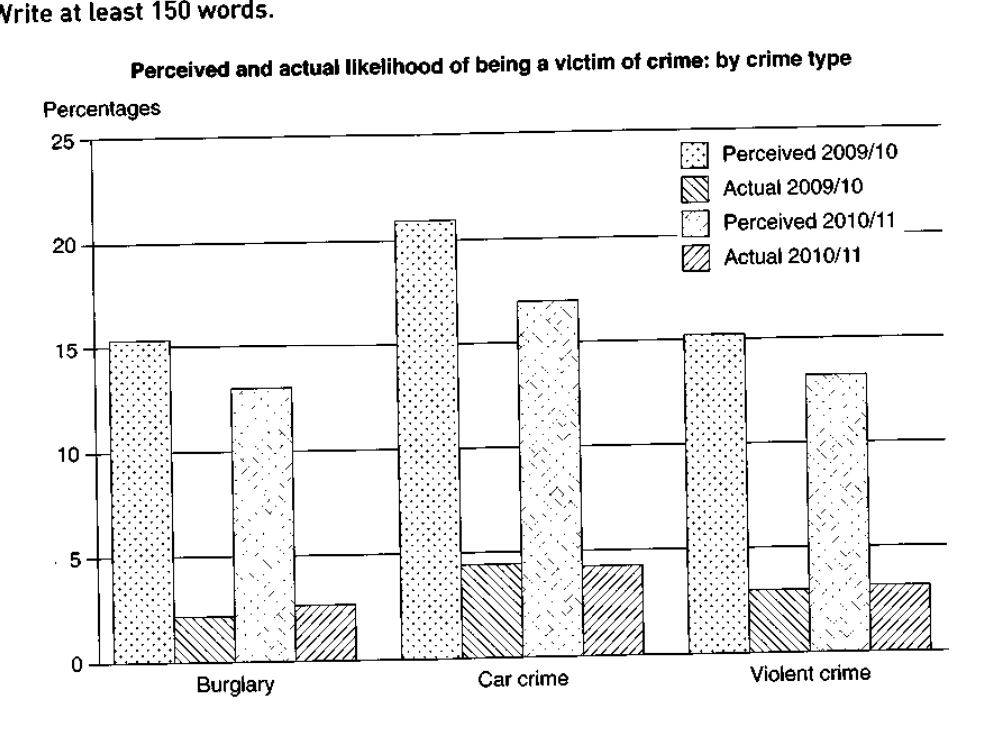
Perceived and actual likelihood of being a victim of crime: by crime type
Student answer (Band 5.0)
The illustration gives information about the victim of crime which are perceived danger and actual likelihood. Overall, in car crime percentage of perceived likelihood was high.
It was quite evident from the line graph that there was three types of crimes which was highlighted. In burglary, the actual likelihood was approximately 2% in 2009/10 and actual 2010/11 was between 2 and 3%. The percentage of burglary in perceived likelihood 2009/10 was upto 15 and of perceived 2010/11 was approximately 13.
Furtheremore, there was a percentage about car crime. The actual likelihood 2009/10 was 4% and actual likelihood 2010/11 was almost same to the previous actual that is 4%. The percentage of perceived 2009/10 in car crime was almost upto 20 and those of perceived 2010/11 was approximately 17%. Now, in violent crime, the percentage of actual 2009/10 and 2010/11 was almost same as 3. The perceived 2009/10 and 2010/11 was 15% and 13%.
AI examiner evaluation
| Criterion | Band |
|---|---|
| Task Achievement / Task Response | 5.0 |
| Coherence and Cohesion | 5.5 |
| Lexical Resource | 5.0 |
| Grammatical Range and Accuracy | 5.0 |
| Overall | 5.0 |
Task Achievement / Task Response: Band 5.0
You identify the chart’s three crime categories and make a relevant overall observation that perceived risk was highest for car crime. You also report several approximate figures, and most are broadly consistent with the chart. However, the overview is too limited: it does not clearly summarise the striking gap between perceived and actual likelihood across all categories, or the general pattern that perceived figures fell in 2010/11 while actual figures changed little. Some details are imprecise: car-crime perception in 2009/10 is about 21%, not merely “almost up to 20,” and violent-crime perception is about 15.5% and 13.5%. A clearer overview and more accurate comparisons would make the response more complete and developed.
Coherence and Cohesion: Band 5.5
The response has a basic sequence: it introduces the chart, gives an overall comment, and then discusses burglary, car crime and violent crime in turn. This makes the categories reasonably easy to follow. However, the progression is mostly a list of separate figures rather than a comparison of the main patterns. Linking phrases such as “Furthermore” and “Now” are repetitive or mechanical, and the opening sentence does not lead smoothly into the overview. Grouping the information by perceived versus actual likelihood, or explicitly comparing the two years within each category, would create clearer progression. More precise references, such as naming the series rather than saying “those of perceived,” would also improve cohesion.
Lexical Resource: Band 5.0
You use relevant chart vocabulary, including “percentage,” “actual likelihood,” “perceived,” and the crime-category names, so the reader can generally understand what is being described. However, the range is limited and several phrases are awkward or imprecise, such as “the victim of crime which are perceived danger,” “percentage about car crime,” and “almost same to the previous actual.” Repeated use of “percentage” and “approximately” also makes the account less flexible. Choose natural collocations for describing data and use terms such as “proportion,” “figure,” “rose,” “fell,” or “remained stable” where appropriate. Check spelling as well: “Furtheremore” should be “Furthermore.”
Grammatical Range and Accuracy: Band 5.0
Most of the response uses short, simple statements, and the intended meaning is usually recoverable. There are attempts to combine ideas, but control is inconsistent. For example, “there was three types of crimes which was highlighted” has subject–verb agreement errors, while “The perceived 2009/10 and 2010/11 was…” uses an incorrect verb form for a plural subject. Articles and sentence construction are also problematic in “the victim of crime which are perceived danger.” These recurring errors make some sentences difficult to read and limit the range of structures demonstrated. Practise accurate plural agreement and build comparisons with controlled patterns such as “The perceived figure fell from… to…, whereas the actual rate remained…”.
See this exact question answered at other band scores. The same prompt compared across bands.
Browse more IELTS Writing model answers or get your own writing scored by the same AI examiner.