Band 5.0 IELTS Writing Task 1 Model Answer
Overall Band Score: 5.0 · IELTS Summit Mastery · 2026-11-26
IELTS Writing Task 1 question
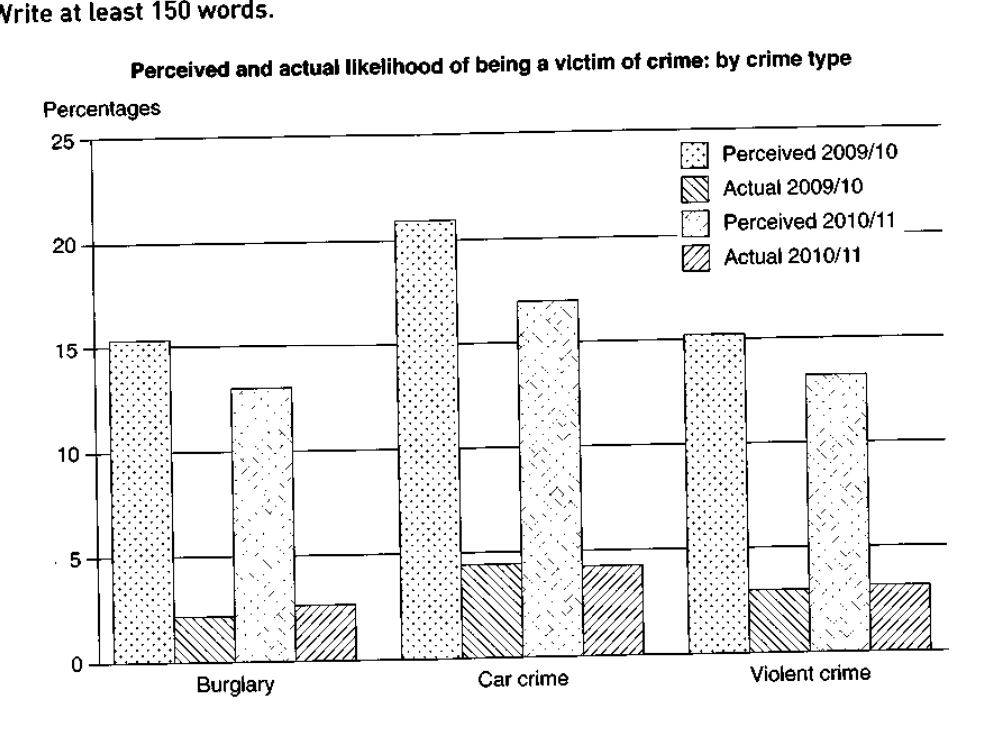
The graph below shows the perceived danger and actual likelihood of being a victim of crime.
Summarise the information by selecting and reporting the main features, and make comparisons where relevant.
Perceived and actual likelihood of being a victim of crime: by crime type
Student answer (Band 5.0)
The given bar charts represent the proportion of crime rate that is assumed to occur and the actual percentage of becoming a crime victim in 2009 to 2010 and 2010 to 2011.
Overall, percieving the fact of being a crime victim was always greater than the likelihood being a victim of actual crime in all three given sectors between 2009 to 2011.
As per the details, in the year 2009/2010 more than 15% had the assumption of burglary to happen when in actual only 3% of this crime was recorded.Similarly, for the next to years ,13% of the population percived of being burglary victim .However, less than 10% of percieved rate was seen
AI examiner evaluation
| Criterion | Band |
|---|---|
| Task Achievement / Task Response | 4.0 |
| Coherence and Cohesion | 5.0 |
| Lexical Resource | 5.5 |
| Grammatical Range and Accuracy | 5.5 |
| Overall | 5.0 |
Task Achievement / Task Response: Band 4.0
You identify the chart’s central contrast: perceived risk is higher than actual victimisation for all three crime types in both periods. You also report some burglary figures, including a perceived rate of about 13% in 2010/11. However, the response addresses the task only partially: it stops before discussing car crime and violent crime, and gives no complete comparison of changes across the two years. The statement that actual burglary was 3% is not well aligned with the chart, which shows about 2% in 2009/10 and 2.5% in 2010/11. The final sentence is unfinished, leaving a comparison unclear. The response is also 37 words below the required minimum. Include a concise overview and cover the main patterns across all categories.
Coherence and Cohesion: Band 5.0
There is a basic structure, with an introductory sentence, an overview beginning “Overall,” and a detail paragraph introduced by “As per the details.” This gives the reader some sense of organisation, and “Similarly” and “However” attempt to connect information. Nevertheless, progression is limited because the response ends mid-thought and does not move systematically through the three crime types or compare the two years. The link “Similarly” does not clearly explain how the second burglary figure relates to the first, while “However” introduces an incomplete point. Organise the details into a clear sequence—for example, perceived figures first and actual figures second—and use linking words only where the relationship between the figures is explicit.
Lexical Resource: Band 5.5
The response uses some relevant chart vocabulary, including “proportion,” “actual percentage,” “likelihood,” and “sectors,” and it attempts to distinguish perceived risk from recorded crime. However, several choices are inaccurate or awkward for describing the data. “Crime rate that is assumed to occur” does not clearly express perceived likelihood, and “assumption of burglary to happen” is an unnatural collocation. “Percieving” and “percived” are misspelled, and “sectors” is less precise than “crime types.” These issues make parts of the report harder to interpret, although the general topic remains recognisable. Use standard chart language such as “perceived likelihood,” “actual victimisation rate,” and “the proportion who believed they might be victims.”
Grammatical Range and Accuracy: Band 5.5
You attempt both simple and more developed sentence forms, including the contrast in “Overall” and the comparison introduced by “Similarly.” Some meaning is understandable, but grammatical control is uneven. For example, “greater than the likelihood being a victim” is missing “of,” and “in the year 2009/2010 more than 15% had the assumption” has an unclear subject and awkward sentence construction. The phrase “for the next to years” also contains an incorrect grammatical form, and the final sentence is incomplete. These problems sometimes obscure the intended comparisons. Build clear sentences with an explicit subject and verb, such as “The perceived figure for burglary fell from about 15.5% to 13%, while the actual rate rose slightly.” Check articles, prepositions, and sentence completion.
See this exact question answered at other band scores. The same prompt compared across bands.
Browse more IELTS Writing model answers or get your own writing scored by the same AI examiner.