Band 5.5 IELTS Writing Task 1 Model Answer
Overall Band Score: 5.5 · IELTS Summit Mastery · 2026-11-26
IELTS Writing Task 1 question
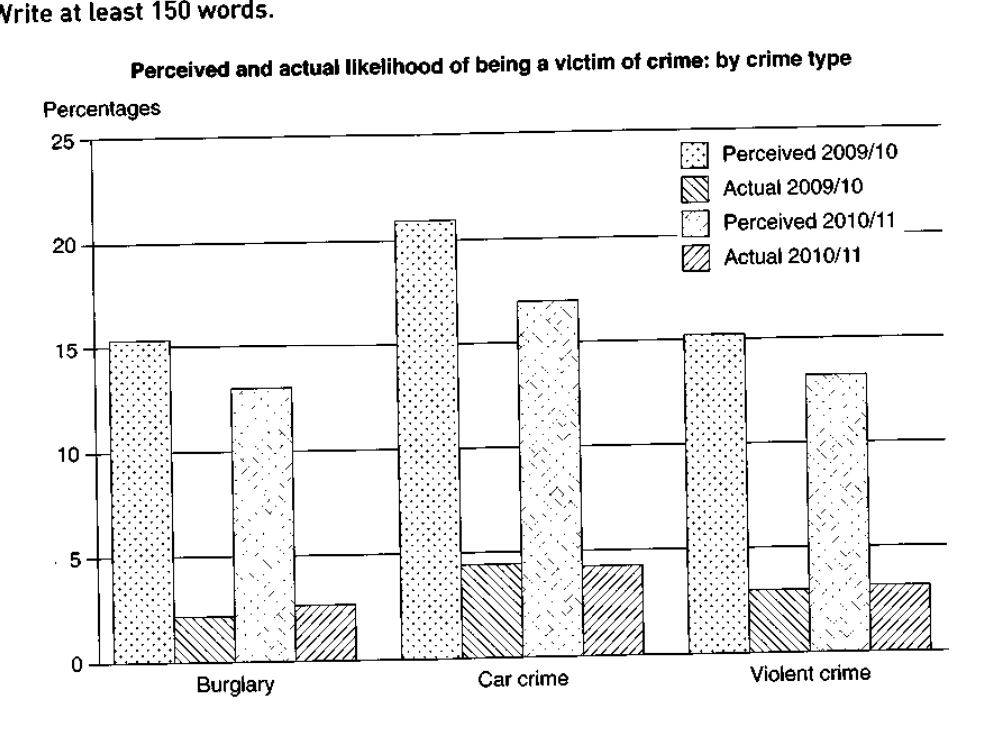
The graph below shows the perceived danger and actual likelihood of being a victim of crime.
Summarise the information by selecting and reporting the main features, and make comparisons where relevant.
Perceived and actual likelihood of being a victim of crime: by crime type
Student answer (Band 5.5)
The given figure illustrates the changes of perceived and actual likelihood of being victim of crime by crime type burglary, car crime, violent crime between 2009 and 2010 amount of crimes measured by percentages.
Overall, the car crime was the most actual and perceived crime over the years, while burglary and violent crimes were gradually the same trends. Furthermore, the perceived in 2009/10 was the highest percentages all the time.
In 2009/10, car crime was the highest perceived violent crime around 21%. With regards to burglary and violent crimes were the same amount of percentages approximately 15% while actual in 2009/10 actual crimes were upward trend car crime was 4%, violent crime was higher than the burglary respectively 3%, 4%.
On the other hand, in 2010/11, remained almost same trends on crimes. Car crime was the still highest perceived crime but it was almost 4% lower than the last year approximately 17% while actual crime was 4%. In terms of violent and burglary crimes, perceived same as 15%. On the actual violent crime remained 4% which is higher than the burglary almost 3%.
AI examiner evaluation
| Criterion | Band |
|---|---|
| Task Achievement / Task Response | 5.5 |
| Coherence and Cohesion | 6.0 |
| Lexical Resource | 5.0 |
| Grammatical Range and Accuracy | 5.0 |
| Overall | 5.5 |
Task Achievement / Task Response: Band 5.5
You identify the main broad pattern: car crime has the highest perceived and actual figures, and perceived likelihood is much higher than actual likelihood. You also compare both periods. However, several details are inaccurate or unclear: in 2009/10, actual burglary was about 2%, violent crime 3%, and car crime 4.5%, but the sentence gives these figures in a confusing order. In 2010/11, perceived burglary was about 13% and violent crime 13.5%, rather than both being 15%; actual car crime remained about 4.5%, not 4%. The overview also misses the notable fall in perceived figures across all three crime types, while actual rates changed only slightly. More precise reporting and a clearer overview would strengthen coverage.
Coherence and Cohesion: Band 6.0
The response has a recognisable four-part structure: an introduction, an overview, and separate paragraphs for the two periods. This gives the reader a basic route through the information, and phrases such as “On the other hand” signal a shift to the later year. However, progression within paragraphs is sometimes difficult to follow. For example, “actual in 2009/10 actual crimes were upward trend” does not clearly connect the figures to the categories, and “violent crime was higher than the burglary respectively 3%, 4%” leaves the comparison ambiguous. Some linking phrases are also used mechanically or do not express a clear contrast. Grouping perceived figures together and actual figures together, with consistent category order, would make comparisons easier to track.
Lexical Resource: Band 5.0
You use relevant topic vocabulary, including “perceived,” “actual,” “percentages,” and the three crime categories, so the reader can generally understand the subject. However, the range is limited and several word combinations are unnatural or imprecise, such as “the most actual and perceived crime,” “same trends on crimes,” and “highest perceived violent crime.” These choices sometimes make it unclear whether you mean the crime type, its likelihood, or its percentage. Repetition of “crime” and “percentages” also limits flexibility. Aim to use precise chart language such as “likelihood,” “rate,” “figure,” and “stood at,” while checking that adjectives and nouns combine naturally.
Grammatical Range and Accuracy: Band 5.0
You attempt both simple statements and longer comparisons, but the range of sentence structures is limited and complex attempts are often faulty. For instance, “With regards to burglary and violent crimes were the same amount” combines an introductory phrase with a clause that lacks a clear grammatical structure. In “car crime was the still highest,” the word order is incorrect, while “the perceived in 2009/10 was the highest percentages” has problems with articles and sentence structure. There are also inconsistent tense and agreement patterns, as in “remained almost same trends.” These errors sometimes make relationships between figures difficult to understand. Practise building clear subject–verb sentences first, then add comparisons using accurate clauses and punctuation.
See this exact question answered at other band scores. The same prompt compared across bands.
Browse more IELTS Writing model answers or get your own writing scored by the same AI examiner.