Band 5.0 IELTS Writing Task 1 Model Answer
Overall Band Score: 5.0 · IELTS Summit Mastery · 2026-11-26
IELTS Writing Task 1 question
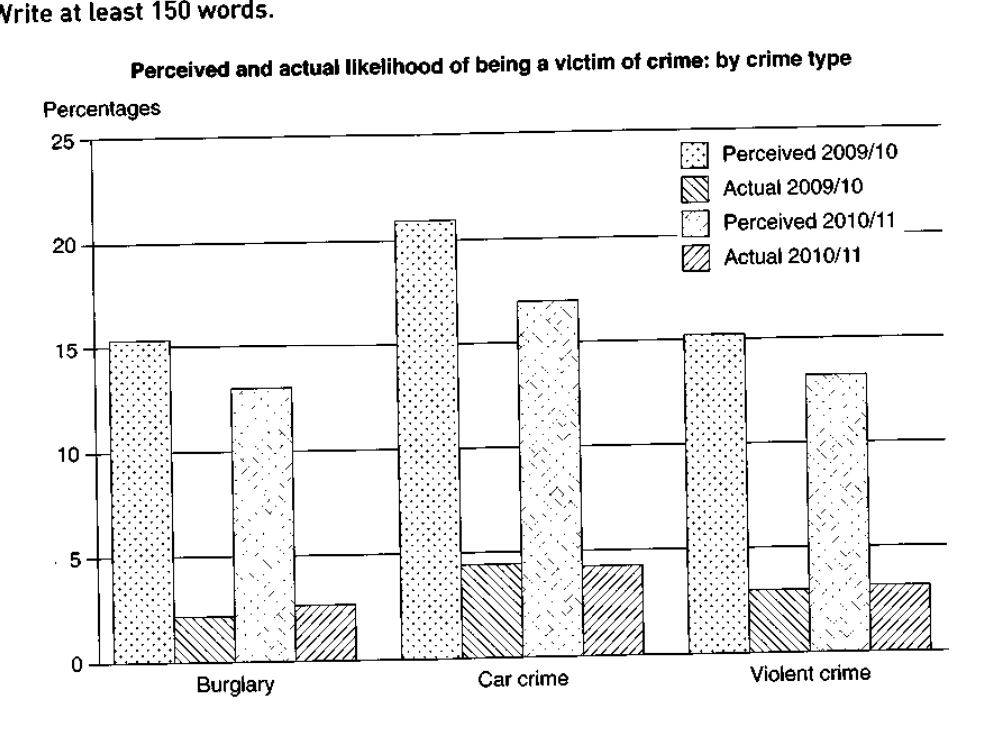
The graph below shows the perceived danger and actual likelihood of being a victim of crime.
Summarise the information by selecting and reporting the main features, and make comparisons where relevant.
Perceived and actual likelihood of being a victim of crime: by crime type
Student answer (Band 5.0)
The diagram below illustrates the perceived danger and actual chance of being a victim of crime.Overall, there are three different kind of crimes activities decribes in the graph. The actaul crime is typically low in all three types. But the incidence of happening a crime is very high.
On one hand , the car crime ratio was highest in both actual and predicted from all of the them . The car crime have to thought about 20 percent but the actual percentage is quite low below five percent .
On the other hand , violent crime on the second place where prevelance is very high but actual crime is very low . The violent crime have 15 actual percentage wherease the predicted ratio is about fifteen percent . Lastly the Burglary have lowest proportion from all three. Burglary have perceived ratio same to voilent crime . The difference in actual happening of crime which is quite low.
AI examiner evaluation
| Criterion | Band |
|---|---|
| Task Achievement / Task Response | 4.5 |
| Coherence and Cohesion | 5.0 |
| Lexical Resource | 5.0 |
| Grammatical Range and Accuracy | 5.0 |
| Overall | 5.0 |
Task Achievement / Task Response: Band 4.5
You identify the chart’s broad contrast: perceived risk is much higher than actual victimisation, and car crime has the highest figures. However, the account only partially reports the main features and includes important inaccuracies. For example, violent crime is not “15 actual percentage”: its perceived figures are about 15.5% and 13.5%, while actual figures are only around 3–3.5%. Burglary and violent crime have similar perceived levels, but burglary is not consistently the lowest in every series. You also omit the clear year-to-year pattern: perceived risk falls for all three crimes, while actual rates rise slightly or remain stable. A more accurate overview and selected comparisons would make the summary more complete and reliable.
Coherence and Cohesion: Band 5.0
The response has a basic structure, moving from an opening overview to comparisons of car crime, violent crime and burglary. Phrases such as “On one hand” and “On the other hand” signal a change in focus, and the reader can generally follow the intended comparisons. However, progression is limited: the paragraphs do not clearly organise the data by year or distinguish perceived from actual figures consistently. Some linking is mechanical or awkward, and the final burglary point ends without a clear comparison or conclusion. Grouping the figures into a concise overview followed by two organised comparison paragraphs would improve the flow and make relationships between categories easier to follow.
Lexical Resource: Band 5.0
You use some task-relevant vocabulary, including “perceived,” “actual,” “percentage,” “ratio” and “proportion,” so the topic is recognisable. However, the range is limited and several choices are inaccurate or unnatural, sometimes making the meaning difficult to interpret. For instance, “incidence of happening a crime” is an awkward way to describe likelihood, while “the car crime have to thought about 20 percent” does not clearly express the chart value. There are also noticeable spelling errors, including “actaul,” “decribes,” “prevelance” and “voilent.” Use precise chart language such as “risk was estimated at,” “the actual rate stood at,” and “fell from … to …,” and check spelling carefully.
Grammatical Range and Accuracy: Band 5.0
You attempt both simple statements and longer comparisons, and the overall meaning can often be recovered. However, the range of sentence structures is limited, and frequent errors in agreement, verb forms, articles and sentence construction make several statements difficult to read. Examples include “three different kind of crimes activities decribes,” “The car crime have,” and “violent crime on the second place.” The sentence beginning “The violent crime have 15 actual percentage” also lacks a clear grammatical structure. Punctuation is inconsistent, including the missing space after the opening sentence. Practise building accurate comparison sentences with a clear subject and verb, for example, “Perceived risk of car crime was highest, at about 21% in 2009/10.”
See this exact question answered at other band scores. The same prompt compared across bands.
Browse more IELTS Writing model answers or get your own writing scored by the same AI examiner.